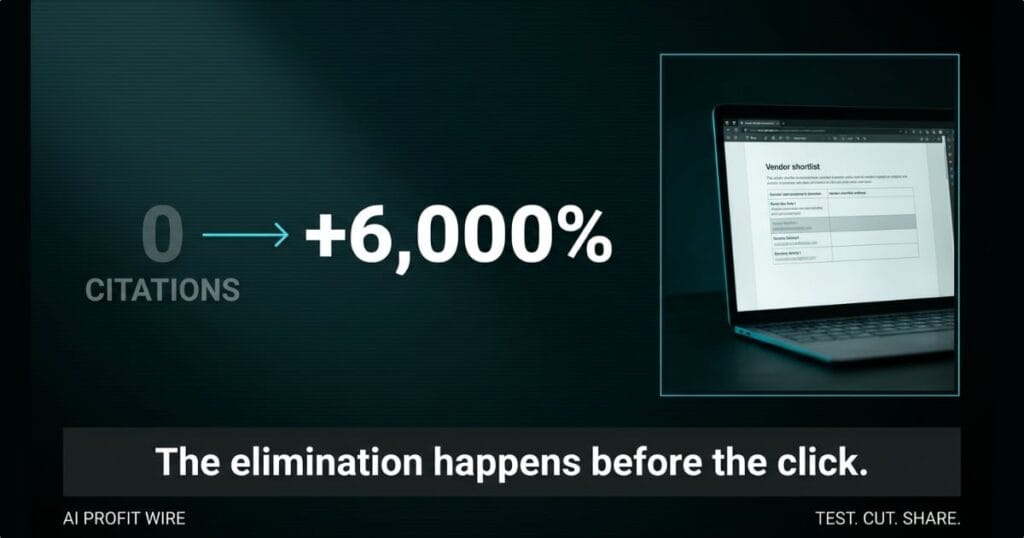
Prevents the 'silent loss' of leads and transactions occurring when AI agents filter out businesses they cannot verify.
What is answer engine optimization?
Answer engine optimization (AEO) is the practice of structuring business data so AI agents can verify it without a human ever opening your website. It applies to any business that relies on digital discovery for lead generation.
An agent takes a vague instruction like “find us a payroll provider for contractors,” decomposes it into narrow sub-queries, retrieves across dozens of sources, and returns a shortlist with reasoning attached. The company either enters the consideration set or it doesn’t, and the whole sequence runs with no visual layer and no brand recall.
Machines discard any claim they can’t corroborate against independent sources before a person sees a single result. The intermediate steps are where the elimination happens, and they are the steps nobody watches.
AEO replaces human persuasion with machine verification.
Does answer engine optimization actually work?
Yes, and the documented results are arriving faster than traditional SEO timelines imply.
One LegalTech client began appearing alongside DocuSign in model outputs within 11 days, with impression growth exceeding 6,000%. A real estate lead platform reached a 7.79% AI citation share, the highest in its competitive set, with AI clicks up 310.8%.
The volume behind this is no longer theoretical. SE Ranking research found traffic from AI search engines grew roughly 16-fold between 2024 and 2026, and roughly 71% of AI answers now include at least 1 citation, with an average of about 3.7 citations per answer.
Every one of those citations is a selection decision made by a machine, and verifiable data is what wins it.
What is the difference between AEO and traditional SEO?
Traditional SEO optimizes for a human scanning a results page and deciding what looks trustworthy. AEO optimizes for a retrieval and verification pipeline running at machine speed.
The extraction step is where good content quietly fails. Passages that depend on surrounding context to make sense get discarded, which means a genuinely excellent long-form guide can be structurally unusable if its claims only cohere when read in order.
Agents also treat a claim that appears only on your own homepage as a marketing assertion, and they often omit it from the final synthesis rather than repeat it. A statement corroborated by independent sources becomes a fact the agent will repeat for you.
SEO wins the click, but AEO wins inclusion in the shortlist.
The vendor folder sits open on the office manager’s desk with the same company listed under 2 names. The rebrand updated the website, the old name is still live on 2 industry directories, and the headcount on LinkedIn disagrees with the about page by 6 people.
A human buyer skims past all 3 contradictions without noticing. The agent researching on her behalf doesn’t, it flags unresolvable conflict and drops the company from the shortlist before anyone at her office knows the evaluation ran.
The fix is boring and it compounds. One firm cleaned up exactly this kind of gap and appeared alongside DocuSign in model outputs within 11 days, with impressions up 6,000%, so the paperwork she already has is the marketing now, it just has to agree with itself.
Why is your business invisible to AI agents?
Retrieval accessibility is the first gate. If robots.txt blocks crawlers like GPTBot, PerplexityBot, ClaudeBot, or Google-Extended, or the content only renders through client-side JavaScript, the document never enters the candidate set regardless of how good it is.
Contradiction is the second gate, and it is worse than absence. An agent that finds conflicting headcount figures across LinkedIn, Crunchbase, and your about page will drop the company entirely, because unresolvable conflict is a stronger negative signal than silence.
These contradictions generate accidentally and constantly: a rebrand that never reached an old directory, a founder listed under a full legal name in one place and a shortened one elsewhere, pricing stated one way on the site and another in a partner listing.
A human visitor resolves them without noticing. A verification system cannot.
Most invisibility is a corroboration failure, not a content quality problem.
What should a small business owner do about AEO now?
Reconcile the entity first. Make the legal name, founding date, leadership, product names, and pricing identical across the website, LinkedIn, Crunchbase, and every industry directory you can influence, then add structured data that states the same facts in machine-readable form.
Permit the crawlers next. Confirm GPTBot, PerplexityBot, ClaudeBot, and Google-Extended are allowed in robots.txt, and that everything an agent needs to read sits in the server response.
This single check accounts for a meaningful share of total AEO failure and takes minutes to verify.
Then attach specifics to every claim. Name clients where permission exists, date the data, publish figures the business can responsibly release, and pursue third-party coverage for the corroboration rather than the link.
Pages also need restructuring so machines can extract them, and a page optimization tool like NeuronWriter handles that extraction problem directly.
Budget follows the same shift. High-gloss brand spend does less work when 71% of AI answers carry citations, because the elimination happens before the agent ever visits your site and no analytics dashboard will show you the drop.
Invest in verifiable facts over compelling adjectives.
Source: AutoGPT Blog
