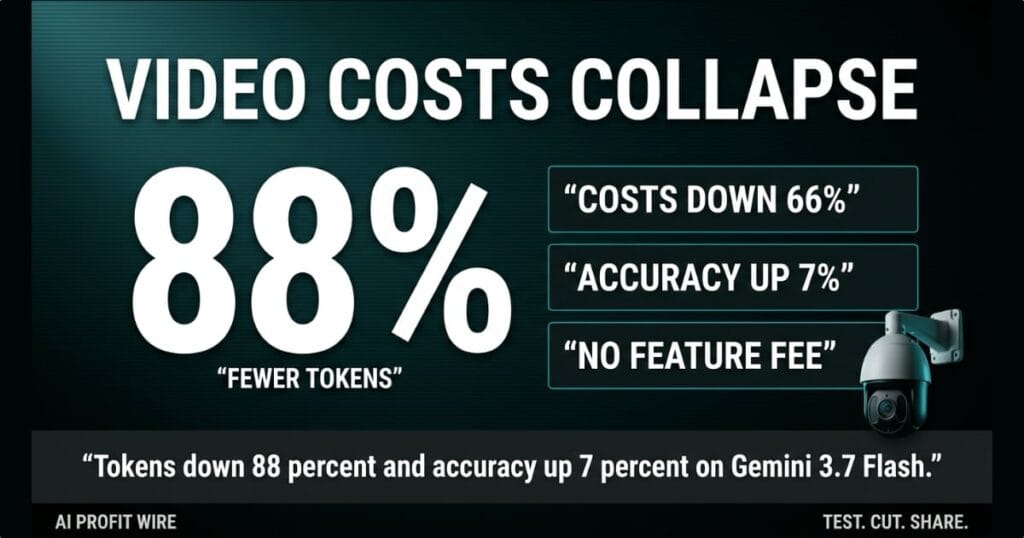
Lowers the cost of automated video analysis and improves the accuracy of finding specific moments in long recordings.
What is agentic video understanding in Gemini?
Agentic video understanding is a processing mode for Gemini 3.7 Flash, 3.6 Flash, and 3.5 Flash-Lite that Google DeepMind launched on September 1, 2026. Instead of ingesting footage at a fixed frame rate, the model takes a goal-directed pass: it decides which segments to watch, at what speed, and through which modality, whether that’s visual frames, audio, or the transcript.
Static processing, the previous default, extracts frames at 1 FPS and bills roughly 100 tokens per second of video at low media resolution. That bill lands whether the recording contains 1 incident or none at all.
Google positions the mode around 4 jobs: sub-second moment retrieval, anomaly detection, precise counting of repeated actions or objects, and needle-in-a-haystack search across multi-hour recordings without consuming millions of tokens. The feature is available today for video uploads and public YouTube videos through the Gemini API.
It’s a switch in how footage gets read, from uniform scanning to goal-directed inspection.
Does agentic video understanding actually cut video analysis costs?
The claim holds on Google’s published benchmarks: up to 88% lower token consumption, up to 66% lower analysis cost, and up to 7% higher accuracy across standard video analysis benchmarks.
The accuracy number matters most, because cheaper usually means worse in video tooling. Google reports the gains across all 3 supported models, with 3.7 Flash sitting at the accuracy-to-cost pareto frontier among tested models for video understanding.
On LongVideoBench, Google’s long-form benchmark, the company publishes large token reductions and accuracy improvements with agentic mode enabled. These are benchmark numbers, not invoices, and your real savings depend on how much dead air sits in your footage, which is why this signal lands at 7 out of 10 on the hype scale.
The mechanism is verified, and the size of your savings depends on what your footage actually contains.
Is agentic video understanding cheaper than static video processing?
Static processing pulls frames at a fixed 1 FPS whether anything happens or not, which makes it predictable and wasteful at the same time. Agentic mode resamples only the interesting time windows at higher frame rates and skips the rest.
Google frames the trade directly: static forces developers to choose between high token costs and techniques that drop critical details. The agentic loop exists to remove that choice, fetching only the moments and signals a query needs across frames, audio, and transcripts.
For short clips where every second matters, static still does the job at a known cost. The economics change on long-form video, from 10-minute how-to guides to 90-minute lectures and multi-hour recordings, where Google says the efficiency gains are most pronounced.
Static bills you for coverage of the whole timeline; agentic bills you for the seconds worth reading.
An exterior camera writes 24 hours of footage a day, and a 1M-token context window fits about 3 hours of it per request at low resolution. Static processing bills roughly 100 tokens for every 1 of those seconds, whether the frame shows a delivery or an empty gate. The recording nobody watches still sends its invoice.
That’s the friction agentic video understanding attacks: up to 88% fewer tokens and up to 66% lower cost, because the model inspects the moments that earn inspection. The empty gate stops costing the same as the delivery.
Small business owners don’t need frame-level surveillance science. They need the same 3 hours of footage searched without a 3-hour bill attached.
Who should use Gemini’s agentic video mode?
Developers and teams working from long recordings get the most out of this: compliance review, training-video archives, lecture platforms, and anyone running camera systems through AI analysis. Long-form is where the token math breaks first, and it’s where the gains concentrate.
Models with a 1M context window process up to 3 hours of video per request at low media resolution, or up to 1 hour at high media resolution. If your work lives in short clips where every frame matters, the static mode still covers you, and you gain less from switching.
Google is also rolling the capability out to the Gemini app across Flash and Flash-Lite models soon, and YouTube’s Ask feature will use it on the watch page in the coming months.
If your footage library is measured in hours, this mode was built for your bill.
How do you enable agentic video understanding?
Set processing to agentic in your Gemini API configuration, in Google AI Studio or the Gemini Enterprise Agent Platform. There’s no additional feature fee: you pay standard Gemini API token pricing for the tokens the mode actually consumes, which varies with the content complexity and the modality the model chooses.
That pricing detail is the whole decision. The mode is a config value, not a subscription, and the API free tier lets you test before committing any paid volume at all.
Run the same recording through static and agentic and compare the two token lines, because your archive’s dead-air ratio decides the savings. While you’re measuring, a scan through the rest of this month’s AI signals is worth 10 minutes for anything else touching your stack.
Turn it on, measure 1 archive, and let your own token line make the call.
Source: Google DeepMind
