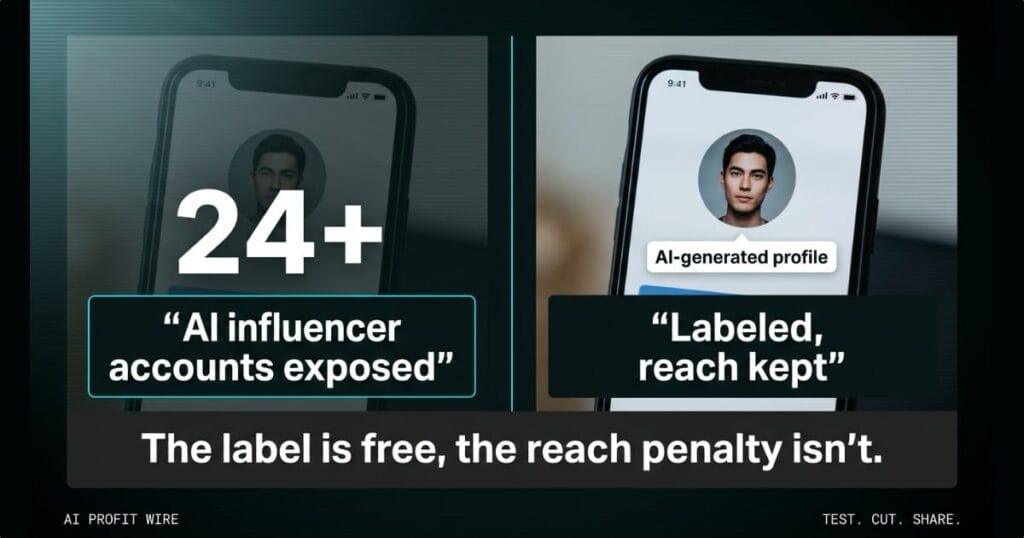
Businesses using AI influencers or virtual brand ambassadors must update their labels to avoid algorithmic penalties.
What is the Instagram AI-generated profile label?
Instagram’s AI-generated profile label is a disclosure tag for accounts that feature a person who was generated or substantially created with AI. It replaced the old AI creator label on August 31, 2026, and the rename is built to make the disclosure obvious at a glance.
The label answers the question a scrolling user can’t: whether the face on the profile belongs to a real human. Instagram said the change responds to users who followed polished profiles that looked like people, only to find out later that the person never existed.
The company’s own wording is blunt about the trust problem. “People don’t like seeing a profile that seems human, only to find out later that the person featured is AI-generated,” Instagram wrote, adding that users want to know when a profile features an AI-generated person.
The label tells users the person featured on a profile was generated or substantially created with AI, before they engage with it.
When did the Instagram AI-generated profile rule take effect?
The policy took effect on August 31, 2026, when Instagram announced the renamed label together with its new enforcement approach. There’s no grace period language in the announcement, so the reach limits apply to unlabeled profiles now.
Creators who don’t properly label an AI-generated profile could see their reach reduced, which means the algorithm shows their content to fewer people. Profiles that do carry the label won’t be penalized simply for featuring an AI-generated person as the profile subject.
The timing isn’t random. Instagram removed an AI image tool earlier in the year after users objected to their public content being used to generate likenesses without an explicit opt-in.
Parent company Meta also reached an $18 billion settlement with U.S. states last week over the platforms’ effects on children and teenagers. Trust is the theme of the moment, and this label is part of the repair bill.
Unlabeled AI personas are already exposed to reach reduction as of August 31, 2026.
How is the new Instagram label different from the old AI creator label?
The old AI creator label described the account type, and the new AI-generated profile label targets the identity behind the account, which is a narrower and stricter disclosure. One tells users what you do, the other declares what the profile is.
The rule also draws a hard line between AI-generated people and AI-assisted content. Using AI to edit photos, polish captions, or create graphics doesn’t require the label, because the profile subject is still a real person in those cases.
That distinction matters for the large share of accounts that use AI tooling behind the scenes. The policy penalizes a synthetic identity, not a synthetic workflow.
The disclosure target has moved from what the account does to what the profile is.
What does the Instagram AI-generated profile label require small business owners to do?
Audit the subject of every profile your business runs and apply the AI-generated profile label if the featured person was substantially created with AI. That covers virtual influencers, AI brand ambassadors, and any synthetic face fronting an account.
The exemption matters as much as the requirement. Profiles that only use AI to edit photos, polish captions, or create background graphics stay outside the rule entirely, so a brand built with AI-powered design tools sits on the safe side of the line while a synthetic face at the front of the account doesn’t.
Agencies running virtual personas for clients carry the sharpest deadline, because the penalty lands on the account’s reach, which is usually the deliverable the client is paying for. The fix is a settings change, not a rebuild.
Label the synthetic subject, skip the label for AI-assisted editing, and the rule costs you nothing.
The wellness coach’s discovery feed is stacked with peer practitioners recommending supplement routines, and 4 of the faces look like colleagues she almost recognizes. The New York Times found hundreds of AI-generated doctors, healers, and wellness personalities doing exactly that in July, promoting supplements or making health claims. Her clients scroll the same feed and can’t tell which testimonies are human.
That’s the trust problem Instagram is now pricing. A profile that looks human borrows credibility from every real person on the platform, and the undisclosed version of that trade was riding free. The new label converts the free ride into a paid one, and reach is the currency.
If the face on your brand account is synthetic, the label costs nothing today and the reach penalty costs everything you budgeted for the quarter. Honest labeling is now the cheaper line item.
Does the Instagram AI-generated profile rule change anything for your business this quarter?
If AI personas are part of your marketing mix, the reach math changes now, because undisclosed accounts run against an algorithm that’s instructed to bury them. The days of scaling an unlabeled virtual ambassador are over in one announcement.
The scale of the problem explains the enforcement. A Wired investigation found more than 2 dozen apparently AI-generated male influencer accounts promoting the gay dating app Goose, some of which reportedly reached out to potential users through direct messages to drive sign-ups.
Health and wellness is the sharper warning for trust-sensitive brands, because the New York Times’ July reporting found hundreds of AI-generated doctors and healers making claims to real users. A reach penalty is the platform’s answer to a category that was selling trust it didn’t have.
Weigh the labeled-AI route against a real creator the way you’d weigh any media buy, on reach per dollar. A labeled AI persona keeps its distribution, an unlabeled one doesn’t, and the talent fee is the only line item that changes.
This quarter’s decision is binary: label the synthetic faces on your accounts or budget for the reach they’ll lose.
Source: TechCrunch AI
