Low-effort AI marketing and emails may be actively hurting conversion rates as customers tune out AI-sounding text.
What’s AI blindness and what changed?
AI blindness is the subconscious act of ignoring content that shows a strong trace to AI. It mirrors banner blindness, the well-documented phenomenon where users stop seeing visual patterns they encounter daily.
Rafal Cymerys coined the term in an August 2026 essay. He describes catching himself unable to focus on documents that carry AI-specific lingo, even when the document covers real substance.
He spent the previous year re-learning how to focus, and these moments show the exact opposite pattern.
Low-effort AI content is becoming invisible to readers who consume it daily.
What’s the evidence behind AI blindness?
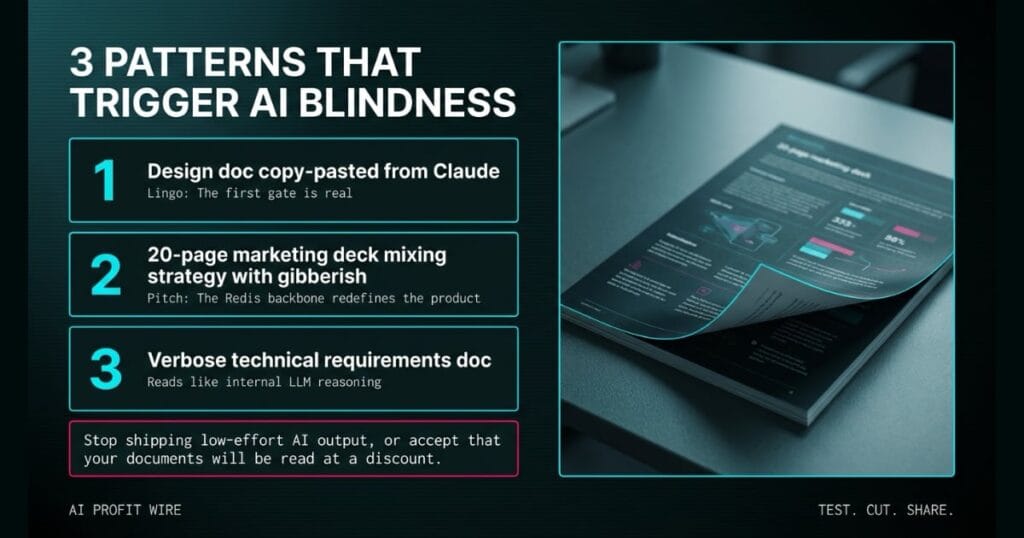
Cymerys lists three document types that trigger his blindness. The first is a design document that looks like a copy-paste from Claude, carrying Claude-specific analysis and lingo like “This cuts just through it” and “The first gate is real”.
The second is a 20-page marketing concept deck that mixes a reasonable marketing strategy with nonsense product technical architecture gibberish. The deck pitches itself with lines like “It’s not selling X, it’s selling Y” and “The Redis backbone redefines the product”.
The third is a technical requirements document that describes a rather simple concept in a very verbose way, reading like someone’s internal reasoning that is not fully sure about certain decisions.
Cymerys notes that an ongoing discussion exists on whether humans are good at recognizing AI-generated text. While most research claims they don’t, he disagrees for the low-effort results.
He cites Florian Roth’s summary of common AI patterns in social media as a parallel for work-related texts.
Real readers are actively tuning out text that carries these AI patterns.
How does AI blindness compare to banner blindness, and what background do small business owners need?
Cymerys compares AI blindness directly to banner blindness. Banner blindness is the well-documented UX phenomenon where users stop seeing parts of a website that look like ads.
He feels pre-trained on AI-generated LinkedIn posts, emails, and websites that are full of text but empty on meaning. His brain learned to spot signs of low-effort AI content and now ignores it without thinking much about it.
The patterns that trigger blindness include the obvious choice of words, the general flow of sentences, and the attempt to pitch every small detail as a breakthrough.
Cymerys adds a sharp example: a document that describes the checkboxes in an RBAC configuration view for an enterprise application should not be sold like the invention of fire.
Cymerys frames filtering as a survival mechanism. With the amount of content being pushed at readers daily, filtering out low-effort AI content is how the brain stays sane.
AI blindness is a psychological filter, not a software filter, and it operates on linguistic patterns.
How does AI blindness affect day-to-day operations for small businesses?
Cymerys gets dragged into an endless back-and-forth with senders, asking questions about things already covered in the documents they sent him. The friction lives in the gap between what was sent and what was processed.
The same AI that was supposed to make him more productive is now slowing him down in an unexpected way.
Founders who ship raw LLM output to clients add friction to their own sales cycle without realizing it. Track these signals weekly because the patterns that trigger blindness shift as AI tools evolve.
Low-effort AI content creates operational friction for any founder who sends documents to clients.
A 20-page marketing deck lands in a buyer’s inbox on a Tuesday afternoon. The cover page carries the line “The Redis backbone redefines the product” next to a glowing testimonial box.
The buyer opens it, scans the first paragraph, and closes the file. He does not hate the deck. He has seen this exact phrasing in 100 similar pitches this quarter, and his brain flagged it as background noise before he reached page 2.
That is what AI blindness does to a sales document. The deck is not rejected, it is filtered out before the substance reaches the decision layer, and the founder who sent it never finds out why the reply went cold.
What’s the final verdict on AI blindness?
AI blindness is a measurable behavioral shift among readers who consume AI-generated content daily. Cymerys documents the exact patterns that trigger it.
The reader’s brain filters the document before the substance lands, and the founder who sent it never finds out why the reply went cold.
Stop shipping low-effort AI output to clients, or accept that your documents will be read at a discount.
Source: cymerys.com
