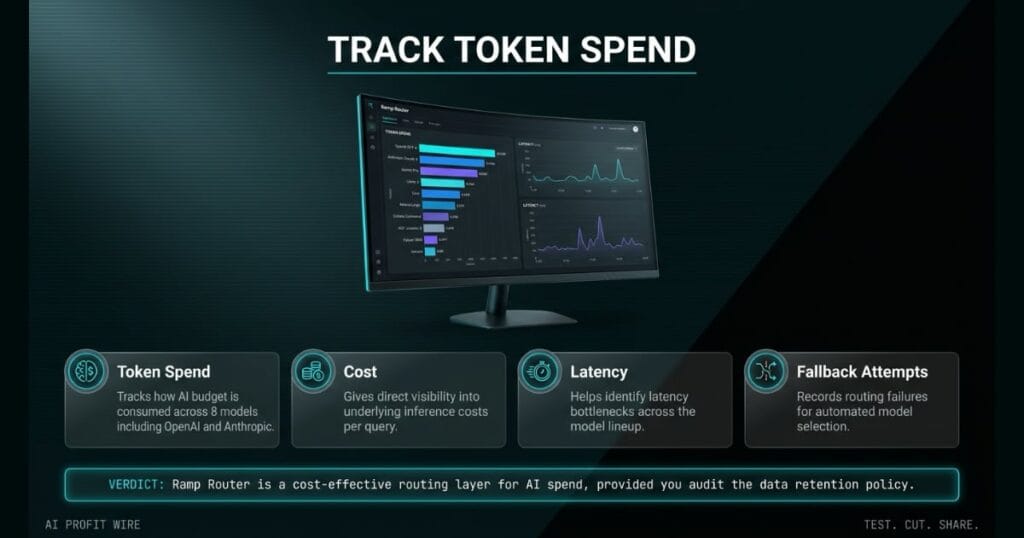
This allows small businesses to optimize AI costs by routing simple queries to cheaper models and complex ones to expensive models, while tracking overall token spend.
What is Ramp Router and what changed?
Ramp introduced Router, an API service that lets companies switch between 8 different large language models through a single integration, consolidating access to OpenAI, Anthropic, DeepSeek, Moonshot, Minimax, Nvidia, xAI, and Z.ai.
The service is free to use for the remainder of 2026, with a $26 launch credit on top, though users still pay the underlying AI model inference costs.
Ramp says it has been using this internal router for its own AI usage needs over the past 3 years, which means the product has a real production track record before today’s public launch.
Ramp Router centralizes multi-model AI access into a single API to control inference spending.
What is the evidence behind Ramp Router?
The launch includes a dashboard that lets users see token spend, cost, latency, and fallback attempts, giving direct visibility into how the AI budget is being consumed across different models.
Router allows routing based on up to 3 user-specified benchmarks, so the system can pick the best model per query automatically instead of relying on a default.
Users can also set a preference for flex usage tiers or route only difficult problems to expensive models, which is the core cost-saving mechanism the product is built around.
The dashboard tracks token spend, cost, latency, and fallback attempts in a single view, which gives founders the first real audit layer over multi-model AI spend.
Ramp also offers several routing strategies on top of the dashboard, including a flex usage tier preference and a route-only-difficult-problems-to-expensive-models mode that automates the cost-saving decision per query.
The opt-out data retention policy records model inputs, outputs, and tool calls for 1 year by default, with personally identifiable information removed before that content is used to improve the product.
The evidence shows a focus on cost tracking and automated routing to cut inference waste.
How does Ramp Router compare to the alternatives, and what background do small business owners need?
Ramp Router competes directly with OpenRouter, which currently offers many more AI model options than Ramp’s current lineup of 8.
Ramp’s advantage is its existing expense management ecosystem, because Router fits neatly with Ramp’s existing AI token usage monitoring and token spend management tools that its customers are already using.
Ramp raised $750 million at a $44 billion valuation in June 2026, which gives the company the capital to scale this new product aggressively against OpenRouter’s established market position.
If Router becomes as attractive a model testing arena as OpenRouter has been, Ramp can build long-standing relationships with AI labs and inference providers worldwide, which becomes a new entry point for selling its core expense management products.
For small business owners, the practical implication is that Ramp is treating AI inference routing as a permanent line item in the corporate expense stack, not a side feature.
Ramp Router ties AI inference routing directly into corporate expense tracking for the first time.
A print shop owner runs 4 different printers for 4 different job types. Premium glossy for client presentations, draft mono for internal proofs, bulk color for marketing flyers, and wide-format for trade show banners.
Every job comes into the queue with a routing tag. The $4 internal memo never goes to the $0.40 per page premium glossy machine, and the $1,200 client deck never goes to the draft printer that bleeds color. The owner does not think about it, because the routing rule handles it automatically.
Ramp Router applies the same logic to AI spend. The $26 launch credit and the free 2026 access means you can map your exact inference costs before committing to a paid tier in 2027. The 3 benchmark routing is the print shop owner’s routing tag, deciding which query goes to which model based on the actual difficulty, not on a default.
How does Ramp Router affect day-to-day operations for small businesses?
Small business owners can use the dashboard to see exactly where their AI token spend goes and identify latency bottlenecks across the 8 supported models.
By setting routing strategies based on the 3 user-specified benchmarks, teams automate the cost-saving process without manually swapping APIs for each task.
The $26 credit removes upfront friction for testing the platform this year, and founders can map their exact inference costs before committing to a paid tier in 2027. Founders tracking broader AI tool adoption can also monitor the latest AI signals for small business owners for adjacent plays on cost optimization.
Ramp Router turns uncontrolled AI inference costs into tracked operational expenses.
What is the final verdict on Ramp Router?
Ramp Router gives small businesses a practical way to route queries to cheaper models and track token waste through a single dashboard.
The free 2026 access and $26 credit make it a low-risk tool for optimizing AI spend before any paid tier commitment in 2027.
The 1 year default data retention policy requires caution for teams handling sensitive inputs, so founders must weigh the operational savings against the data privacy tradeoff before connecting production systems.
Ramp Router is a cost-effective routing layer for AI spend, provided you audit the data retention policy first.
Source: TechCrunch AI
