Reduces AI onboarding time for employees and increases operational efficiency by integrating agents into existing communication workflows.
What is Slack AI agent collaboration and what changed?
Slack now allows humans to collaborate directly with AI agents like Claude inside team channels, turning Slack into what Ben’s Bites calls “the new IDE” for agentic work.
The shift moves AI from a separate browser tab or standalone app into the same workflow where the team already lives, which removes the friction of context switching between tools.
Personal agents are essentially just files and tools connected to an agentic interface, which means the agent can read context from the channel instead of asking the user to re-explain it.
Slack is shifting from a chat app into an agentic workspace where teammates and AI share the same channel.
What is the evidence behind Slack AI agent collaboration?
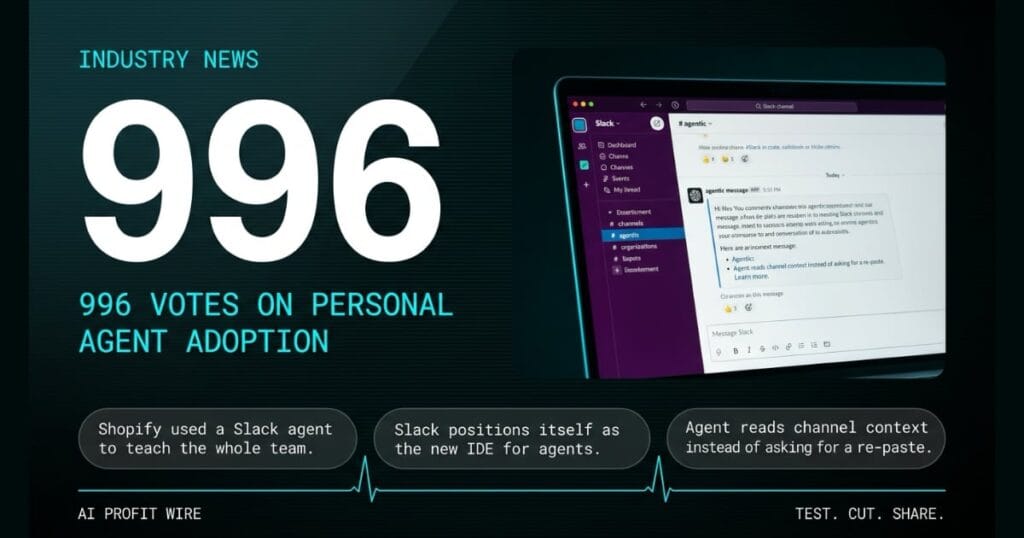
Ben’s Bites ran a poll asking “Do you use a personal agent?” and reported 996 total votes, signaling real demand for personal agent adoption inside knowledge work teams.
The newsletter also cited Shopify as a working example: when Shopify posted about their Slack agent, they said it helped so many other team members learn how to use agents, which is a concrete proof point that embedding agents inside Slack accelerates internal AI adoption.
The post frames Slack as the natural home for agentic work, because the team conversation, the agent, and the work product all live in the same place.
Ben’s Bites also notes that personal agents are essentially a folder of files and tools connected to an agentic interface, which means the agent can swap between providers without changing the channel it lives in.
Shopify’s Slack agent is the proof that workflow integration drives AI adoption, not training.
How does Slack AI agent collaboration compare to the alternatives, and what background do small business owners need?
The traditional alternative is a separate ChatGPT or Claude browser tab that an employee opens in parallel to Slack, copying context back and forth between the two.
The Slack agent approach removes the copy-paste loop. The agent reads the channel context directly, which means the team member does not have to manually re-paste the conversation every time they ask a question.
Small business owners need to know that agentic tools can now collaborate inside team channels, not just in a private 1 on 1 chat with a model in a separate app.
The Ben’s Bites post frames personal agents as essentially just files and tools connected to an agentic interface, which means the same Slack channel can hold both human teammates and agent teammates reading the same context.
This collapses the context-switching tax that kills productivity in any team where the daily workflow already lives inside Slack, not in a separate AI tool tab.
Integrated agents outperform standalone tools by killing the context-switching tax.
A 12 person logistics brokerage runs every shipment quote, carrier check, and customer reply through Slack channels. The ops manager has ChatGPT open in a second browser tab to draft carrier emails and to summarize customer briefs.
The friction is constant. A customer pings Slack asking for an updated rate. The ops manager copies the original brief, pastes it into ChatGPT, drafts the reply, copies it back, edits it in Slack, and ships it. That loop runs 30 times a day, and the manager is exhausted by lunch.
The Shopify Slack agent pattern fixes this by collapsing the loop into one channel. The agent reads the original brief directly, drafts the reply, and the ops manager approves. The 996 votes in the Ben’s Bites poll say the market has already decided this is the way agents get used.
How does Slack AI agent collaboration affect day-to-day operations for small businesses?
Teams who embed agents in Slack reduce the time spent training new hires on AI, because the agent is sitting in the same channel where the work happens.
Internal coordination tasks like drafting replies, summarizing threads, and pulling context from previous conversations can be delegated to the agent without leaving the channel.
Founders tracking where AI tools are landing inside team workflows can monitor the latest AI signals for small business owners for adjacent plays on internal team productivity.
Operational efficiency increases when AI lives in the primary communication channel instead of a separate destination.
What is the final verdict on Slack AI agent collaboration?
Embedding AI agents in Slack is the most practical path to actually getting a team to use AI, because it removes the friction of a new interface entirely.
The Shopify proof point shows that adoption accelerates when the agent lives where the work already happens, not in a separate tab.
For any small business running daily operations through Slack, this is the lowest-friction path to AI adoption, because the team does not have to learn a new interface or open a new tab to start using agents in their workflow.
Slack agents are the fastest way to move AI from a destination tool into a teammate inside the existing workflow.
Source: Ben’s Bites
