Lowers the risk and cost of hiring junior talent by using AI to accelerate their ability to ship usable features.
What is AI-native junior engineering and what changed?
AI-native junior engineering is the shift where entry-level developers focus on product ownership and decision making, not on writing syntax from scratch.
Francisco Trindade, VP of Engineering at Braze, put it bluntly: “AI ate the junior’s marginal value.” The work of writing a basic pull request is no longer the differentiator it used to be.
The role has evolved from a code-executor into a technical manager of AI tools, where the junior handles the trade-offs and inconsistencies that AI cannot resolve alone.
The junior’s value is now about managing complexity, not writing lines of code.
What is the evidence behind AI-native junior engineering?
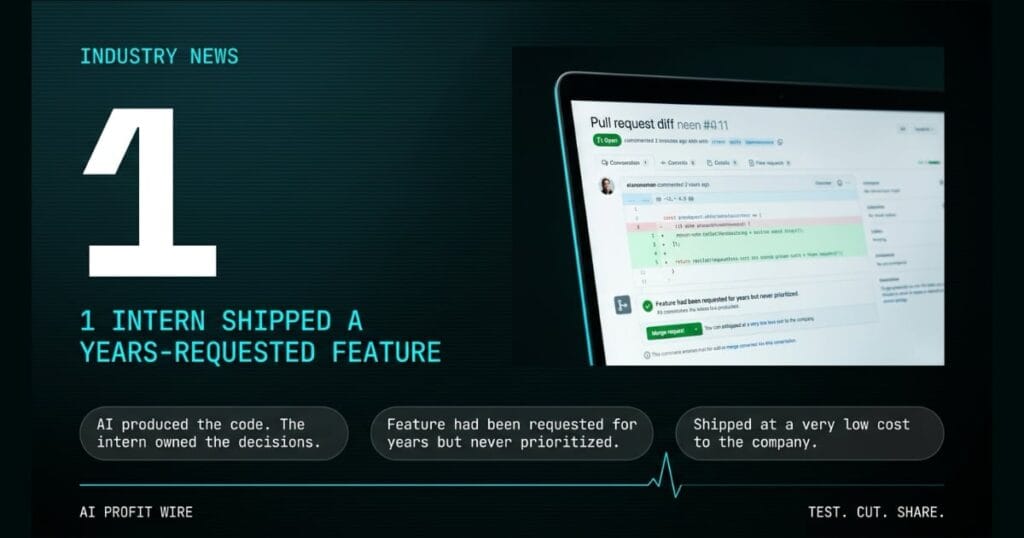
Trindade shared a Braze case study where 1 intern led the development of a feature that had been requested for years but had never been prioritized.
The intern talked to the product manager, wrote the design document, aligned with the team, and built it. AI produced much of the code, but the intern owned every decision, every trade-off, and every inconsistency.
The feature shipped at what Trindade calls “a very low cost for the company.” A customer problem that would not have been solved has now been solved.
AI allows junior talent to ship production-ready features with minimal senior oversight.
How does AI-native junior engineering compare to traditional hiring, and what background do small business owners need?
Traditional hiring required senior engineers to spend meaningful time explaining the company’s technical context, the language patterns, the tooling, and the codebase nuances.
AI-native hiring short-circuits that cost. A lot of the basic training that previously required actual human effort from senior peers can now be short-circuited with AI.
Small business owners should look for candidates who have already started their careers with AI as a core competency, because they will be in the best spot once they acquire domain experience.
The trade-off is that AI-native juniors still need human context for productivity, which means senior peer time gets redirected from syntax explanations to architecture and product decisions.
Trindade makes the point explicitly: context coming from humans is still key for productivity in software, and that effort has not been eliminated even as AI short-circuits the basic training layer.
Training costs have collapsed because AI now handles the technical onboarding layer that used to consume senior time.
A junior bookkeeper at a 14 person HVAC contractor opens the Wednesday payroll run. 4 crews worked overtime across 2 jurisdictions with different prevailing wage rules, and the senior accountant is on a 2 week vacation.
Three years ago, the junior would have waited, escalated, or filed the payroll late and eaten the penalty. Today, the junior owns the reconciliation while an AI tool pulls the prevailing wage tables, flags the discrepancies, and drafts the journal entries for review.
The 14 person firm did not hire a senior accountant to backfill the vacation. They hired an AI-native junior who can clear the same backlog at a fraction of the cost. That is what “AI ate the junior’s marginal value” actually means in practice.
How does AI-native junior engineering affect day-to-day operations for small businesses?
Small businesses can now tackle their low-priority backlog without diverting senior resources, which unlocks the customer frustrations that previously never met the prioritization threshold.
AI acts as a safety net for syntax and boilerplate, while the junior engineer focuses on the business logic, the customer perspective, and the trade-offs AI cannot decide.
The Braze case study shows the pattern in practice: a customer problem that had been ignored for years shipped at very low cost, because the intern owned the decision loop while AI produced the code.
This is the structural unlock for any small business with a backlog of low-priority customer requests that never get prioritized because the senior cost is too high to justify the work.
Founders who track shifts in technical hiring can monitor the latest AI signals for small businesses to stay ahead of the role evolution curve.
AI-native juniors turn the low-priority backlog into delivered customer value without hiring a senior.
What is the final verdict on AI-native junior engineering?
AI does not erase the need for junior engineers. It increases their value by collapsing the training cost and letting them own decisions earlier.
Small business owners should hire AI-native juniors to increase capacity, lower onboarding overhead, and free senior time for architecture work.
Trindade’s argument is structural, not aspirational: junior engineers still add capacity to an organization, and AI expands what every level can handle, including juniors. The pattern does not require a senior reorganization to deliver value.
The Braze case study proves the unit economics: a feature that was ignored for years shipped at a very low cost to the company, because the intern owned the decision loop while AI handled the syntax layer.
Hire junior talent to manage the complexity AI cannot, and let AI erase the training cost that used to make juniors expensive.
Source: franciscotrindade.me
