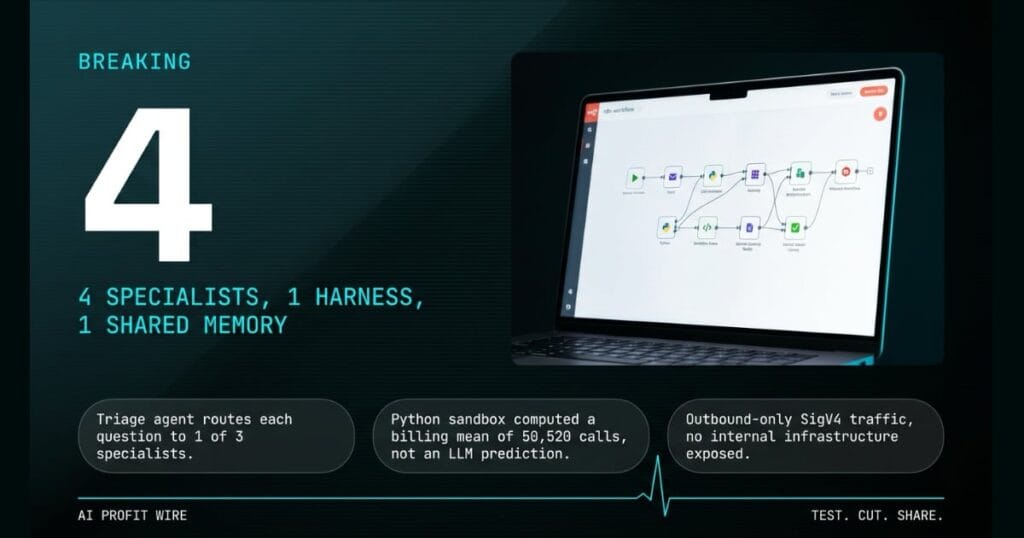
Reduces customer churn and support overhead by automating complex triage and memory management without requiring a custom database.
What is Amazon Bedrock AgentCore and what changed?
Amazon Bedrock AgentCore is a managed platform from AWS for building, connecting, and optimizing multi-agent AI teams at scale.
The AgentCore harness, now generally available, assembles and runs the agent loop for you without requiring custom code.
One harness resource serves up to 4 specialists, replacing the old model of provisioning 4 separate agents.
It turns fragmented AI bots into a unified support team that runs on a single managed loop.
What is the evidence behind Amazon Bedrock AgentCore?
The n8n team shipped a 10 node workflow that demonstrates a triage agent routing each customer question to 1 of 3 specialists.
One specialist uses the AgentCore Code Interpreter, a Python sandbox that runs calculations instead of letting the LLM predict them. In the demo, a customer disputed whether their 5 busiest API call days exceeded the 50,000 daily plan. The sandbox computed the mean at 50,520 calls, proving the customer was over by 520 calls, or 1 percent.
The architecture uses SigV4 signing for outbound-only traffic to AWS, which means nothing on your side needs to be exposed to the internet.
The n8n credentials only hold the caller identity keys, while the execution role runs inside the agent’s own Firecracker microVM, which is the standard isolation pattern AWS uses across Bedrock.
The Python sandbox replaces LLM guesswork with executed code for verified numerical answers.
How does Amazon Bedrock AgentCore compare to the alternatives, and what background do small business owners need?
The traditional alternative is a vector database plus an embedding pipeline to maintain long-term memory across agents.
AgentCore handles memory as a managed capability scoped by Actor ID and Session ID, so an Actor ID identifying the customer gives every specialist the same history to read and write.
You need an AWS account with Bedrock model access enabled in your Region, plus 2 IAM identities. The caller identity holds the access keys that go into your n8n credential, and the execution role is what the agent runs as at runtime.
AgentCore runs every session in its own Firecracker microVM with no shared state and no shared filesystem, which means the memory isolation between customers is enforced at the infrastructure layer, not by your application code.
Tool definitions travel with each invocation rather than being fixed on a deployed agent, which keeps token cost down because the model only sees the tools it actually needs for that specific call.
It removes the vector database bottleneck from the AI support stack without changing the AWS bill structure.
A dental office manager sits in front of a 4 chair practice. The orthodontist, oral surgeon, endodontist, and periodontist all work the same week, and every patient chart lives in the same physical folder behind the front desk.
When a patient moves from a root canal with the endodontist to a crown prep with the general dentist, the next specialist opens that same chart and reads the X-ray, the medical history, and the prior notes. No re-explaining the allergy to latex, no re-printing the insurance card.
AgentCore applies the same logic to AI. The 50,520 calls figure computed by the analysis specialist is the exact number the architecture specialist uses on the follow-up question, because both calls land on the same harness with the same Actor ID. The customer never has to paste those 5 numbers again.
How does Amazon Bedrock AgentCore affect day-to-day operations for small businesses?
Support teams can automate complex triage without forcing customers to repeat their problem when a ticket is escalated.
The Python sandbox means billing, usage, and contract disputes get resolved with executed math instead of model predictions.
Founders who already run their customer support on chat tools can drop the AgentCore node into a Slack or Webhook trigger and route to specialists from there. The AI support patterns documented for Tidio cover the front-end half of that flow, while AgentCore handles the back-end memory.
The architecture also scales horizontally without rewriting code. Adding a 4th specialist is a single new agent node on the canvas with its own tool grants, while the shared Actor ID memory model means no migration work for existing customer records.
For billing disputes specifically, the Python sandbox eliminates the most common hallucination failure mode in support AI, which is confident wrong math on usage and rate calculations.
It kills the “can you repeat that” friction that erodes customer satisfaction in any multi-stage support workflow.
What is the final verdict on Amazon Bedrock AgentCore?
AgentCore is a ruthless efficiency play for any founder already inside the AWS ecosystem.
Running 4 specialists on 1 harness collapses the token cost, the infrastructure cost, and the management burden in a single move.
It is the fastest way to deploy a high-accuracy AI support team without provisioning a vector store or hiring a dev-ops engineer.
Source: blog.n8n.io
