Drastically reduces the bottleneck of software production and allows non-technical founders to contribute directly to the codebase.
What are AI coding agents and what changed?
AI coding agents are autonomous tools that author software issues and submit pull requests, replacing the production bottleneck of human writing with a new bottleneck of human review.
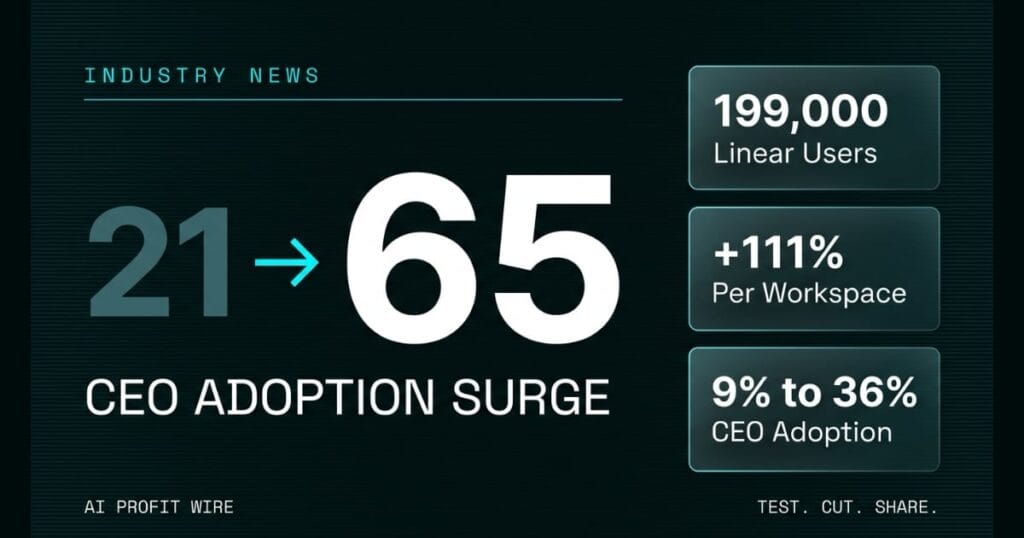
Teams using these agents saw weekly pull requests grow from 21 to 65 over 2 years, while traditional teams without agents remained nearly flat, moving from 8 to 10 pull requests.
AI agents now author nearly half of all software issues created within the Linear platform, which represents a massive shift from 2 years ago when fewer than 1 in 1,000 issues were AI-generated.
AI coding agents have effectively tripled the raw output of software teams that adopted them.
What is the evidence behind Linear’s AI coding report?
The data comes from usage patterns of approximately 199,000 paid Linear users with a known company size, tracking the entire workflow from the first issue to the closing pull request.
Pull requests opened per workspace rose 111% since June 2024, with growth accelerating through 2026 as model quality and adoption climbed together.
Adoption is widespread across all roles, with product managers’ use of AI features climbing from 12% to 34%, and CEOs at companies with 201 or more employees jumping from 9% to 36% adoption in 6 months.
The 111% increase in pull requests per workspace is the headline number that proves AI is driving a volume surge in software production.
How do AI coding agents compare to traditional software teams?
Coding agent teams produce significantly more code but do not necessarily save time, because they have replaced the act of writing with the act of coordinating and reviewing AI-generated output.
Agent-led teams jumped from 21 to 65 weekly pull requests, while traditional teams only moved from 8 to 10, showing that the gains are almost entirely tied to agent adoption rather than process improvement.
Non-engineers are now performing tasks previously reserved for developers, with product managers attaching pull requests rising from 3% to 10%, and designers rising from 1% to 8%.
AI agents let non-technical founders ship code directly, bypassing traditional engineering queues and reshaping who can build software.
How does the 111% pull request growth reshape founder roles?
The 111% increase in pull requests per workspace since June 2024 is the headline number that proves AI is driving a volume surge in software production, not just a quality bump.
Product managers’ use of AI features climbed from 12% to 34% in the same window, which means the role shift is already happening across the entire product team, not just engineering.
CEO adoption at companies with 201 or more employees jumped from 9% to 36% in 6 months, which means the strategy layer is now touching code directly, not just spec-writing.
The 111% per-workspace growth and the 9% to 36% CEO jump together confirm that AI coding agents are reshaping founder roles, not just developer productivity.
A pair of shears hits the station counter with a metallic click. The stylist has adopted an AI tool that handles all color-mixing ratios and automated client bookings.
The tool doesn’t let the stylist leave the salon early. Instead, it makes it so easy to fill the calendar that they’re now performing 111% more haircuts per week.
The workload hasn’t vanished: it’s just scaled up. The stylist is more exhausted than ever, but the business is processing more volume than it ever could manually.
How do AI coding agents affect day-to-day operations for small businesses?
The primary operational benefit for small business owners is the collapse of the engineering queue, because non-technical founders can now ship code directly without waiting on a developer.
This shift reduces the reliance on expensive external developers for small changes, with founders spending more time on creation and commenting, including a 26 minute monthly increase in commenting time.
AI usage has not replaced existing work but added a new layer of coordination work, which is a critical detail for those tracking AI operational shifts reshaping founder workflows to manage payroll and capacity.
The bottleneck has moved from “can we build this” to “should we build this,” which is a strategic shift founders need to internalize.
What is the final verdict on AI coding agents?
AI coding agents provide a massive advantage in output volume and accessibility for non-technical founders, even though they do not reduce the hours worked.
The ability for a CEO or product manager to ship a pull request directly eliminates the communication lag between vision and execution, which is the structural win Linear’s data confirms.
Small business owners who adopt coding agents will see output multiply, but they should expect total work hours to climb, not fall, as the AI adds a coordination layer to the existing stack.
AI coding agents are a volume multiplier, not a time-saver, and founders who treat them as the former will win the next 2 years of software output.
Source: linear.app
