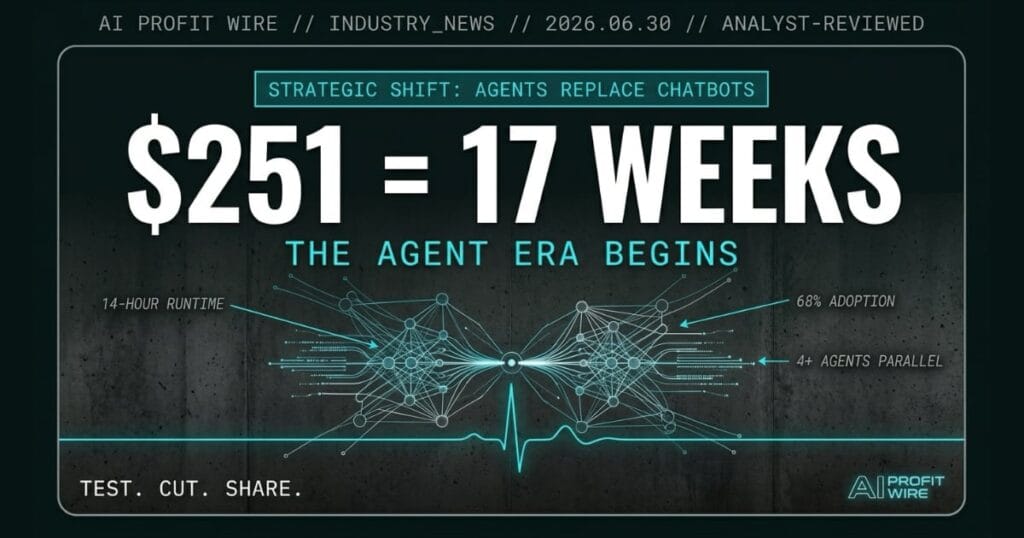
Transitioning to AI agents can drastically reduce project costs and turnaround times, turning weeks of human labor into hours of AI work.
What’s the shift from chatbots to agents and what changed?
AI is shifting from chatbot-style interaction, where a human prompts each step, checks output, and prompts again, to autonomous agent systems that run for hours on a single assignment. The shift moves from co-intelligence (working with AI) to delegation (assigning work to AI). Ethan Mollick, Wharton professor and author of One Useful Thing, framed it directly in his June 30, 2026 essay: work is increasingly about assigning work to agents, rather than working together with chatbots.
The capability jump is measurable. METR tested Opus 4.7 and found it built a software package in 14 hours of autonomous work that would take humans 2 to 17 weeks. Token cost: $251. Mollick’s own test had Fable work 9 hours autonomously on projects that would have taken a team well over a week of human labor. METR and the UK government AI Security Institute both estimate human-programmer-hours per prompt is increasing at better than exponential rates. GDPval, which compares AI to human experts using professional judges, confirms the curve.
The chatbot era is ending. The agent era has begun. The competitive gap between adopters and laggards widens non-linearly.
What’s the evidence behind the shift to autonomous agents?
The evidence spans multiple independent benchmarks and internal adoption data from AI labs. METR’s 14-hour Opus 4.7 run produced software worth 2 to 17 weeks of human engineering for $251 in tokens. Mollick’s Fable test produced complex software projects in 9 hours that would have taken a team well over a week. Mollick cites a joint study by OpenAI and academic economists: 70% of sampled OpenAI users made at least one Codex request equivalent to more than 1 hour of human work, and 25% made a request equivalent to 8 hours of human work.
Internal adoption data confirms the shift. Inside OpenAI, every department now uses Codex as its primary AI tool. The average worker generates 85% of output tokens in Codex rather than ChatGPT. A quarter of OpenAI workers run 4 or more agents simultaneously every week. Legal, HR, and other non-tech functions adopted agents at nearly the same rate as engineers. KPMG data shows employee adoption of AI agents reached 68%, with only 2% of leaders reporting significant pushback. A separate study of Claude Code users found software engineers had similar success rates to other professions, and domain expertise predicted success better than coding background.
Multiple independent benchmarks now confirm weeks of human work compress to hours of agent runtime, and adoption is enterprise-wide, not limited to engineering teams.
How does the shift to autonomous agents affect day-to-day operations for small businesses?
Operations shift from supervising tasks to defining outcomes and judging results. The bottleneck isn’t AI capability anymore. It’s your willingness to hand off entire workflows and your ability to judge whether the output is any good. Mollick’s framing: the best way to use agents is to think of yourself as a manager, not a prompt writer. You define the outcome, set constraints, and let the agent run.
The cost economics are decisive. Devin (Cognition’s AI software engineer) runs roughly $500 per month for teams. Claude Code runs roughly $20 per month. The $251 token cost for 2 to 17 weeks of engineering work isn’t a software cost. It’s a structural shift in who can do what work. Small businesses can now access capabilities that previously required hiring specialists: software development, research, analysis, content production. The 68% enterprise adoption rate means your competitors are already testing this. For founders tracking which operational roles are being reshaped fastest, our live archive of pipeline-filtered AI signals monitors the shift.
The small business owners who win are those who know what good output looks like, not those who write the best prompts.
A 12-week progressive overload protocol takes a fitness coach 3 days of manual drafting to balance exercise selection, set schemes, and deload timing. An agent with a single prompt describing the client, the goal, and the preferred format runs overnight, and the coach reviews the final deliverable in 45 minutes the next morning. The $251 equivalent isn’t the software cost. It is the structural shift: the coach no longer manages task execution, only the quality standard and the client relationship. The 14-hour runtime happened while they slept. The capability curve is exponential, which means the gap between adopters and laggards widens non-linearly. The operator who starts delegating full projects to agents now compounds that advantage every month.
What’s the final verdict on the shift to autonomous agents?
Small business owners should identify their first complete workflow that fits agent delegation. Agents are not yet reliable for every task, and they require expertise to evaluate output. The capability curve is exponential, which means the gap between adopters and laggards widens non-linearly. Mollick’s data point is the framing: if your organization wrote an AI plan any time before winter 2025, it described a system that could do a couple of hours of work with a fairly high error rate. A few months later, you can get 16 hours or more of work from a single prompt.
The tactical move is to start with one project you can define clearly, delegate fully, and judge accurately. The delegation requires three things: a clear outcome definition, a set of constraints, and your own expertise to evaluate whether the result is good. The coaches, consultants, and service providers who win this shift aren’t the ones with the best prompting skills. They’re the ones with the deepest domain expertise, because domain expertise is what lets you judge agent output. Coding background didn’t predict success with Claude Code. Domain expertise did.
Start with one project you can define clearly, delegate fully, and judge accurately. The capability curve doesn’t wait for laggards.
Source: oneusefulthing.org
