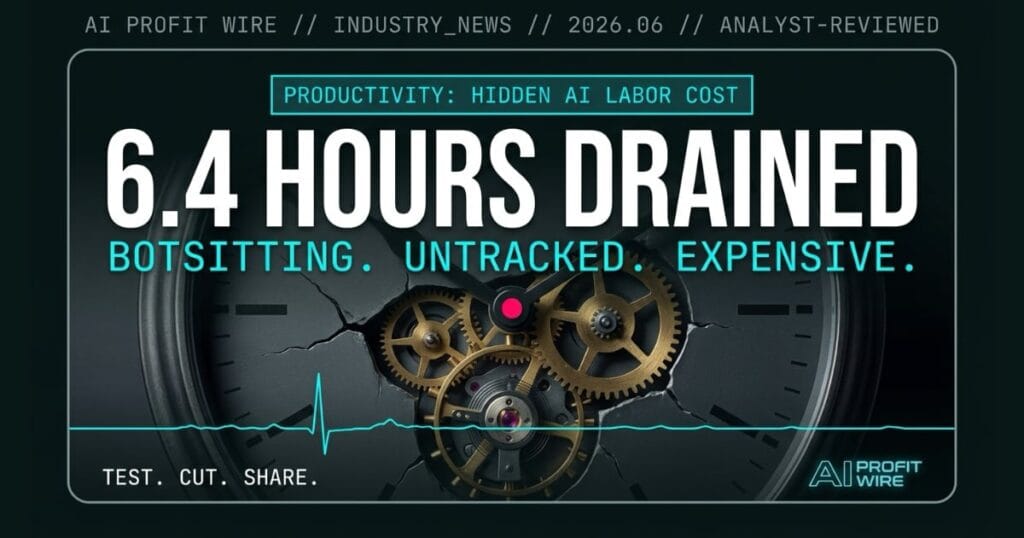
Unrecognized AI maintenance tasks are draining nearly a full workday per employee weekly and significantly increasing turnover risk, directly impacting labor costs and productivity.
What is AI botsitting and what does the 6.4 hours per week study show?
Botsitting is the term researchers are using to describe the hidden labor of supervising AI: reviewing outputs for errors, providing missing context, re-doing tasks the AI completed incorrectly, and manually verifying results before they go live.
A Business Insider study published in June 2026 found that white-collar workers spend an average of 6.4 hours per week on botsitting tasks. Workers with the heaviest botsitting loads are 73 percent more likely to be actively looking for a new job.
6.4 hours per week is 332 hours per year, per employee, in invisible AI overhead that no vendor invoice captures.
What is the real cost of AI botsitting for a small business with fewer than 10 employees?
At a loaded labor cost of $30 per hour for a knowledge worker, 332 hours per year represents approximately $10,000 per employee in uncounted AI maintenance costs. For a 5-person team where every role touches AI tools daily, the aggregate annual overhead approaches $50,000 before any efficiency gain is factored in.
The 73 percent turnover correlation compounds that number further. Replacing a skilled knowledge worker typically costs 50 to 200 percent of their annual salary in recruitment, onboarding, and productivity loss during ramp-up.
An AI deployment that increases turnover risk by 73 percent among your heaviest AI users is producing a negative ROI that most business owners will never connect to the tool that caused it.
Should small business owners track botsitting hours the same way they track billable hours?
Yes. Botsitting is a direct labor cost and it belongs on the same spreadsheet as software subscriptions. Tracking it requires one change: ask every employee who uses AI daily to log the time they spend reviewing, correcting, and re-doing AI outputs for one week.
The result will tell you whether your AI workflows are net-positive or net-negative on your actual operating margin. You can compare this pattern against other AI productivity cost signals being tracked in the pipeline to see how the botsitting burden compares across different tool categories.
If any role on your team is spending more than 2 hours per day correcting AI output, the workflow design is broken before the tool ever touches profitability.
The restaurant owner who runs the numbers on a new piece of kitchen equipment before signing the lease knows exactly what I’m talking about. You don’t just ask what the machine costs. You ask what it costs to run, what it costs to clean, and what it costs when it breaks during a Saturday dinner rush. AI tool adoption skips that last question almost every time. The output looks right in the demo. The botsitting bill shows up three months into the subscription when your best admin is spending her afternoons fixing what the AI got wrong and she’s already updating her resume.
What is the final verdict on the AI botsitting 6.4 hours per week finding?
The Business Insider study puts a verified number on a cost that has been real for every business running AI tools but invisible on every P&L. The 6.4 hours is a study average, which means some roles are lower and some are significantly higher.
The actionable move is a one-week audit before the next renewal cycle for any AI tool your team uses daily. Measure botsitting hours. Compare them to the subscription cost. Run the full math.
The AI vendors aren’t going to put a botsitting estimate on the pricing page, which means the only way to know your real cost is to measure it yourself before the invoice auto-renews.
Source: Business Insider
