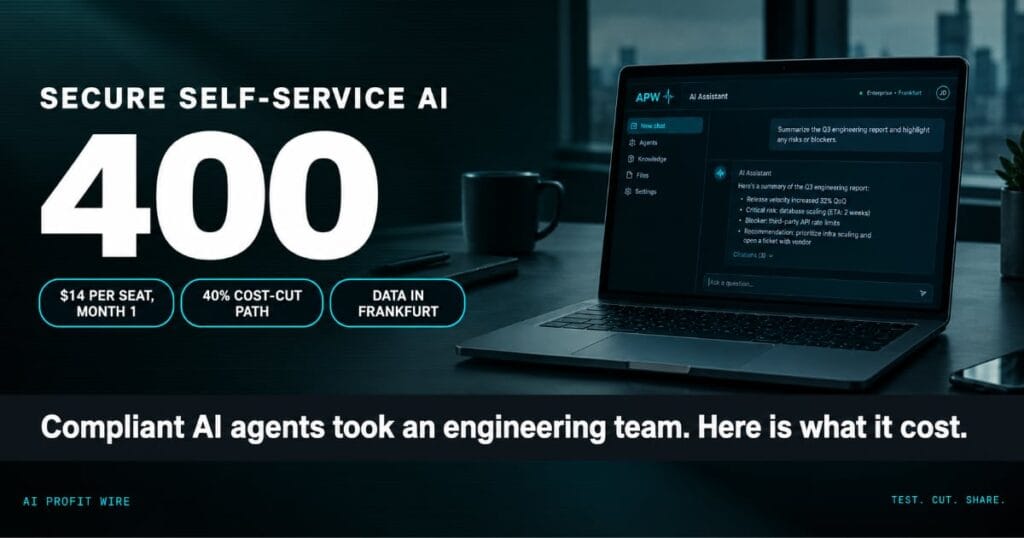
Shows how regulated financial firms can safely deploy internal AI tools, though requires custom enterprise engineering.
What Are Secure AI Agents For Financial Services?
Secure AI agents for financial services are assistants employees can use on their own, inside an environment that keeps client data governed, auditable, and in-region. German commercial insurance broker MRH Trowe rolled them out to approximately 400 employees in the first month of production.
According to the AWS case study, the framework combines three pieces: Strands Agents, an open-source SDK that builds the agents in a few lines of code, Amazon Bedrock AgentCore, which runs them in production with per-session isolation, and LibreChat, an open-source chat interface layered with enterprise controls.
Basic chat failed the business on four counts: responses lacked internal data grounding, multi-step workflows were impossible, connections to internal systems were missing, and every team standing up its own tool created shadow AI. The stack exists to answer all four at once.
Self-service AI in a regulated firm works when the environment is governed before the first employee logs in.
How Does The MRH Trowe Stack Meet German Compliance Rules?
The architecture answers three compliance questions directly: where the data lives, who can reach it, and what each user actually did. Sensitive client and insurance data stays inside the AWS Europe (Frankfurt) Region, because German financial sector rules leave no room for ambiguity on residency.
Employees sign in through Microsoft Entra ID, and the identity is passed server-side to the agent, so an agent can only reach the signed-in user’s own calendar and files. Each agent session is isolated at the compute and filesystem level, which means one employee’s agent cannot read another’s context.
The first production agent turns a Microsoft Teams meeting into structured minutes with date, participants, agenda, topics, and action items, all retrieved under the employee’s own identity. A board member’s shorthand for the rollout: if you and a colleague are doing things twice, build an agent.
Compliance here is an architecture property, not a policy document.
How Is This Different From Standard SaaS AI Tools?
A standard SaaS AI subscription trades data isolation for setup speed, and a regulated broker cannot sign that trade. MRH Trowe’s build inverts it: engineering effort up front, then per-seat costs that fall as usage grows.
The infrastructure-and-token cost ran about $14 per seat in the first month, and the team sees a path to cut roughly 40 percent more through right-sizing and scheduled scaling. A usage dashboard tracks unique users, token consumption by model, and cost per user, so the number is watched, not hoped for.
The custom stack also buys things a per-seat SaaS price never includes: private connectivity through a transit gateway and zero-trust provider instead of the public internet, and agent rollouts that happen without downtime to the chat application.
The build-versus-buy line for AI agents runs straight through your compliance mandate.
The new associate at a small accounting firm pasted client spreadsheet rows into a free chatbot to speed up reconciliation, and the issue only surfaced at the quarterly review. The data question arrived after the data did, which is the normal sequence at firms without an architecture answer.
MRH Trowe faced the same moment with 400 employees and answered before deployment: Entra ID identity passed server-side, sessions isolated at the compute level, everything pinned to Frankfurt. The question never needed a policy memo because the plumbing already settled it.
The bill for that control ran about $14 per seat in month 1, with about 40 percent more to come off. When your data carries a residency mandate, the plumbing line item arrives before the model subscription does.
Who Actually Needs Custom AI Infrastructure?
This build fits regulated firms that already run cloud infrastructure teams and carry data residency mandates. MRH Trowe was among the first German insurance brokers to operate exclusively on cloud-based IT, which is why the AWS-native path was open to it at all.
A founder with under 50 employees and no compliance mandate is buying engineering overhead, not capability. At that size, the self-service AI that pays for itself usually faces customers, and a managed platform like the one we scored in our Tidio intelligence report covers it without an infrastructure hire.
The middle zone, consultancies and fintechs handling client data under NDA, should steal the design pattern and rent the rest: server-side identity, per-session isolation, and a cost-per-user dashboard from day 1.
Buy the custom stack when the regulator demands it, rent the platform until then.
What Should You Do About Self-Service AI This Quarter?
Start with the data question, not the tool question. Write down where client data is allowed to live and which systems an AI assistant may touch, because those two lines decide the entire architecture.
If you operate under a residency or audit mandate, budget for the plumbing before the first agent ships: identity, isolation, and region pinning. If you don’t, cap your spend with a managed platform and revisit the custom build when scale or regulation forces it.
Track one number from day 1, cost per active user, the same metric MRH Trowe’s dashboard watches. The rollout paired the technology with use case workshops and power user identification, because adoption is the half of the project that compounds.
Secure self-service AI is a governance project with a chat interface, and the governance ships first.
Source: AWS Machine Learning Blog
