This development could significantly reduce cybersecurity software costs for small businesses while improving threat detection and remediation workflows.
What’s MAI-Cyber-1-Flash and what changed?
Microsoft introduced MAI-Cyber-1-Flash, a cybersecurity model and platform that reportedly costs half as much as rival systems to operate. The tech giant released the model on a Monday as it aims to revamp its enterprise AI strategy after facing lukewarm success with its Copilot system.
The model is embedded in Microsoft’s MDASH multi-agent vulnerability identification and remediation platform, which the vendor originally released in May. Alongside this model, Microsoft also launched Project Perception, an agentic security platform that furnishes teams of agents to monitor and patch security vulnerabilities.
Microsoft also claimed that MAI-Cyber-1-Flash outperformed Anthropic’s Mythos, OpenAI’s GPT-5.6 Sol, and Google’s Gemini 3.5 Flash Cyber on a widely used benchmark. This benchmark performance remains unverified externally by independent parties.
Microsoft is aggressively competing on price and accessibility in the AI cybersecurity space.
What’s the evidence behind MAI-Cyber-1-Flash?
The primary evidence comes from Microsoft’s own claims that the model costs 50% less than rival systems while matching or exceeding their performance. Analysts from The Futurum Group and Forrester provided positive commentary on the structural approach, noting the availability and cost advantages.
David Nicholson, an analyst at The Futurum Group, noted that the key advantage is that this model is available to everybody, as opposed to restricted models like Mythos and GPT-5.6. He explained that the system intelligently routes the consumption of tokens to appropriate models to ensure users aren’t paying top dollar.
Allie Mellen, a Forrester analyst, pointed out that Microsoft is leveraging its vertical integration by launching its own model based on its own data. She emphasized that the truly difficult part of building an agentic system is the harness around the model, which Microsoft is releasing as a comprehensive product.
Expert commentary supports the routing architecture, but benchmark claims lack external verification.
How does MAI-Cyber-1-Flash compare to the alternatives, and what background do small business owners need?
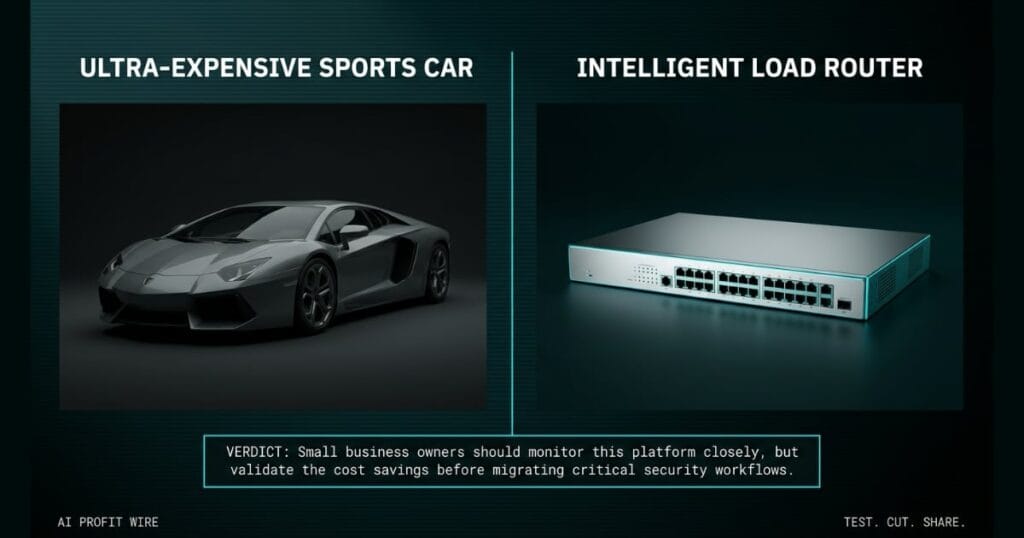
MAI-Cyber-1-Flash differentiates itself through a routing model that selects the lowest-cost AI for specific security tasks, contrasting with powerful, cybersecurity-dedicated models. Nicholson likened dedicated models like Mythos and GPT-5.6 to a high-end, ultra-expensive sports car, whereas Microsoft’s approach acts as an arbitrage between models to pick the right one for the right job.
The model routes security vulnerability identification requests to 3 AI models from OpenAI and is currently built on OpenAI’s GPT-5.4, all of which provide cybersecurity capabilities in addition to generative AI features such as reasoning, coding, and agentic workflows.
This launch occurs in the wake of government restrictions on other cyber models, which the Trump administration initially deemed a national security threat and forced off the market. Anthropic’s Mythos was subsumed under a restricted launch in April, and OpenAI followed a similar trajectory in May by restricting its cyber model to approved users.
Microsoft is offering unrestricted access and token arbitrage in a highly restricted market.
How does MAI-Cyber-1-Flash affect day-to-day operations for small businesses?
For small business owners, this development could significantly reduce cybersecurity software costs while improving threat detection and remediation workflows. The intelligent routing mechanism means companies aren’t paying premium prices for high-end models when a less expensive option can handle the specific security task.
Project Perception coordinates red, blue, and green team agents to handle the orchestration, saving users time, resources, and architecting efforts. Handling these security workflows internally through an automated platform reduces the need for massive in-house security teams, a structural shift we track across our ongoing coverage of AI-driven cybersecurity platforms for small business owners.
By embedding this technology into the MDASH platform, Microsoft provides a comprehensive system rather than just a standalone model. This integrated approach allows small businesses to deploy coordinated security agents without building the complex harness required to manage them.
Small businesses gain access to enterprise-grade security orchestration at a claimed fraction of the cost.
The weekly invoice from your logistics partner shows a line item for expedited freight that’s 50% higher than the standard rate. The charge hides a quiet inefficiency, where the partner routes every single shipment, even low-priority bean deliveries, through their premium air freight service.
You don’t need a high-end sports car to deliver a low-priority bean shipment across the state, and paying ultra-expensive rates for that route drains your margins silently. You need a router that looks at the load, the urgency, and the destination, then selects the lowest-cost transport that gets the job done without a catastrophic failure.
Microsoft is applying this exact logic to cybersecurity, routing token consumption to 3 AI models to avoid paying top dollar for basic vulnerability identification. Small business owners can’t afford to pay premium rates for every digital security sweep, and this architecture forces the system to arbitrage the cost.
What’s the final verdict on MAI-Cyber-1-Flash?
Microsoft is making an aggressive play to dominate the AI cybersecurity market by competing on cost and unrestricted access. The routing architecture addresses the core problem of inference inflation that plagues enterprise AI adoption.
The claims of cutting costs by half and outperforming rivals on a widely used benchmark are compelling but remain unverified externally. The inclusion of expert commentary from The Futurum Group and Forrester adds credibility to the structural approach.
For small business owners, the promise of lower security expenses and automated remediation workflows is a significant operational advantage. The integration into the MDASH platform provides a comprehensive system rather than just an isolated model.
Small business owners should monitor this platform closely, but validate the cost savings before migrating critical security workflows.
Source: AI Business
