Lets voice AI model providers on AWS Marketplace bill the software charge by metered usage instead of by the hour; SageMaker AI endpoint charges still apply.
Amazon announced usage-based metering of AWS Marketplace software charges for Amazon SageMaker AI bidirectional streaming on November 11, 2026, and the read matters to anyone paying hourly software fees on live voice AI. The software bill now follows the audio you process.
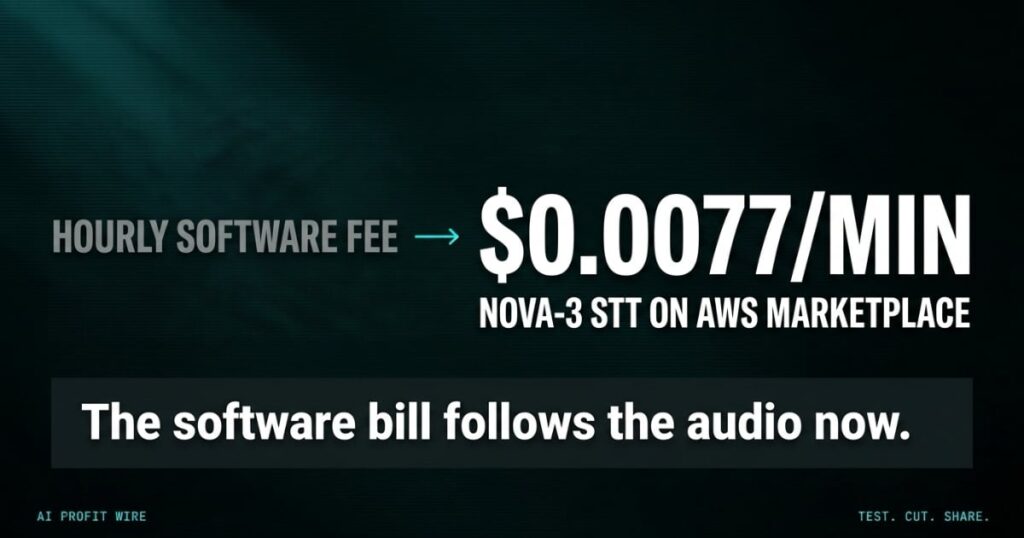
Deepgram’s Nova-3 monolingual speech-to-text lists at $0.0077 per minute on its AWS Marketplace listing, matching Deepgram’s own pricing page, checked on November 12, 2026, and the listing carries a free trial. SageMaker AI endpoint infrastructure charges still apply, so the change reaches the software half of a voice AI bill.
What Is Usage-Based Billing For Amazon SageMaker AI Streaming?
Usage-based metering lets model providers on AWS Marketplace charge for what a customer consumes during a live bidirectional streaming session, instead of a flat hourly software fee. Amazon announced it on November 11, 2026, with Deepgram as the launch partner bringing speech-to-text and text-to-speech billing to AWS Marketplace.
For hourly-priced listings, the software charge accrues while the model is available. The new path lets a provider report consumption during the live session instead, which Amazon describes as aligning billing with how customers consume streaming and real-time AI workloads.
Customers deploying streaming models on SageMaker AI already paid for the endpoint infrastructure that hosts the model. The new metering covers the separate Marketplace software charge, reported while the stream runs, per the AWS Machine Learning Blog.
The software charge now tracks consumption on live streams, while infrastructure billing stays separate.
How Does SageMaker AI Metering Work On A Live Stream?
SageMaker AI opens a second WebSocket connection, a companion metadata stream, alongside the existing data connection when a session starts. The model server reports metering records as JSON text frames on that stream while audio flows, per Amazon’s post.
Model servers opt in by returning one header on the WebSocket upgrade response, and both connections carry the same request ID so the server can correlate metering records with the active inference session. Amazon recommends sending records incrementally as usage accrues.
Each record carries a billing dimension and a consumed-units count. Under the per-second example in Amazon’s post, 12 minutes of metered audio bills as 720 units, and a session can last 30 seconds or 30 minutes.
The metering stream has a rate quota of 1 message per second per connection and a 512-byte maximum message size. Providers can set a header that stops inference if the metering connection drops, which trades inference availability for metering continuity.
Amazon recommends sending metering records as usage accrues, which reduces the usage left unreported if a session ends. Before release, providers validate the integration with a known-quantity test, reconcile records against seller usage reports and buyer charges, and test interrupted sessions, metadata-stream loss, and malformed messages.
The software bill now follows the audio, measured while the stream runs.
Usage-Based Or Hourly: Which SageMaker Marketplace Pricing Fits Voice AI?
The request-response version of Marketplace metering reported a unit count in an HTTP response header, which worked because the billable quantity is known when the response is sent. Bidirectional streaming runs an HTTP/2 event stream from the client and WebSockets to the model server, so usage accumulates while the session is still open.
Hourly software pricing bills while a model is available, including quiet periods. Usage-based metering aligns the Marketplace software charge with reported usage, so an open connection no longer defines the bill, and an open connection lasting 12 minutes does not by itself define billable audio either.
Model providers set one per-unit price for real-time inference across all instance types, shown per request with up to 3 decimal places, and a released listing cannot switch between hourly and per-inference pricing. The choice is structural, so it belongs in the planning stage, not the launch week.
Intermittent voice traffic fits per-unit billing; a saturated 24/7 queue may fit a negotiated fixed-price private offer better.
A fuel pump charges for the gallons that move through the nozzle. The hour a mechanic leaves the nozzle hanging on its hook costs nothing at the pump, and a fleet owner still checks the invoice line by line.
Voice AI software fees worked the other way: the hourly line could bill while the model sat available, whether audio moved or not. Amazon’s metering ties the Marketplace software charge to what flows, 720 units for 12 minutes of metered audio under the per-second example.
Two lines still land on the invoice, the software meter and the endpoint infrastructure charge. Reading both before you deploy costs less than discovering the second one at renewal.
Who Does SageMaker AI Usage-Based Billing Affect?
Teams deploying real-time transcription, contact center voice, voice agents, and captioning on AWS. The metering model changes how the AWS Marketplace software charge is calculated for those workloads, per Amazon’s post.
Buyers gain consolidated AWS billing, negotiated rates through private offers, and no separate billing relationship with the model provider to manage. Model providers gain a native way to bill per consumed unit instead of packaging hourly software fees.
Amazon’s post builds on a series of work between Deepgram and AWS: Amazon introduced bidirectional streaming for real-time inference on SageMaker AI in November 2025, and Deepgram later added AWS IAM temporary delegation and enhanced observability metrics. If voice AI sits anywhere in your stack, from an AI receptionist answering calls to live support transcription, this change reaches your software line.
Our roundup of AI voice tools for small business prices the voiceover side of the stack (ElevenLabs, Murf and Speechify), a layer apart from streaming speech-to-text.
If you deploy or sell streaming voice models on AWS, this change hits your software bill first.
How Much Does Deepgram Cost On AWS Marketplace?
Deepgram’s Nova-3 monolingual speech-to-text lists at $0.0077 per minute on its AWS Marketplace listing, with private pricing available on request. The listing carries a free trial, and the rate matches Deepgram’s own pricing page, checked on November 12, 2026.
On that page, monolingual streaming runs $0.46 per hour on pay as you go, Nova-3 Multilingual runs $0.0092 per minute, and the Growth plan drops Nova-3 monolingual to $0.0065 per minute, starting at $4,000 a year in prepaid credits. Deepgram says its $200 free credit covers roughly 43,000 minutes of Nova-3 transcription and does not expire; at the $0.0077 streaming rate, $200 buys about 26,000 minutes.
Text-to-speech carries its own rates on that pricing page: Aura-2 at $0.030 per 1,000 characters and Aura-1 at $0.0150. Teams building both sides of a voice agent can meter STT and TTS under the same Marketplace billing path.
At $0.0077 per minute, the software meter prices 100 minutes of live audio at 77 cents before infrastructure. The infrastructure half still bills while the endpoint is provisioned, so the full cost picture needs both numbers.
Per-minute software billing plus a separate endpoint charge is the new invoice shape for voice AI on AWS.
Should You Switch Your Voice AI Stack To Usage-Based Billing?
If your call volume swings by hour or season, per-unit billing matches the software charge to the audio you serve, and quiet hours stop costing software rent. Fixed-price contracts through private offers still suit saturated, predictable queues.
Model providers listing on AWS Marketplace configure their model server to report usage through companion metadata streaming, and Amazon’s SageMaker Marketplace Onboarding Agent Skill accelerates onboarding with starter templates that advertise metadata-stream support. Amazon tells providers to review and production-harden that code before submission.
Check how your provider counts metered audio, because those counting rules, not how long a connection stays open, set the software charge. Deleting test endpoints when testing completes stops ongoing infrastructure charges.
Track both charge types in AWS Billing and Cost Management, and reconcile reported units against Marketplace reports, since transport delivery alone does not establish that usage was billed. Our AI API pricing tracker keeps current per-token prices for the language model side of a voice agent.
Match the pricing model to your real usage curve, and audit the metering before the invoice does it for you.
SageMaker AI Usage-Based Billing: Frequently Asked Questions
Does usage-based billing replace SageMaker AI endpoint charges?
No. SageMaker AI endpoint infrastructure charges still apply while the endpoint is provisioned. The metering change covers the AWS Marketplace software charge.
How is usage counted during a live stream?
The model server sends metering records on a companion WebSocket while the session runs. Under the per-second example, 12 minutes of metered audio reports 720 units.
Can you negotiate Deepgram pricing on AWS Marketplace?
Yes, through private offers with negotiated per-unit rates or fixed-price contracts. Deepgram’s public rate for Nova-3 monolingual streaming is $0.0077 per minute.
What happens if the metering connection drops?
By default, inference continues in data-only mode and metering stops. Providers can set a header to stop inference instead, prioritizing metering continuity over availability.
Source: AWS Machine Learning Blog. Last Updated: November 11, 2026. Signal Type: breaking.
