Saves administrative time by integrating scheduling and task management directly into existing communication channels.
A wave of AI agents now lives inside the messaging apps you already use, iMessage, WhatsApp, Telegram, and plain SMS, and you reach them the way you would text a colleague. TechCrunch’s October 2026 roundup cataloged 22 of them, covering general assistants, family coordinators, travel planners, and tools aimed at work.
You text the agent what you need, and it remembers context, connects to your calendar and inbox, and completes tasks: scheduling appointments, sending emails, making reservations, and reminding you days later. For a small business owner, the pitch is a coordination layer that costs less than a lunch.
What Are AI Agents That Live in Your Text Messages?
They are AI assistants you address by text, inside iMessage, WhatsApp, Telegram, Signal, RCS, or SMS, with no new app to open and no dashboard to learn.
The category splits into 3 groups: general assistants for individuals like Comma and Caddy, family coordinators like Fambot, Ohai, and Ollie, and work-focused agents like Town, which raised a $55 million Series A led by Andreessen Horowitz and Forerunner in June 2026.
Some carry unusual autonomy. Wajo’s agent Fo has its own email address, phone number, and payment card, so it interacts with businesses without you handing over personal credentials, and it calls in a human assistant when it hits a task it cannot finish.
The category shift is real: the assistant lives inside the conversation thread you already check all day, and the interface is a text message.
How Many People Actually Use AI Text Agents?
Usage numbers are starting to back the hype. Szn’s own site reports more than 7,500 businesses served across 16 countries, with over 10,000 jobs completed and 95 hours of calls handled.
Poke became the first AI agent on Apple’s Messages for Business platform in June 2026, and a month later AI coding startup Cognition acquired its parent company in a deal valued in the low nine figures, after users exchanged 100 million messages in 3 months.
Instinct, still in private beta, raised $1 billion in September 2026 at a $10 billion valuation, and Tab came out of stealth in early October at $300 million. Most of the 22 tools still carry beta labels, but the category is past the concept stage.
The demand is proven on usage and deal flow, not on launch posts, and that is what separates this wave from the last one.
Are Text-Message AI Agents Better Than a Standalone App?
For coordination work, the text thread wins on friction, because you never leave the app where the request arrived.
Comma works across your browser, computer, and files while staying reachable through Signal, Telegram, and WeChat, and it checks its own work before surfacing completed tasks for your approval.
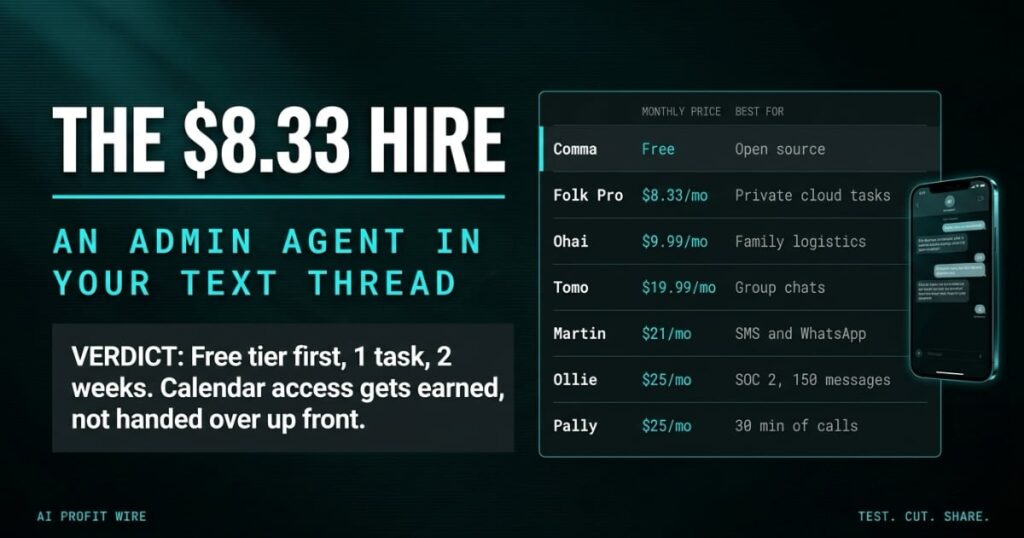
Folk runs on its own private cloud computer and can execute multi-step tasks and run code, which goes further than a conversational reply, and its Pro plan costs $8.33 a month for unlimited background tasks.
The tradeoff is trust: an agent with write access to your calendar and email demands more vetting than an app that only answers questions.
Who Are AI Text Agents For?
Founders and team leads whose week is eaten by coordination: scheduling, follow-ups, reservations, research, and the small administrative loops that never show up as a line item but always show up as hours.
The family coordinators target households, with Fambot sending a summary of the next day every evening and Ollie holding SOC 2 compliance, a security standard common across the industry, while Stanley serves content creators by turning voice notes into scripts, captions, and scheduled posts.
Test these agents on your own coordination queue before you hand them anything customer-facing.
The welcome screen asks for 3 permissions in its first minute: calendar, inbox, and a card on file. That is the whole purchase decision in a single dialog, because an $8.33 subscription and write access to a working week are two different products.
Vet the agent the way you would vet the first admin hire. One narrow job, watched for 2 weeks, with access expanded only after the agent proves it holds context and finishes what it starts.
Every permission granted before that review finishes is a bet placed on a demo. The agents that pass get the calendar, the inbox, and eventual access to the card, and the ones that fail stay on 1 thread where the damage is contained.
Is an AI Text Agent Worth $8.33 a Month?
At the low end, yes, provided you scope it to 1 recurring coordination task and verify it holds context before expanding access. Folk’s Pro plan at $8.33 a month covers unlimited background tasks, Ohai starts at $9.99 based on family size, and Tomo’s basic plan starts at $19.99.
The mid tier runs $21 to $25: Martin starts at $21, Ollie charges $25 for 150 messages and $100 for up to 1,000, and Pally charges $25 for 30 minutes of calls a month.
If your bottleneck is inbound customer questions rather than your own admin work, the better spend is a customer-facing tool, and our Tidio intelligence report breaks down what AI support chat costs against what it captures.
Comma is free and open source, and several others including Folk, Pally, and Wajo’s Fo carry free tiers, so the honest test costs nothing but 2 weeks of attention.
Start free, delegate 1 task, and let the agent earn the paid tier before you hand it your calendar.
Source: TechCrunch AI
