Helps small business founders evaluate when to deploy AI agents versus hiring human staff for operational roles.
What Is the AI Co-Founder Debate at TechCrunch Disrupt 2026?
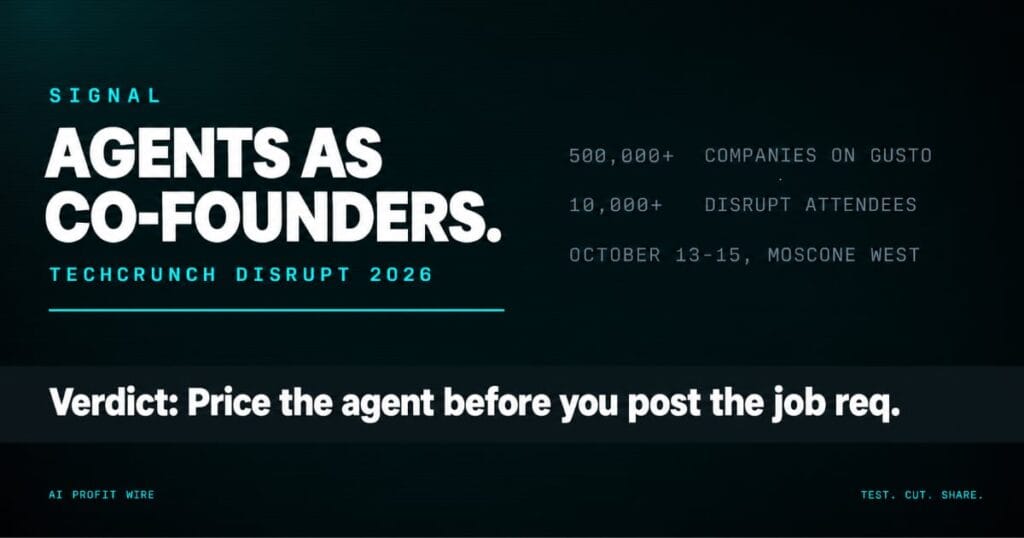
TechCrunch Disrupt 2026 runs October 13-15 at Moscone West in San Francisco, and one of its Builders Stage sessions asks whether a startup’s first 10 people still need to be people.
The session, titled “Hiring When AI Is a Co-Founder,” features Josh Reeves, CEO and co-founder of Gusto, Michelle Johnson, senior vice president at Insight Partners, and John Koelliker, CEO and co-founder of Leland.
The core question is which early-stage work should humans own, and which should founders delegate to AI agents capable of completing multistep tasks on their own.
This is a staffing framework discussion from 3 leaders who see hiring data and scaling patterns at scale.
Can AI Agents Replace Early Startup Hires?
Agents can take on engineering, customer support, research, and operational work that founders previously assigned to early employees, according to the session description.
The article frames the shift as a change in the starting question: instead of “who do we hire next,” founders ask what work needs doing and whether a person is the best way to do it.
The open problems are ownership and accountability, who checks the agent’s work, who makes the final call, and what happens when an agent gets something wrong.
How Is Delegating to AI Agents Different From Hiring the Old Way?
The old model treated every new capability as a new employee, while the agent model adds a third option between hiring and not doing the work at all.
Every early hire has always been a trade-off between capability, cost, and speed, and agents change the math by completing multistep tasks rather than assisting a person who completes them.
What doesn’t delegate is understanding what customers need, challenging a bad strategy, taking responsibility when something fails, and building the culture a company grows around.
Who Does the AI Co-Founder Question Actually Affect?
Any founder or leader deciding between headcount and automation this quarter, across the 10,000+ attendees expected at Disrupt. The same question already runs through customer-facing teams, which is why our Tidio intelligence report tracks what AI support agents handle without a human on the ticket.
Gusto supports more than 500,000 companies across payroll, benefits, compliance, onboarding, HR, and retirement, which puts Reeves close to how small businesses decide when to grow their teams.
Johnson works with CEOs and CROs on go-to-market strategy and AI implementation, and previously helped scale Flock Safety from less than $1 million to $90 million in ARR.
The job spec for your first support hire has sat open in a browser tab for 3 nights, and you still cannot justify the salary line. Josh Reeves walks on stage in October running a company that supports more than 500,000 small businesses. The question he brings is the one your spreadsheet is stuck on: does the work need a person, or does it need a system that completes multistep tasks on its own.
Support queues and research requests sit on the delegable side of that question. Customer judgment and ownership when something fails stay on your side of the line, and that line decides what your first 10 hires look like.
Should You Rethink Your Next Hire Around AI Agents?
Yes, if the role you are scoping is built on repeatable, checkable tasks, because the source frames that work as delegable before you open a requisition.
Perform a task audit: list every task the role would own, mark which are repeatable and verifiable, and price those against an agent workflow before pricing a salary.
Keep humans on the responsibilities the article flags as non-delegable: customer understanding, strategy challenges, and ownership when something fails, because those define the role of an early employee more than task volume does.
Audit the task list before the salary, delegate what is checkable, and hire for the judgment no agent carries.
Source: TechCrunch AI
