Reduces operational costs for businesses running AI agents or batch data processing tasks over the weekend.
What is DeepSeek API weekend pricing and what changed?
DeepSeek stopped distinguishing between peak and off-peak API pricing on weekends, effective 12:00 a.m. Beijing time on Aug 23. Every token processed on Saturdays and Sundays now bills at the off-peak rate, no matter the hour.
The company confirmed the shift in a notice issued Saturday and reported by Bloomberg. Usage billed before the cutover continues to settle under the previous pricing standards, so the discount applies cleanly from Aug 23 forward.
DeepSeek’s official pricing page now defines peak hours as 01:00-04:00 and 06:00-10:00 UTC, Monday through Friday. Every hour outside those weekday windows, which includes the entire weekend, bills at off-peak rates.
The weekend is now a flat 50% discount window on DeepSeek API usage.
What is the evidence behind DeepSeek API weekend pricing?
Bloomberg reported the change on Aug 23, citing DeepSeek’s own notice to API users. The notice confirmed that Saturdays and Sundays no longer distinguish peak from off-peak billing.
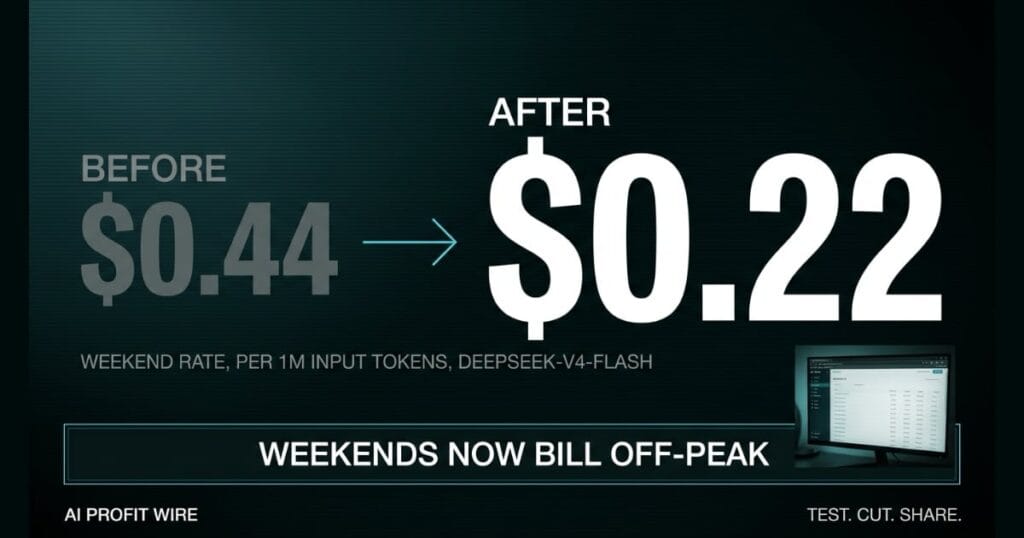
The official rate card backs the discount with hard numbers, because off-peak rates are set at exactly half of peak rates across every model and billing category. On deepseek-v4-flash, 1M cache-miss input tokens cost $0.22 off-peak versus $0.44 at peak, and 1M output tokens cost $0.66 versus $1.32.
The gap scales on the heavier model: deepseek-v4-pro output runs $1.98 per 1M tokens off-peak versus $3.96 at peak. Cache hits follow the same 2x pattern at $0.007 versus $0.014 per 1M input tokens on flash, and $0.022 versus $0.044 on pro.
The 50% weekend discount is documented in DeepSeek’s official pricing table, not in marketing copy.
How does DeepSeek API weekend pricing compare to the alternatives, and what background do small business owners need?
The practical comparison is timing, not vendors, because the identical deepseek-v4-flash job costs half depending on when it runs. A Sunday batch job bills at $0.22 per 1M cache-miss input tokens, while the same job inside a weekday peak window bills at $0.44, and the invoice is the only thing that moves.
Before this change, weekend daytime hours carried peak rates, which capped the cheap weekend stretch to the overnight hours. The update expands the low-rate window from a few scattered overnight hours to all 48 hours across Saturday and Sunday.
Inside DeepSeek’s lineup, deepseek-v4-flash pairs the lower rates with a 2500 concurrency limit, while deepseek-v4-pro carries a 500 limit and 3x the output price at $1.98 per 1M tokens off-peak. deepseek-v4-flash-vision-exp matches flash’s rates token for token, so image-heavy enrichment jobs get the same weekend halving, and bulk work that doesn’t need pro-grade reasoning defaults to flash on price alone.
Picking the right model and the right day now saves more than any prompt optimization.
14 dryers hum through a Wednesday afternoon while the utility meter on the wall ticks at double its overnight rate. The laundromat owner fires the heavy thermal loads at 11 p.m. instead, because time-of-use billing charges peak prices during working hours, Monday through Friday.
He runs the numbers every month and the pattern holds: the same 3-hour dryer cycle costs him half as much after dark. The electricity is identical and the wash results are identical, and the only variable on the invoice is the clock.
DeepSeek’s API now runs that same logic in your favor, with rates you can check: the $0.44 peak price per 1M input tokens becomes $0.22 for all 48 weekend hours. The output is identical, and the only variable you move is the calendar.
How does DeepSeek API weekend pricing affect day-to-day operations for small businesses?
The operational move is a schedule audit: list every recurring AI job and ask whether anyone touches its output before Monday morning. Weekly report generation, product description rewrites, and bulk data enrichment runs are the usual candidates, and none of them need a weekday slot to do their work.
Moving those jobs into the Saturday and Sunday window bills them at half the peak rate with zero code changes, because cron expressions, workflow schedulers, and automation platforms all support day-of-week conditions. DeepSeek isn’t the only vendor repricing AI capacity, and we log every one of those moves as they land in the running signal log.
A 6-hour enrichment run that no client sees until Monday has no business paying Tuesday peak rates. That single calendar edit is the cheapest optimization most small business owners will ship this quarter.
One schedule change turns the weekend into a standing 50% discount on AI batch work.
What is the final verdict on DeepSeek API weekend pricing?
DeepSeek turned Saturday and Sunday into a flat-rate discount window where every token bills at the off-peak rate, half the peak price. The change is live as of Aug 23, applies automatically, and costs nothing to adopt.
For small business owners already paying for API-driven work, this is a scheduling decision rather than a purchasing one. The vendors who charge you by the hour of the week just told you which hours are cheap.
Move the heavy jobs to the weekend and take the 50%.
