Differentiating your business with authentic, experience-driven content builds stronger customer loyalty than generic AI-generated material ever can.
What’s the Robin Williams AI slop response and what changed?
A blog post by Jay Acunzo uses a Good Will Hunting scene to argue that lived experience beats AI-generated content.
The post hit the front page of Hacker News, drawing 200+ points and 100+ comments within hours of publication. The scene is the bench monologue in Boston Public Garden, where Sean (Robin Williams) dismantles Will’s (Matt Damon) book-learned confidence by listing experiences Will has read about but never actually lived. Acunzo uses the scene to frame AI as having “read the internet” without having “lived a life.”
Experience is the only competitive advantage AI can’t replicate.
What’s the evidence behind the Robin Williams AI slop response?
The evidence is engagement-based and analytical, not empirical. The Hacker News audience typically dismisses “authenticity” framing as marketing fluff, so 200+ upvotes from that crowd signals the argument landed with people who don’t usually buy it.
Acunzo points to Robin Williams’s performance as proof: any actor could read the same script, but zero other actors would produce that exact moment. The post also notes that scientific discovery converges on the same truth regardless of who finds it, but art doesn’t. Hand 2 artists the same brief and you get 2 different works. The same script, 2 different performances. The same prompt, 2 different outputs from a human versus a model.
Original creation requires a life, not just a language model.
What’s the difference between knowing and living according to the post?
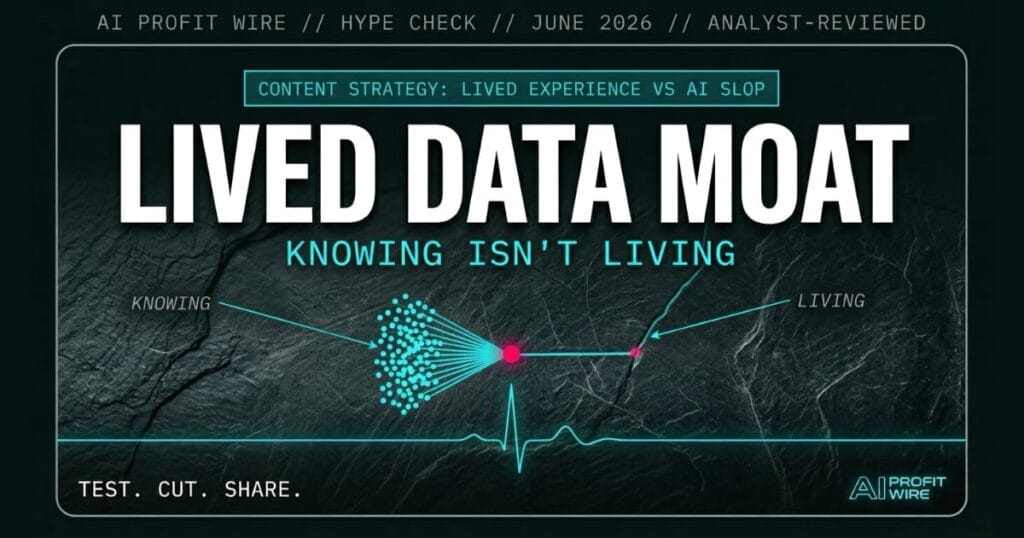
Acunzo draws a direct line from the Good Will Hunting scene to the current AI moment. Will has read the books and knows the theories. Sean has lived the experiences the books describe. The post calls Will “the human equivalent of ChatGPT” because Will has expertise without wisdom, theory without experience, knowing without living.
The same distinction applies to AI-generated content in 2026. A model can summarize every book ever written on pipeline forecasting, pricing strategy, or customer retention. It cannot tell you what it smells like in the Sistine Chapel, to borrow Acunzo’s framing of the original speech. It cannot tell you what a 3 AM cash crunch feels like when payroll hits in 6 hours. It cannot tell you why your specific customer said “fine” when they meant furious. The knowing layer is commoditized. The living layer is the moat, and the post argues we’ve reached a dangerous moment where the market is convincing too many people that knowing is enough.
The market is paying a premium for lived specificity in 2026. Generic knowing is free.
How does the Robin Williams AI slop response affect day-to-day operations for small businesses?
Small business owners now compete against infinite cheap content that sounds competent but means nothing. Generic blog posts, emails, and social content trained on the same prompts blend into noise, and the cost of producing that noise is effectively zero.
The operational shift is from volume to specificity. The businesses that win will document their actual processes, failures, and customer conversations rather than outsourcing voice to tools. This isn’t about rejecting AI entirely, it’s about using it for research while reserving creation for what only you have witnessed. Tools like NeuronWriter handle the research and optimization layer without replacing the voice that closes the deal. The operational patterns that separate surviving businesses from invisible ones live in that specific, lived documentation.
Your proprietary data is your customer conversations, not your ChatGPT subscription.
The inspection report says passed. Every box on the checklist is checked. The junior inspector fresh out of trade school has never seen what a stress-fracture weld looks like in month 3 of a bridge load, but the form is perfect and the signature is on the line. The senior welder who walks the same beam knows the sound a cracked weld makes when you tap it with the hammer, and that sound isn’t on any form.
AI writes the same way. It checks every structural box, hits every section header, uses the right vocabulary, and produces copy that means nothing because it hasn’t sat in the room where the actual decision got made. The businesses that win in 2026 will be the ones that document the sound the cracked weld makes, the specific operational fact no checklist captures, and refuse to outsource that knowledge to a model that has read the internet but hasn’t lived a single day of your actual operation. The market is already flooding with content that sounds right and means nothing. The counterweight is the specific, the witnessed, the operational scar tissue that no prompt can fabricate.
What’s the final verdict on the Robin Williams AI slop response?
The post is a strategic warning, not a product review. It claims that outsourcing your voice to AI is a race to the bottom that you will lose to someone with more capital or cheaper labor. The 200+ points and 100+ comments on Hacker News suggest this message landed with an audience that typically dismisses “authenticity” as marketing fluff.
The implication for small business owners is direct. Your content moat is not your AI stack. It is the specific operational knowledge you’ve accumulated by actually running your business: the customer conversations, the failures, the workarounds, the seasonal patterns, the supplier quirks. Document those. Publish those. Let AI handle the research and optimization layer. Reserve the final voice for what only you have witnessed.
Document your actual operations, or compete on price with infinite AI slop.
Source: jayacunzo.com
