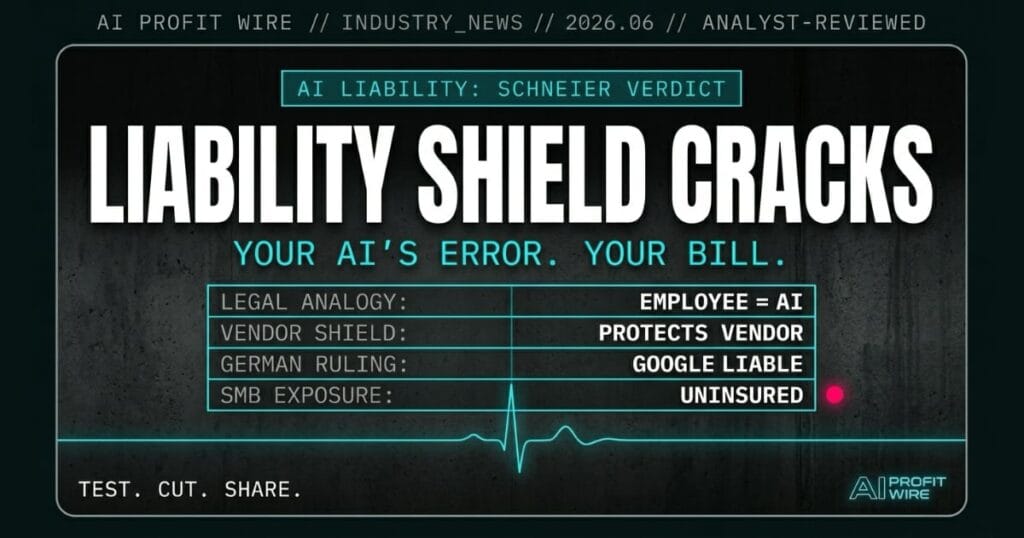
Understanding future liability rules is crucial as relying on AI without oversight could expose your business to significant legal and financial risks.
What’s AI liability and what changed?
AI liability is the legal responsibility a company holds for errors produced by artificial intelligence systems it deploys.
Bruce Schneier argues that companies should be held liable for AI mistakes exactly as they’re for human employee errors. He points to Google’s AI overviews as the current test case for this principle.
Businesses can no longer assume AI output comes with built-in legal protection.
What’s the evidence behind AI liability?
Schneier’s argument rests on direct legal analogy between human workers and AI systems.
If a company hired human writers to produce summaries, that company would be liable for inaccuracies. Schneier states that allowing businesses to hide behind “faulty AI” would introduce “disastrous incentives for corporate misbehavior” and asks why employers wouldn’t replace humans with cheaper, unaccountable machines.
The evidence is structural: identical outputs, identical liability, no special AI exemption.
How does AI liability affect day-to-day operations for small businesses?
Any small business using AI for client-facing output now carries uninsurable legal exposure.
This includes AI-generated contracts, tax advice, customer communications, or product descriptions. The vendor that built the AI tool will not absorb the cost of its errors in your specific deployment context, which means the financial and reputational damage lands on your balance sheet.
Your AI’s mistake is your lawsuit, period.
A solo marketing consultant uses an AI model to draft competitive analyses for client proposals. The model hallucinates a competitor’s pricing tier that doesn’t exist. The client signs the contract based on the analysis, then discovers the error during onboarding. The client fires the consultant, not the AI vendor. The contract sits between consultant and client, and the liability sits where the contract sits. That’s The Truth-Seeker in AI liability: the uncomfortable reality is that every vendor’s terms of service are written to protect the vendor, not you. The consultant’s signature on the proposal is what the court reads. Schneier’s argument lands hardest on small operators who assume vendor liability clauses are a shield. They aren’t. Audit every AI-generated deliverable before it leaves the building, or accept that the next hallucination is yours to pay for. Our live archive tracks which AI liability and governance signals directly impact small business risk exposure.
What’s the final verdict on AI liability?
Small business owners must audit every AI deployment for legal exposure before the first client sees the output.
This means documenting human review steps, maintaining records of AI-generated versus human-verified content, and negotiating vendor contracts with explicit liability language rather than accepting standard terms. The businesses that survive the liability shift will be those that treated AI output as their own from day one.
Accountability isn’t a bug in the AI system, it’s the feature that keeps your business standing.
Source: simonwillison.net
