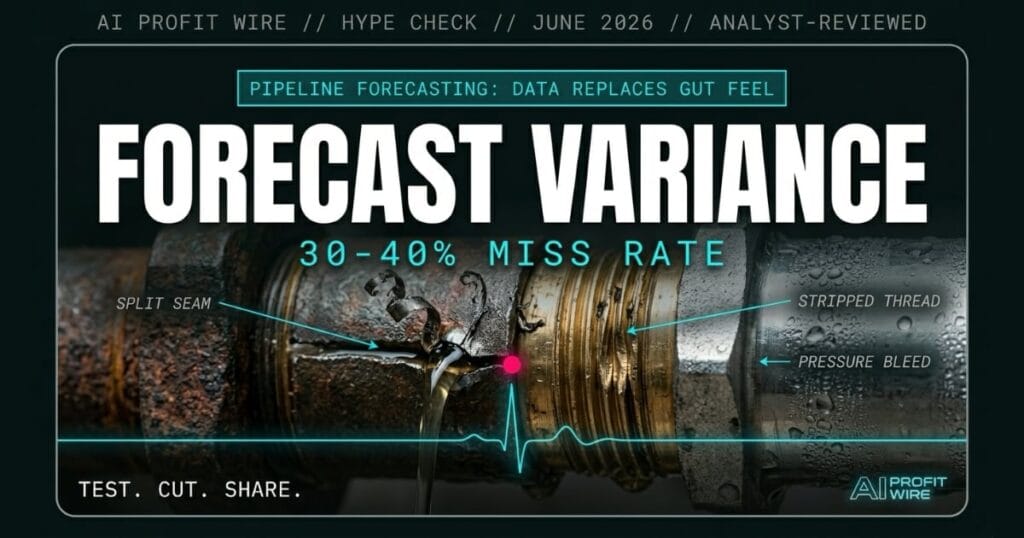
Implementing AI pipeline reviews can directly increase revenue predictability and save wasted hours in status meetings, preventing end-of-quarter shortfalls.
What’s AI-powered pipeline analysis and what changed?
AI-powered pipeline analysis applies pattern recognition to CRM data to flag at-risk deals and generate forecast summaries automatically.
Traditional B2B forecasting relies on rep self-reporting and manager intuition, which produces forecast swings of 30-40% from actual closes. The forecast gets touched by 5 people before it lands, and none of them are looking at the same data. AI replaces this gut-feel approach with behavioral signals like deal velocity, engagement gaps, contact depth, and stage duration compared against historical patterns.
Clean CRM data is the non-negotiable foundation, not the AI layer itself.
What’s the evidence behind AI-powered pipeline analysis?
The core evidence is structural: deals sitting in Proposal Sent for 45 days when the median is 12 represent a pattern humans miss in weekly standups but AI catches instantly. The same logic applies to engagement signals, activity gaps, contact depth, and stage duration tracked together, none of which a rep will volunteer in a Monday review.
The source identifies HubSpot deal scoring and Gong as existing platforms already delivering this pattern recognition layer, which means most HubSpot customers already own the tooling without activating it. The barrier isn’t procurement. It’s data hygiene and stage definition discipline. Standardized deal stages, automatic activity tracking, and historical close rate data by segment and rep are the prerequisites, and most small businesses haven’t built that foundation.
The capability is installed in your stack today. The activation is what’s missing.
Which 5 behavioral signals does AI pipeline analysis track?
The source identifies 5 specific behavioral signals that AI tracks together to flag at-risk deals. No single signal triggers a flag. The combination does, because the same deal might look healthy on 1 signal and broken on 4 others.
The 5 signals are deal velocity (how long the deal has sat in each stage versus historical averages), engagement signals (email opens, meeting attendance, reply latency), activity gaps (days since last logged contact), contact depth (how many stakeholders are involved on the buyer side), and stage duration (time in current stage versus median for that stage). A deal in Proposal Sent for 45 days when the median is 12 fails on deal velocity and stage duration simultaneously. A deal with 3 stakeholders that suddenly drops to 1 fails on contact depth. A deal with no logged activity for 14 days fails on activity gaps. Reps rarely volunteer any of this in a Monday standup. AI surfaces all 5 in one read.
The pattern only emerges when all 5 signals are tracked together. Single-signal scoring misses the deal that’s dying on 4 fronts and passing on 1.
How does AI-powered pipeline analysis affect day-to-day operations for small businesses?
Weekly pipeline reviews shift from 40-minute status recitations to targeted coaching on the 5 deals the system flagged. CROs receive digest emails showing deal momentum, projected close probability by segment, and flagged anomalies without sitting in an hour-long call hoping someone updated Salesforce.
RevOps builds the infrastructure: standardized deal stages, automatic activity tracking, and historical close rate data by segment and rep. The operational lift is real. Businesses without dedicated RevOps face a setup tax that can take 60 to 90 days to pay off, and many abandon the project before that. The operational patterns that separate predictable revenue from quarterly surprises live in this data architecture, not in the AI tool itself.
Small businesses without dedicated RevOps face a setup tax that can derail the project before it delivers value.
The weekly pipeline review in most small businesses is a performance of confidence. Reps narrate deals they have emotionally invested in. Managers apply pressure that skews self-reporting upward. The founder sits through it hoping the numbers hold. Then the quarter ends at $460K against an $800K forecast and everyone acts surprised.
AI pipeline analysis doesn’t eliminate this theater, but it introduces a second actor: the behavioral record. A deal sitting in Proposal Sent for 45 days when the median is 12 doesn’t care about the rep’s conference handshake or the verbal commitment that never made it into the CRM. That friction, between what people want to believe and what the data actually shows, is where the 30-40% variance lives. The small business that installs this counterweight early stops building hiring plans and inventory commitments on forecasts that were always going to miss. The cost of the setup tax is real, but the cost of another quarter built on a 30-40% wrong forecast compounds every time you renew a lease, sign a vendor contract, or commit to a hire based on numbers that don’t reflect reality.
What’s the final verdict on AI-powered pipeline analysis?
It’s a high-impact upgrade for any business with clean CRM data and disciplined stage definitions already in place.
Businesses running on spreadsheets and standup updates will struggle with the data foundation requirement. Those with structured HubSpot instances and existing Gong subscriptions can implement this without new vendor contracts, making the ROI case straightforward: reduced forecast variance, recovered meeting hours, and fewer end-of-quarter surprises that force fire-sale discounts to hit quota. The source frames this as a systems problem, not a people problem, which means throwing more reps or more forecast meetings at the variance won’t fix it. Only the behavioral data layer will.
Prioritize CRM data hygiene before evaluating any AI forecasting layer, or you’ll automate your existing chaos instead of fixing it.
Source: ATAK Interactive
