Government restrictions on AI releases could delay your access to the most powerful automation and cybersecurity tools, potentially stalling productivity gains.
What’s GPT-5.6 and what changed?
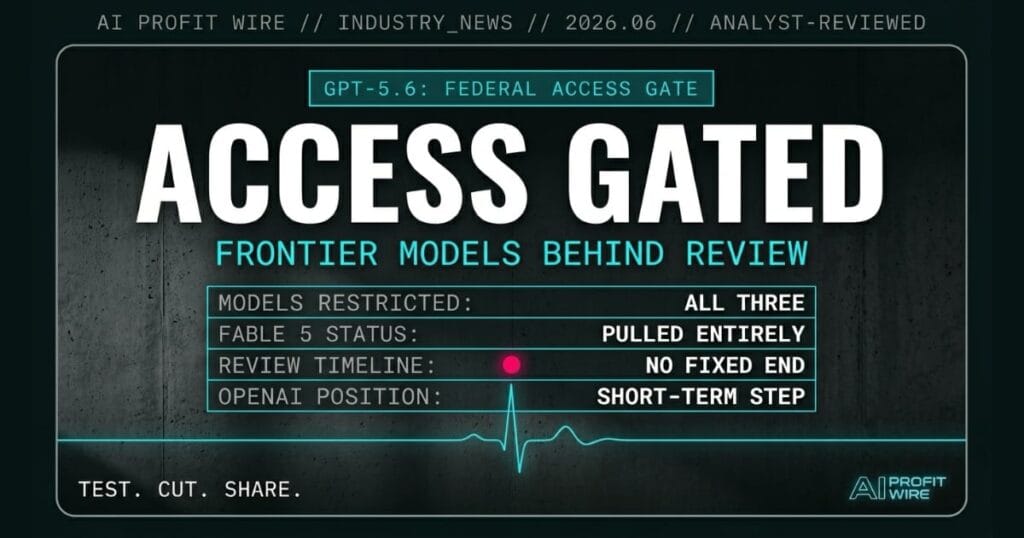
OpenAI limited its GPT-5.6 model rollout to a small group of trusted partners after a U.S. government request.
The lineup includes Sol at $5 per million input tokens and $30 per million output tokens, Terra at half that rate, and Luna at $1 and $6 respectively. OpenAI stated the preview is a short-term step toward broader availability.
This is the second major frontier model restricted by the Trump administration in one month.
What’s the evidence behind the GPT-5.6 restriction?
The restriction follows the administration’s order that Anthropic remove its Fable 5 model from public access for any foreign national, which led Anthropic to take it down entirely.
Former White House AI adviser Dean Ball noted that President Trump’s voluntary 30-day government review process for frontier AI has created conditions for heavy-handed restrictions without clearly defined safety standards.
Without fixed safety benchmarks, launch delays can extend indefinitely while competitors in other countries advance.
How does the GPT-5.6 restriction affect day-to-day operations for small businesses?
Most small businesses using ChatGPT, Codex, or the OpenAI API will not receive the new models until broader availability rolls out.
OpenAI plans broader availability soon, and the company explicitly warned that this access process should not become the default. Your automation and cybersecurity tool upgrades are now tied to federal review timelines.
If your 2026 roadmap assumes uninterrupted access to frontier models, that plan has a single point of failure you didn’t choose.
The businesses that treat model access as a variable, not a constant, are the ones that keep shipping. I keep a running archive of which signals actually change the operational math for small business owners, and you can find the latest pipeline-filtered updates at the live feed of AI access restrictions and model availability shifts.
A small SaaS company builds its customer support pipeline on a single frontier model. The pipeline handles tier-1 tickets automatically, escalates complex issues, and generates weekly analytics reports. Then the model gets restricted overnight. The support queue doesn’t crash, it just stops improving. The automated reports pull from a fallback model that produces longer, less accurate summaries. Response times climb from 90 seconds to 4 minutes. Customers don’t leave immediately, but satisfaction scores drop 12 points in the first week. That’s The Phantom Workflow applied to model access risk: the system appears functional, but the intelligence underneath degraded without warning. The GPT-5.6 restriction is this pattern at scale.
The pricing is published ($5/$30 for Sol, $2.50/$15 for Terra, $1/$6 for Luna), but the ability to purchase isn’t guaranteed. The Fable 5 precedent proves models can be pulled entirely after release. The operators who survive these disruptions are the ones who mapped fallback models months before the restriction hit: primary model for high-stakes work, secondary for routine triage, tertiary for status updates. Build the fallback map before you need it. Our live archive tracks which AI access restrictions and model availability shifts directly impact small business operations.
What’s the final verdict on the GPT-5.6 government restriction?
This is a structural access risk, not a temporary inconvenience.
OpenAI’s pricing for GPT-5.6 is set, but the ability to buy isn’t. The government review process has no published timeline, and the precedent of Anthropic’s Fable 5 suggests models can be pulled entirely after release.
Build your stack assuming your best tool can disappear without warning.
Source: TechCrunch AI
