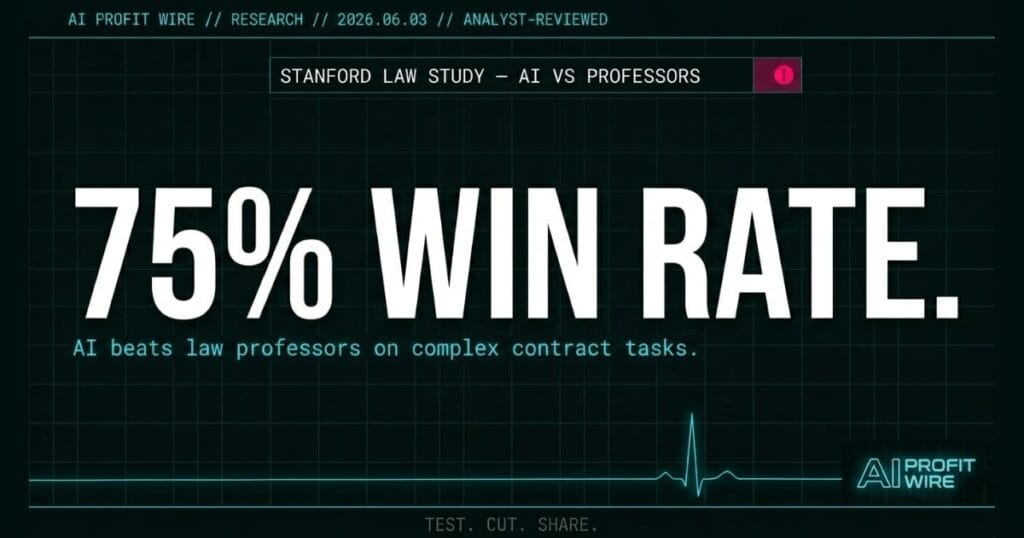
Suggests significant future cost reductions for legal drafting, compliance, and research for small business owners.
What does the Stanford Law research actually show?
AI can outperform human law professors on specific legal tasks. The study was conducted by Stanford Law School. It focuses on professional reasoning and complex task execution. The premium for high-level legal reasoning is no longer tied to a human degree.
What proof backs this signal?
The evidence comes from a controlled study by one of the world’s top legal institutions. This research earns a Hype Score of 7/10 because it targets professional-grade output. The data shows AI beating experts in speed and accuracy for specific tasks. When Stanford Law validates a performance gap, the result is an operational fact rather than a marketing claim.
Should small business owners care about this research?
Yes because it signals a massive reduction in costs for legal drafting and compliance. SMBs often overpay for research that AI now handles faster. This shift enables leaner operations for those who can verify the output. You can find more on how to build these lean systems in our signals feed. The cost of compliance is shifting from a fixed professional fee to a marginal compute cost.
The assumption is that AI is for emails and summaries. Watch the demos and it looks like a toy for the marketing team. Try to automate a complex contract review and the model hallucinates every 3rd clause. The gap between the 5-minute demo and the 40-hour production reality is where most founders lose money. Stanford now proves the reasoning is there, but the bridge to production is still broken. The tool is capable. The implementation is fragile. Legal bills keep arriving while the AI sits idle.
Should you act on this signal now?
Stop using expensive legal counsel for first-draft research and basic drafting. Use AI to generate the baseline and pay humans only for final verification. This reduces the billable hours on the first 80% of the work. Audit your current legal spend and move drafting tasks to AI before the next quarterly review.
Source: law.stanford.edu
