Tidio Intelligence Report
Tidio
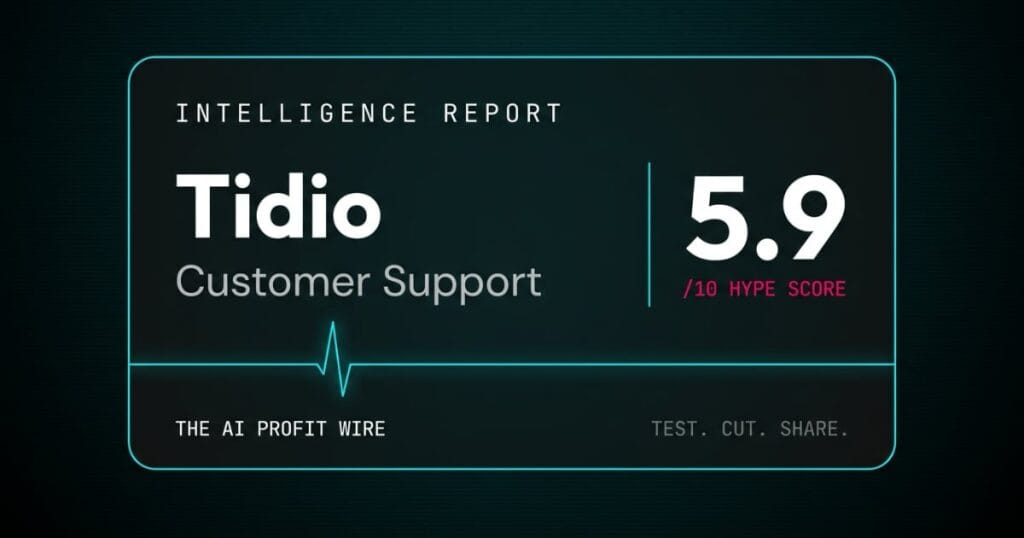
Tidio scores 5.9/10. A fast, easy live chat and FAQ automation start for small stores, held back by a bill that runs on 3 meters, Terms that allow price changes without notice and offer no refunds, and AI results that are all self-reported. Cost the whole plan before you subscribe.
In This Report
What is Tidio and who is it for?
Tidio is a live chat and AI support platform for small online stores, and it scores 5.9/10 on the Hype Check against Intercom and Zendesk.
For 1 store with 2 agents, about 500 conversations a month, and about 100 of them handled by AI, Tidio costs $164 a month, Intercom Essential costs $157, and Zendesk Suite Team costs $110 for the 2 seats before any AI usage, and each tool meters its AI differently.
The score sits at 5.9 because the free plan and Shopify distribution are real. Against that, your bill runs across 3 separate pools (human conversations, Lyro AI conversations, and Flows visitors), the Terms allow price changes without prior notice and offer no refunds, and every performance number traces back to Tidio’s own marketing.
Tidio is the easiest way to add live chat and FAQ automation to a small store, and the trade is a bill that grows on 3 separate meters.
Disclosure: Metadata Marketer earns a commission if you purchase through links on this page. This does not affect the Hype Check score or editorial assessment.
How big is Tidio’s user base, and how well do users rate it?
Community Adoption: 7.8/10
Distribution is strong on the platforms I could read, and the ratings elsewhere are more mixed.
The Shopify App Store listing shows Tidio at 4.8 out of 5 across 1,340 reviews, and the WordPress plugin page shows 70,000+ active installations and 3,523,405 downloads. Tidio’s About page says more than 300,000 companies worldwide trust it, which is the vendor’s own count.
Trustpilot shows 3.7 out of 5 across 225 reviews, which is a middling score next to Shopify’s. One reviewer (Sam Gadalla, October 2025) says Tidio doubled his rate without notifying him and charged him for a full year. That is a single account and I couldn’t corroborate it on a vendor page, so I treat it as community feedback and not as a documented event.
The old version also quoted G2 at 4.6 across 1,904 reviews, Capterra at 4.7 across 590+, a number 1 Shopify ranking, 205+ countries, and a Reddit thread. G2, Capterra, and Reddit block automated readers, and the Shopify page shows no ranking badge, so all of it is removed. The old 80,000 installs and 1,203 Shopify reviews were outdated and are replaced above.
A 4.8 Shopify rating across 1,340 reviews and 70,000+ WordPress installs show real adoption, and a 3.7 Trustpilot rating across 225 reviews shows where the friction sits.
Is Tidio’s pricing honest, or does it hide fees?
Pricing Model: 4.0/10
The prices are public and the free plan is real, and the score stays under 5 because the bill runs on 3 meters and the Terms favor Tidio.
The pricing page lists a Free plan, Starter, Growth, Plus, and Premium. Tidio bills human conversations, Lyro AI conversations, and Flows visitors separately, and the page sells Lyro and Flows as add-ons. A "billable conversation" only counts when a human agent sends a message, per the pricing FAQ.
The old version quoted a $700 a month jump from Growth to Plus, with Plus at $749 and Premium at $2,999. The live page shows Plus starting at $300 a month plus monthly usage, and Premium as contact for pricing, so that cliff is removed. It also said the 500-conversation Growth tier costs about $59, and the live page shows $89 for 400 billable conversations and $129 for 600.
The Terms of Service (section 8) cut against the buyer. They say Tidio may automatically upgrade your account when your use exceeds your plan, that it can change prices and correct errors without prior notice, and that it doesn’t provide refunds except as required by law or in exceptional circumstances. CheckThat.ai describes the auto-upgrade as triggering at 95% of conversation usage.
The old version added that Lyro stops dead at its limit, a $32 to $64 doubling that it called documented, and a 3-to-7-day free plan burn rate. I couldn’t verify any of the three on a readable page, so they are removed. On the cost, Featurebase calls Tidio’s pricing one of the most complicated models in the support software space and estimates real bills at 2 to 3 times the advertised tier, which is its analysis and not a Tidio figure. See current Tidio plans and start free.
Public prices and a usable free plan earn a middle score, and 3 billing meters, no-refund terms, and price changes without notice keep it under 5.
Tidio scores 5.9 out of 10 on our Hype Check. The full verdict and the numbers behind that score are further down this page.
Does Tidio’s Lyro AI actually resolve what it claims?
Benchmark Data: 4.5/10
Every performance number I could verify comes from Tidio, and the Intercom comparison comes from an aggregator.
Tidio’s Lyro blog post says Lyro is averaging 64% resolution and peaking at 90%, and the pricing page says Lyro solves up to 67% of customer problems. Those are marketing figures from the vendor, measured on Tidio’s own definition of resolved.
Cosupport.ai says Intercom’s Fin resolves 65% of conversations end to end with 96% accuracy. The old version attributed those figures to HappyFox, and they are on Cosupport.ai. Cosupport.ai is a comparison site, and I found no test that ran Lyro and Fin on the same tickets.
The old version also said the 90% peak came from a single case study called Axioma, and cited Builts.ai and Fin.ai for scope limits. I couldn’t verify those pages, so those 3 claims are removed.
The performance evidence is vendor marketing plus one comparison site, and I found no independent test of Lyro against a competitor.
What do reviewers say about Tidio?
Expert Sentiment: 6.5/10
The reviewers I could verify split cleanly: praise for ease of use, criticism of reliability and pricing.
ToolTester gives Tidio its Best Live Chat Tool for Ease of Use badge for 2025 and 2026. BlogVault (Shreya, January 14, 2026) says an unreliable mobile app and superficial analytics show Tidio is not ready for professional use. I treat it as one reviewer’s view.
Featurebase, a SaaS pricing reviewer, calls the pricing among the most complicated in the category. The old version also cited Gartner Peer Insights comments and Software Advice and G2 complaints. Those pages aren’t readable here, so they are removed.
The verified consensus is easy setup and a confusing bill, and the sources are 1 award page, 1 critical blog, and 1 pricing analysis.
Is Tidio production-ready?
Release Maturity: 6.8/10
Tidio is a shipping product with a public changelog, and its API sits behind the upper plans.
The vendor runs a public updates feed. The API documentation says OpenAPI is available exclusively on the Plus and Premium plans, and the pricing page lists OpenAPI, a dedicated success manager, and departments under Plus, which starts at $300 a month plus usage. The old version put that gate at $749, and it is now $300.
The old version also quoted 56 incidents since January 2025, a 4-hour average resolution time, and an April 17, 2026 outage. The status pages I could open didn’t confirm those figures, so they are removed. I have no verified evidence about reliability either way.
Tidio is a maintained product with a working changelog, and I have no verified reliability data, so the score stays near the middle.
What does the overall 5.9 Hype Score mean for your business?
A 5.9 means Tidio is a good starting point for a small store that wants live chat and FAQ automation, and a product to watch closely once the bill grows.
Community Adoption carries the score, because Shopify, WordPress, and the vendor’s customer count all point the same way. Benchmark Data and Pricing Model pull it down, because the AI results are self-reported and the bill runs on 3 meters.
The score held at 5.9 in this update. Pricing Model held at 4.0 even though the $700 cliff, the $749 Plus tier, and the $2,999 Premium tier on the previous version were wrong, because the Terms problems (no refunds, price changes without notice, automatic upgrades) and the 3 billing meters are confirmed. Community Adoption held at 7.8 and the other 3 signals held.
Start on the free plan, model your real conversation count, and price all 3 meters before you commit to a paid tier.
What does Tidio actually cost at every tier?
All prices come from the official pricing page, read on September 21, 2026 in US dollars. The monthly figure is the Monthly view and the yearly figure is the Annually view, labeled 2 months free.
- Free ($0): 50 billable conversations a month, 50 one-off Lyro AI conversations, and 100 Flows visitors reached
- Starter ($29/mo, or $24.17/mo billed annually): 100 billable conversations, 50 one-off Lyro conversations, 100 Flows visitors, live chat, and ticketing
- Growth (from $59/mo, or $49.17/mo billed annually): from 250 billable conversations, with the 400-conversation tier at $89 and the 600-conversation tier at $129 monthly, plus advanced analytics, user permissions, and macros, with up to 10 seats
- Plus (from $300/mo plus monthly usage): custom conversations, OpenAPI, a dedicated success manager, departments, and custom branding, with a custom number of seats
- Premium (contact for pricing): from 3,000 Lyro AI conversations, a guaranteed 50% Lyro resolution rate, pay-per-resolution billing, and SSO
- Lyro AI Agent add-on (monthly billing): 50 conversations for $39, 100 for $75, 200 for $140, and 500 for $350
- Flows add-on: from 2,000 visitors reached for $29 a month, or $24.17 billed annually
- No Tidio branding add-on: $20 a month on monthly billing, or $16.67 billed annually
The old version said Starter costs $39 monthly, and the live page shows $29. It also said branding removal is free on Plus and Premium, and the page lists custom branding under Plus and no Tidio branding as an add-on.
Model your conversation count first, because the human-conversation tier and the Lyro add-on are 2 separate bills. See current Tidio pricing.
Tidio vs Intercom vs Zendesk: which costs less for 1 store, 2 agents and 500 conversations a month?
Zendesk Suite Team costs $110 a month for 2 seats before AI usage, Intercom Essential costs $157, and Tidio costs $164 for 1 store, 2 agents, and about 500 conversations a month with about 100 handled by AI.
| Tool | Best At | Monthly Cost (1 store, 2 agents, 500 conversations) | Where It Breaks | Best Fit For |
|---|---|---|---|---|
| Zendesk | Omnichannel depth on Suite Team | $110/mo seats on yearly billing, AI usage extra | Live chat needs Suite; monthly billing costs more | Teams growing into multiple channels |
| Intercom | Paying only for AI outcomes | $157/mo (Essential, 2 seats, 100 Fin outcomes) | Fin fees scale with resolutions; Advanced costs more per seat | Teams expecting AI to resolve most chats |
| Tidio | Fast Shopify setup and FAQ automation | $164/mo (Growth 400 conversations plus Lyro 100) | 95% usage auto-upgrades; 10-seat cap; three meters | Small stores wanting simple setup |
Every price was read on September 21, 2026 from Tidio, Intercom, and Zendesk. The workload is my choice: 1 store, 2 agent seats, about 500 conversations a month, about 100 AI resolutions, US dollars.
Tidio bills only conversations that include a human reply, so 500 conversations with 100 handled by Lyro leaves about 400 billable. The Growth tier at 400 conversations is $89 and the Lyro 100 add-on is $75, which adds up to $164 on the pricing page’s own cost calculator. If you want headroom, the 600-conversation tier makes it $204.
Intercom Essential costs $29 per seat on monthly billing, so 2 seats cost $58, and Fin charges $0.99 per outcome, so 100 outcomes cost $99. The page says you never pay if Fin can’t answer, and it lists a Messenger live chat, a shared inbox, and ticketing on Essential.
Zendesk’s Suite Team lists $55 per agent a month paid yearly, and the page says monthly billing carries a typically higher effective monthly rate. The Support Team plan at $19 covers email and ticketing, while messaging and live chat sit in Suite Team. The page bills usage-based features on top of the seat price, so I have no AI resolution fee to add.
For this workload, Tidio and Intercom land within $7 of each other on monthly billing, and the choice comes down to whether you’d rather pay per conversation tier or per AI outcome.
Worth naming plainly: the Zendesk row is on yearly billing and the other 2 are on monthly, because Zendesk’s monthly seat price wasn’t readable from my location, so read it as a floor and not a like-for-like number.
What billing warnings should you know before subscribing to Tidio?
Every term below comes from Tidio’s own Terms of Service or pricing page.
- You can cancel any time, and there are no refunds. Section 13 says "You can cancel your recurring subscription at any time to stop further charges to your account", and Section 8 says "We do not provide refunds for our Services, except as required by law or it is justified by exceptional circumstances".
- Prices can change without notice. Section 8 says Tidio reserves "the right to change or update information and to correct errors, inaccuracies, or omissions at any time without prior notice", so a published price isn’t a contract.
- Your plan can be altered at any time. Section 8 says you "agree to have your existing payment plan altered at any time during the subscription", and that Tidio may downgrade you to a free subscription if payment fails.
- Overuse can upgrade your account automatically. Section 8 says "Tidio may automatically upgrade your account in the event that your use of the Services exceeds your purchased subscription plan". CheckThat.ai puts the trigger at 95% of your conversation usage.
- Add-ons bill on your stored card. Section 8 says agents and add-ons can be purchased through your Tidio panel using stored card details, so a click in the panel can add a monthly charge.
- Lyro’s free 50 conversations don’t refresh. The pricing FAQ says every account starts with 50 Lyro conversations and that you need to upgrade to the Lyro AI Agent plan to refresh it monthly.
- Plan changes wait for the next cycle, and trials end as a downgrade. The pricing FAQ says changes take effect at the start of your next billing cycle, and that at the end of a trial the account is automatically downgraded to the Free plan unless you upgrade.
- Removing Tidio branding is an add-on, and self-serve plans stop at 10 agents. The pricing page lists No Tidio branding as a $20 monthly add-on, and says you can add up to 10 agents on self-serve plans and custom numbers on Plus.
The safe approach: start on the free plan, turn auto-upgrade off if your account offers it, write the renewal date in your calendar, and price a Lyro add-on before you switch it on.
Why does Tidio’s bill read like a menu with 3 price lists?
I ran restaurants for 16 years, and Tidio’s bill reads like a menu with 3 price lists: one for the plate, one for the sauce, and one for the side.
In a kitchen you cost the whole plate, not just the protein, because the guest pays for all of it. Tidio’s plan price covers the human conversations, and the Lyro add-on is a second bill that at 100 conversations costs $75 against $89 for the 400-conversation tier.
The smart way to buy is to price the whole plate before you order. Count your conversations, decide how many Lyro should handle, and add the Flows visitors and branding you’ll actually use.
Cost the whole plate before you subscribe, because the plan price is only the first of 3 meters.
Who should use Tidio?
There are 4 profiles where a 5.9/10 still earns its place.
New Shopify or WooCommerce stores testing live chat. The free plan gives 50 billable conversations a month, and the Shopify listing shows 4.8 across 1,340 reviews.
Solo owners who want setup in an afternoon. ToolTester gives Tidio its Best Live Chat Tool for Ease of Use badge for 2025 and 2026.
Stores that want FAQ automation without a developer. Lyro starts at $39 a month for 50 conversations, and Tidio says it solves up to 67% of customer problems, which is the vendor’s claim.
Teams under 10 agents. Growth includes up to 10 seats, and the 400-conversation tier at $89 a month covers a small team’s human conversations.
Who should skip Tidio?
There are 5 situations where Tidio isn’t the right buy.
Teams planning more than 10 agents. Self-serve plans stop at 10 agents, and more seats mean Plus at $300 a month plus usage.
Buyers who want predictable pricing. The Terms allow price changes without prior notice and automatic upgrades, and they offer no refunds outside the law.
Teams that want AI to do most of the resolving. Intercom charges only for Fin outcomes at $0.99, and no independent test compares Lyro with Fin.
Owners who only need free basic live chat. Tawk.to lists a free plan with unlimited agents, without an AI agent.
Teams that need reliable mobile apps and deep analytics. BlogVault’s January 2026 review called Tidio not ready for professional use.
What is the final verdict on Tidio?
Yes for small stores that want live chat and FAQ automation set up fast and will watch all 3 bills. Not for teams that need more than 10 agents, frozen pricing, or verified AI results.
A 5.9/10 buys a usable free plan, deep Shopify distribution, and a public changelog. It costs you a bill split across 3 meters, no refunds, price changes without notice, and AI results that are all self-reported.
If you run 1 store with about 500 conversations a month, start free, price the 400-conversation tier at $89 and Lyro 100 at $75, and compare it with Intercom Essential at $157 before you subscribe. For the rest of the stack, see the Systeme.io Intelligence Report for funnels and email and the Beehiiv Intelligence Report for your newsletter. Browse the full Intelligence Report archive for more.
Try Tidio free. Check your auto-upgrade setting first.
If you’re also budgeting for design production alongside customer chat, see our best AI chatbot and design tools roundup, which prices Tidio alongside Kittl for a solo store’s full stack. For the methodology behind every Hype Check score, see the Pipeline page. For weekly pipeline intelligence, subscribe to The AI Profit Wire.
This report is updated quarterly. Pricing verified September 21, 2026. The score held at 5.9 in this update. Pricing Model held at 4.0 even though the $700 Growth-to-Plus cliff, the $749 Plus price, and the $2,999 Premium price were wrong, because the Terms problems and the 3 billing meters are confirmed. Community Adoption held at 7.8 with updated Shopify, WordPress, and Trustpilot counts while G2 and Capterra could not be read. Benchmark Data, Expert Sentiment, and Release Maturity held.
Test. Cut. Share.
Tidio’s terms allow price changes without prior notice, so treat every renewal as a negotiation. Our software renewal playbook covers what to check 60 days out and how to test your export before you commit.
Tidio scores 5.9/10. A fast, easy live chat and FAQ automation start for small stores, held back by a bill that runs on 3 meters, Terms that allow price changes without notice and offer no refunds, and AI results that are all self-reported. Cost the whole plan before you subscribe.
See Tidio pricing →Scores 5.9/10, below our 7.0 threshold. Read the verdict above before you commit.
