YouTube Monetization in 90 Days: The Real Math and the 8 Prompts Intelligence Report
In This Report
What does “monetized in 90 days” on YouTube actually require?
The YouTube Partner Program has four separate gates, and only two of them run on a 90-day clock. Both of those two are Shorts paths.
Full monetization on long-form video requires 1,000 subscribers plus 4,000 public watch hours, and that watch-hour total is measured across a rolling 12-month window. There is no accelerated version of this path. A creator hitting 4,000 hours in 90 days has simply done it faster inside the same 12-month window, and the window itself does not compress.
The Shorts path is where the 90-day figure comes from. Full monetization through Shorts requires 1,000 subscribers plus 10,000,000 valid public Shorts views within 90 days. A lower gate exists at 500 subscribers plus 3,000,000 Shorts views in 90 days, although that tier opens fan funding features rather than the full ad revenue share.
Every “90 days to monetization” claim is a claim about Shorts, and the price of admission is ten million views.
What is the evidence behind the four monetization gates?
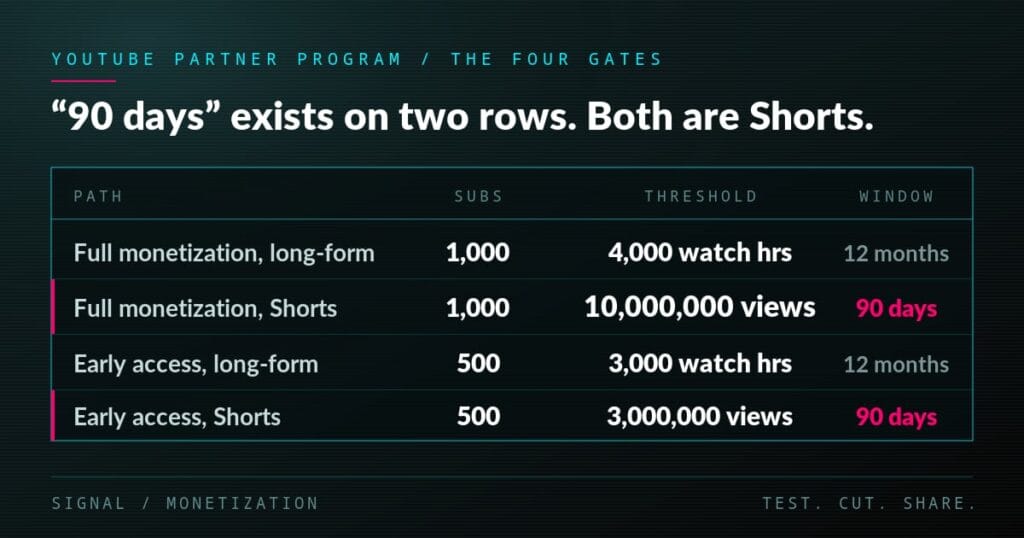
The thresholds are published requirements, not estimates, and they split cleanly along format and tier.
Full monetization, long-form: 1,000 subscribers and 4,000 public watch hours over 12 months. Full monetization, Shorts: 1,000 subscribers and 10,000,000 valid Shorts views over 90 days. Early access to fan funding, long-form: 500 subscribers, 3 valid public uploads in the last 90 days, and 3,000 watch hours in the last 12 months. Early access, Shorts: 500 subscribers, the same 3 uploads, and 3,000,000 views over 90 days.
All four gates carry the same underlying conditions on top of the numbers: an active AdSense account, no live community guidelines strikes, and compliance with every monetization policy. Channel review against those policies typically runs about a month after the numeric threshold is cleared, which means the calendar math is never only about views.
A channel can hit the numbers and still fail the review, because the numbers are the entry fee and the policy check is the actual decision.
How does the inauthentic content policy change the AI-built channel strategy?
On July 15, 2025, YouTube renamed its repetitious content policy to the inauthentic content policy. The rename was a clarification rather than a new restriction, because mass-produced material had never been eligible for monetization, although the new language made the enforcement target explicit.
The definition YouTube uses covers content that is mass-produced or repetitive, content built from a template with little variation between uploads, and content that is easily replicable at scale, phrasing that traces to the policy’s pre-rename wording (per MediaNama) and still describes the enforcement target today. Channels assembled from AI scripts, synthetic narration, and slideshow visuals sit directly inside that definition, particularly when every upload shares the same structure, pacing, and voice.
This creates a specific trap for the prompt-pack approach. A creator who runs eight generic prompts through a model and publishes the raw output produces exactly the profile the policy describes, which means the tooling sold as a monetization accelerator is the tooling most likely to fail the policy review at the end of the run.
A reported enforcement wave in January 2026 removed channels operating at scale on this model, per Tech Times. The policy is not a ban on AI, and creators using AI as an assist layer continue to monetize normally.
The policy does not measure how much AI you used, it measures whether your uploads are distinguishable from each other.
Running four businesses at once means I look at every “do it in 90 days” claim the same way I look at a supplier quote that comes in 40% under everyone else. The number isn’t the lie. The thing the number leaves out is the lie.
In restaurant operations the version of this was the vendor promising a food cost drop with no mention of the yield loss on the cheaper cut. The math on the invoice was real. The math on the plate was not.
A prompt pack works the same way. Eight prompts genuinely do produce a channel plan in an afternoon, and that part is true. What gets left out is that the plan lands you on the one path where the finish line is ten million views, and the content style it generates is the style the reviewer is trained to flag.
How does this affect day-to-day operations for a small business channel?
The practical decision is not whether to use AI, it is which layer of production the AI touches.
Research, source gathering, outline structure, analytics interpretation, and editing assistance are all safe territory, because none of those layers appear in the finished video as a recognizable template. Script voice, on-camera delivery, and final edit judgment are the layers that determine whether uploads look interchangeable, which makes them the layers to keep human.
Disclosure is a separate operational requirement. Any video containing synthetic voice, AI-generated visuals, or realistic altered footage must be marked as altered or synthetic content in YouTube Studio at upload, and skipping that disclosure creates a compliance problem independent of the inauthentic content review. Creators building with synthetic narration should understand the tooling before committing a channel to it, and our ElevenLabs Intelligence Report covers where AI voice holds up and where it breaks.
For a small business channel the realistic sequence is also different from the prompt-pack promise. Ad revenue is the slowest and smallest early income stream, and affiliate placement, service inquiries, and email capture all produce revenue well before 1,000 subscribers arrive.
Build the monetization stack that pays before YPP, because the gate is a milestone rather than a business model.
What are the 8 prompts for building a YouTube channel with AI?
These 8 prompts replace the generic prompt packs circulating on social. Every one of them does three things the generic versions do not: it forces your real inputs into the model, it carries a policy constraint so the output cannot drift into inauthentic content territory, and it ends in a deliverable you can grade rather than a wall of confident filler.
The pattern matters more than the prompts. A prompt without your real numbers is a prompt that invents its answer, and a prompt without a constraint is a prompt that optimizes for sounding impressive. Copy these, or copy the structure and write your own.
Use the Policy Pre-Flight Prompt at the bottom before you publish anything, because it is the only one that catches a demonetization problem while it is still cheap to fix.
1. The Gate Math Prompt
Act as a YouTube monetization analyst. Before advising anything, ask me for: my niche, my current subscriber count, my current watch hours, my weekly production capacity in hours, and whether I can appear on camera or use my own voice. Then calculate which of the four YPP gates I can realistically reach, and how many months each takes at my stated capacity. Show the arithmetic. If none are reachable inside 12 months at my capacity, say so directly and tell me what capacity would be required instead. Do not motivate me. Output a single table of gate, required output per week, and estimated months to threshold.
Why this beats the generic version: The original version asks for a complete operating system with no inputs, so the model invents a plan for a channel it knows nothing about. This version refuses to advise until it has your real numbers, and it is allowed to tell you the target is unreachable.
2. The Niche Survivability Prompt
Act as a YouTube market analyst. I will give you three candidate niches. For each one, assess: whether the format requires my face or original voice to be credible, how much of the existing top content is already AI-assembled, and whether a viewer could tell my video apart from the tenth result on the same topic. Rank the three by how defensible they are against YouTube’s inauthentic content policy, not by search volume. Name the single strongest differentiation angle for the winner, and be specific about what I personally bring that a prompt cannot.
Why this beats the generic version: Ranking niches by search volume sends you straight into the categories already saturated with AI-assembled content. Ranking by policy defensibility sends you somewhere you can actually survive a review.
3. The Hook Audit Prompt
Act as a retention analyst. I will paste my video title, my thumbnail concept in words, and my first 15 seconds of script. Do not write me a new one yet. First, tell me exactly where a viewer clicks away and why, in one sentence per drop-off point. Then rewrite only the weakest of the three. Every rewrite must be something I could actually say out loud on camera in my own vocabulary. Flag anything that reads like a template a hundred other channels are also using.
Why this beats the generic version: Asking a model to generate hooks produces generic hooks. Asking it to diagnose your existing hook first produces a reason, and the reason is the thing you can reuse on every future video.
4. The Algorithm Reality Prompt
Act as a YouTube data analyst. Explain what impressions, click-through rate, average view duration, and returning viewers each actually control in the recommendation system, and which of them I cannot influence in my first 90 days. Separate the metrics that respond to my effort from the metrics that only respond to scale. For each metric I can influence, give me one test I can run this week with a measurable before and after. Skip anything that requires a budget.
Why this beats the generic version: Most algorithm advice hands you a list of metrics with no indication of which ones you can actually move at your size. Splitting effort-responsive from scale-responsive metrics stops you optimizing things that will not budge until you are ten times bigger.
5. The Production Constraint Prompt
Act as a production manager. My weekly capacity is [X hours]. Design a workflow that uses AI for research, outlining, and editing assistance only, and keeps the script voice, the on-camera delivery, and the final edit decisions human. Mark clearly which steps YouTube’s disclosure rules require me to flag as altered or synthetic content. If your workflow would produce videos that look, sound, and move the same week to week, redesign it. Output as a checklist with time estimates per step that fit inside my stated capacity.
Why this beats the generic version: This is the prompt that keeps you out of the inauthentic content bucket. It bounds AI to the layers that never appear in the finished video, and it forces the workflow to fit the hours you actually have.
6. The Revenue Sequencing Prompt
Act as a creator business strategist. Ad revenue is the slowest and smallest early income stream on YouTube. Given my niche and my subscriber count, rank every other revenue path (affiliate, sponsorship, digital product, service, community) by how much it can realistically earn before I ever hit YPP. For each one, state the audience size where it starts working and the single thing that has to be true for it to work at all. Tell me plainly which paths do not apply to my niche.
Why this beats the generic version: Chasing the Partner Program first means waiting a year to earn anything. Sequencing revenue by when it starts working means the channel pays for itself long before the gate opens.
7. The Weak Video Autopsy Prompt
Act as a YouTube data analyst. I will paste the analytics from my three worst-performing videos and my three best. Find the pattern that separates them, and state it as one testable sentence. Then tell me what single variable I should change on my next upload to test that pattern, and what result would prove the pattern wrong. If the sample is too small to conclude anything, say that instead of inventing a pattern.
Why this beats the generic version: The permission to say the sample is too small is the whole prompt. Without it, a model will confidently manufacture a pattern from six videos and you will spend a month optimizing for noise.
8. The Policy Pre-Flight Prompt
Act as a YouTube policy reviewer. I will paste my channel concept and three planned video descriptions. Assess them against the inauthentic content policy: is this content mass-produced, templated, or easily replicable at scale by someone with the same prompts? Point to the specific element in my plan that a reviewer would flag first. Then tell me the smallest change that makes it defensible. Be adversarial. Assume you’re trying to demonetize me.
Why this beats the generic version: No prompt pack includes this one, and it is the only prompt here that can save the channel. Run it before you publish anything, not after a strike arrives.
The verdict on the 90-day monetization claim
Treat any 90-day monetization promise as a Shorts strategy until proven otherwise, and price it at ten million views before deciding whether the strategy fits the channel.
Use AI for research, structure, and editing assistance. Keep voice, delivery, and final judgment human, and disclose synthetic elements at upload. That boundary is the difference between a channel that compounds and a channel that clears the numbers and fails the review.
The 90-day claim is not false, it is incomplete, and the missing piece is the entire cost.
Sources: third-party creator tool TubeBuddy
