Increases revenue and reduces administrative overhead by automating appointment scheduling and e-commerce sales recovery.
Who invested in Ringg and how much?
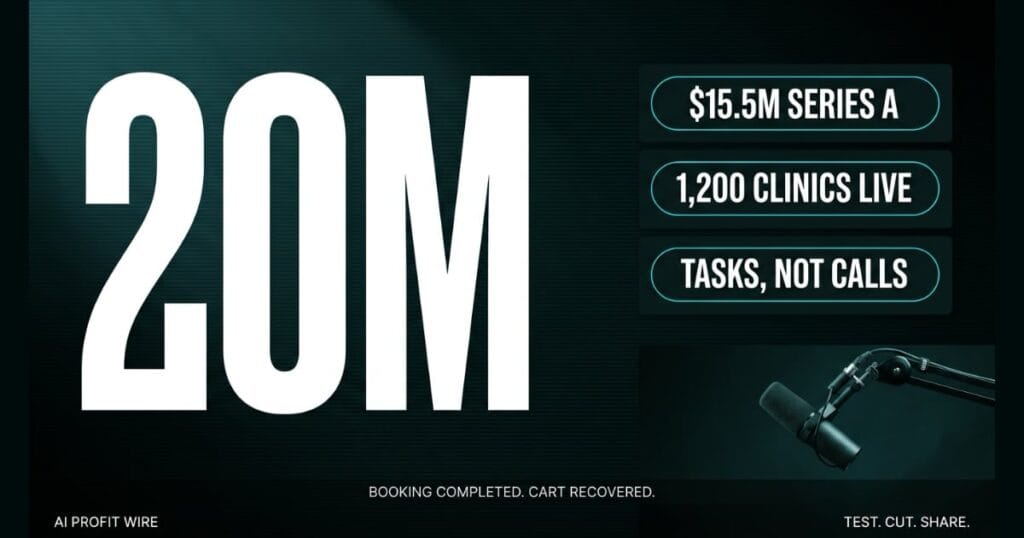
Peak XV Partners provided $10 million in fresh capital as an extension of Ringg’s Series A.
The initial $5.5 million tranche closed earlier in 2026, and the extension lifts the round total to $15.5 million. Peak XV principal Rishen Kapoor credited the company’s research-lab origins for its ability to run difficult enterprise workflows end to end, with quality and consistency.
Ringg now holds $15.5 million to push voice AI past the phone call.
How many calls does Ringg process every month?
The platform handles 20 million call attempts monthly, and voice still drives over 70 percent of its business, with chat and WhatsApp channels expanding alongside.
Demand pressure supports that trajectory: Truecaller research finds 76 percent of consumers in India prefer phone calls for business interactions. Automation built for that preference inherits a very large addressable base.
Scope matters too, since coverage extends past talk: merchant onboarding plus L1 and L2 support now sit in the completed-work column, per Peak XV principal Rishen Kapoor.
Ringg’s agents book appointments across 1,200 Practo clinics, covering visit scheduling and post-visit follow-ups automatically. The client roster runs deep for a 40-person company: Flipkart, Groww, Policybazaar, fintech Cred, and Shell, where browser-based support requests join the automated mix.
20 million monthly attempts across brands like Flipkart is production volume, not a pilot.
How is Ringg different from other voice AI tools?
Co-founder Siddharth Tripathi told TechCrunch that high-volume outbound calling and lead qualification turned into a permanent price war on use cases that never stuck.
The company started life as a text-to-speech startup called DesiVocal, and training its own speech models proved expensive enough to reroute the strategy up the stack. Enterprise voice agents became the product, with fintech Cred signing as customer number 1.
The pivot now targets workflows that end in outcomes: abandoned-cart recovery for e-commerce sites, clinic bookings, and KYC checks for fintech apps. Building and running raw models stays costly for now, so Ringg operates as an orchestration layer routing each task to whichever model fits the job.
The competitive map explains the urgency: Deepgram, ElevenLabs, Cartesia, Sarvam, and Smallest.ai all sell models, while orchestrators Bolna and Blue Machines chase the same layer directly. TechCrunch’s own read lands where the money does, with whoever owns the customer relationship and the outcome.
Tripathi frames the positioning himself, describing a platform where agents bring outcomes rather than serving as voice agents for enterprises.
Conversation vendors compete on per-minute rates, and Ringg competes on completed transactions.
A two-chair dental practice lets its office phone ring out for the third time before noon, while 11 unpaid booking carts sit queued in the online scheduler. Between patients, the reception manager adds 90 minutes of manual callbacks to tomorrow’s shift plan.
Ringg’s agents close this exact loop across 1,200 clinics, booking visits and chasing no-shows while the chair stays occupied. Storefront commerce runs the mirrored play, recovering abandoned carts at 2 AM without waking anybody on staff.
Judge software in completed appointments and the empty-chair cost starts to dwarf the per-minute meter. Paying for closed outcomes beats renting conversation time, and that is the entire shift this funding round prices in.
Can small businesses use Ringg today?
Buying direct isn’t on the menu for U.S. owners right now, because Ringg prefers partnering with global capability centers, the offshore hubs multinationals rely on for back-office and support work.
Growth signals inside the company tell you where this goes anyway: more than 15 of its 40 employees joined within the last 3 months. Hiring concentrates on forward-deployed engineers who pair technical skill with product management, plus researchers tasked specifically with driving down model-running costs.
Partnering through capability centers places its automation capacity next to human support teams, a delivery model Western self-serve tools rarely attempt.
Watch the outcome-pricing standard it normalizes, because that expectation transfers to every vendor pitch you take this year.
Does Ringg’s funding change anything for your business this quarter?
The funding touches no checkout button you control this quarter.
What compounds is the negotiating posture it hands you, since outcome-priced competition just banked $10 million more to chase exactly the workflows draining your admin hours. Vendors you already meet will echo the finished-task framing whether they can prove it or not.
Run one audit before the next demo reaches your inbox: list every leaky phone workflow you operate, unbooked consults, unanswered cart abandonments, stalled KYC follow-ups, and attach a dollar loss to each incident. Walking in with those numbers turns every future pitch into a pricing negotiation you control.
Owners who recover those hours tend to reinvest them in owned media, and an AI voice synthesis pipeline covers the production side of that move without new headcount.
Price every dropped call and abandoned cart today, so outcome-based vendors negotiate against your numbers instead of their brochure.
Source: TechCrunch AI
