Automates competitive intelligence and brand tracking across the podcast ecosystem, saving hours of manual listening.
What does the Radar podcast search engine do?
Radar is a podcast search engine from Particle, the AI newsreader startup founded by former Twitter engineers.
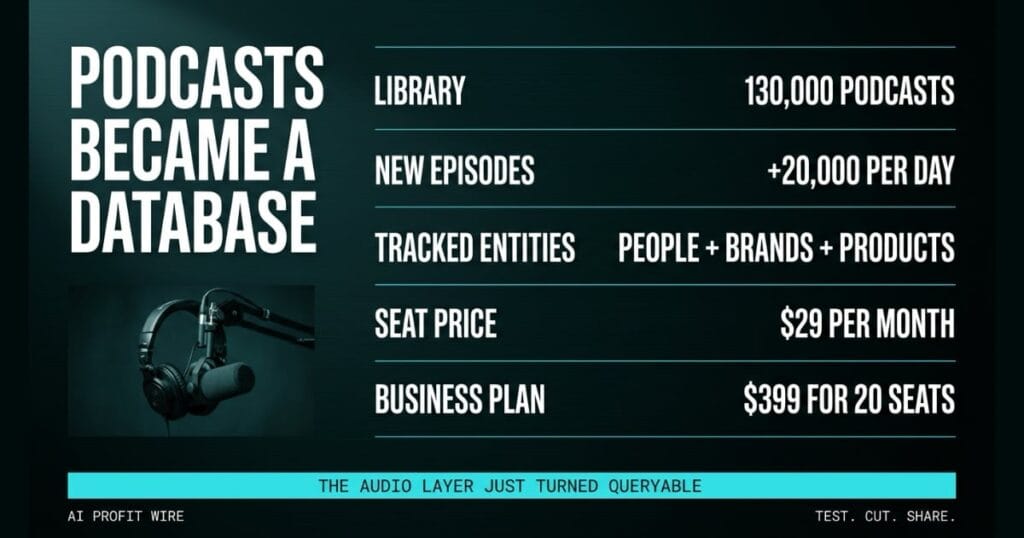
It transcribes more than 130,000 podcasts and understands what the audio means, pulling key quotes, highlights, and self-contained clips with timestamps. That library makes it the largest transcribed podcast service in existence, covering every Apple Top 200 show across 135 verticals.
The idea grew inside Particle’s own app, which used the underlying tech to surface podcast clips beside related news stories. Once AI agents started needing access to audio intelligence, the team spun the capability into a standalone product.
Beykpour’s longer pitch stretches past shows, toward all new media and audio intelligence flowing through one API as the catalog widens.
Radar turns 130,000-plus podcasts from forgotten audio into a queryable business database.
Does Radar actually make podcasts searchable?
Yes, and the intake rate backs the claim: 20,000 new episodes land in the index every day.
Transcriptions carry speaker labels and rich metadata, and the system understands the entities being discussed, people, companies, brands, products, and topics. Users track mentions and receive alerts the moment a name comes up, or batched as a daily or weekly digest.
Filters go deeper than keyword matching, so you can require a specific guest discussing a defined topic before anything fires at you. Searches narrow to top-tier shows only, and notable clips arrive pre-cut with timestamps so nobody scrubs through a 90-minute episode hunting one quote.
“Agents are generally blind to audio” until something transcribes it, CEO Sara Beykpour told TechCrunch, which is exactly the gap this index fills.
Pre-chosen clips serve readers who cannot hear a full episode and refuse a thin summary, in her framing, the fastest honest read on what a conversation actually contained.
The database answers who-said-what-about-whom questions that raw RSS feeds never could.
How is Radar different from other podcast monitoring tools?
Traditional monitors alert on keywords, while Radar tracks understood entities, episode ads, listener ratings and reviews, and chart rankings in one place.
Its dedicated ads search engine finds every episode where a given company advertises and charts how that sponsorship trends over time. Political bias analysis, audience size estimates, sponsorship data, and brand suitability scores round out the ledger.
The real flagship is programmatic: an API and MCP interface lets external AI agents query everything directly, and hedge funds already operate as the highest-volume API customers. Search platform Exa counts among its integration partners.
Competing monitors listen for words, and Radar prices meaning, ad flow, and momentum across the whole category.
Six weeks into a rival contractor’s new maintenance subscription plan, the owner of a 3-van HVAC outfit finally hears about it from a trade podcast playing in his truck. The reveal sits in episode 44 of a show he always meant to catch and never did.
20,000 new episodes land daily across the categories his customers and competitors talk in, and none of them arrive on a schedule he controls. Keeping up by ear means assigning payroll to playback, the least scalable research department ever invented.
Market moves that once surfaced through a customer’s offhand comment now sit indexed before lunch. The first quote usually sets the local price, and learning your own market’s news weeks late is expensive anywhere.
Who is Radar actually for?
Hedge funds pay the biggest bills as the highest-volume direct API customers hunting signals humans haven’t indexed, followed by journalists, researchers, and AI search builders.
The practical tier for owners is smaller but real: agencies watching client categories, newsletter publishers sourcing expert quotes with timestamps, e-commerce teams counting competitor ad frequency week over week. Anyone whose job involves briefing themselves or a client on who said what benefits first.
Casual listeners gain nothing here, and neither will businesses without $29 a month and a genuine monitoring habit to act on.
If competitors, guests, or ad trends shape your offers, Radar reads while you sell.
Is Radar worth $29 a month?
At $29 per seat monthly, one caught competitor announcement pays for several months of monitoring, assuming somebody acts on what arrives.
The $399-per-month business plan bundles 20 seats for teams splitting the listening load, and API access runs on custom pricing keyed to volume. Value hinges on response speed, so wire the Slack alerts into a channel a named person actually owns.
Particle’s stated roadmap extends the same engine to YouTube videos and news clips next, widening the net without raising the seat price yet. Early subscribers inherit indexing history as it accumulates month over month.
Publishers who act on tracked quotes then need audio assets of their own, and an AI voice synthesis tool covers that production gap before any hiring does.
Radar earns its keep the day its first alert changes one real decision.
Source: TechCrunch AI
