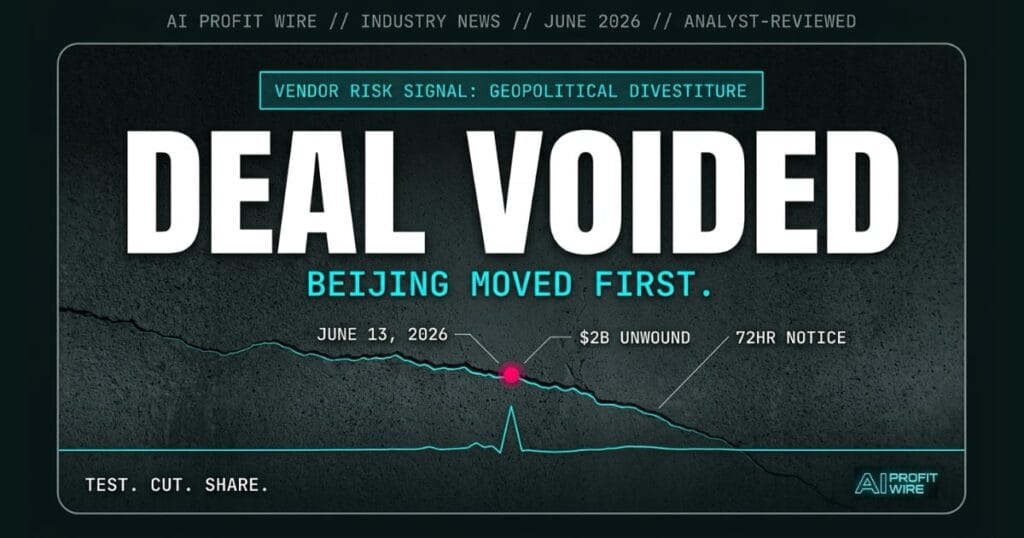
Signals rising geopolitical risks and regulatory unpredictability that can disrupt AI partnerships, supply chains, and cross-border investments, potentially limiting future tool access.
What is the Meta Manus divestiture and what changed?
Meta is actively dismantling its $2 billion acquisition of Chinese-founded AI startup Manus after Beijing issued a national security-driven divestiture order.
The operational separation is already underway as of June 13, 2026, with data sharing halted and Meta employees blocked from using Manus tools internally. Manus co-founders are in discussions to raise approximately $1 billion from outside investors to reclaim the company, with a potential restructure as a Chinese joint venture and a Hong Kong listing under consideration.
A $2 billion completed acquisition can be unwound in months when governments treat AI infrastructure as a national security asset rather than a commercial transaction.
What is the evidence behind the Meta Manus divestiture?
TechCrunch reported that Chinese regulators scrutinized the transaction earlier in 2026, citing concerns about technology export controls and foreign investment rules, which led to the formal divestiture demand.
Manus parent company Butterfly Effect had already relocated staff to Singapore in mid-2025 before the acquisition closed. Benchmark, a Manus investor, has already collected proceeds from the deal, while Asian investors are cooperating with Beijing’s order. China has separately expanded travel restrictions on AI researchers and introduced new approval requirements for U.S. investment in domestic AI firms including ByteDance, Moonshot AI, and StepFun, indicating a systemic regulatory posture rather than an isolated action.
The evidence shows coordinated bilateral regulatory escalation that makes cross-border AI ownership structurally unstable regardless of deal size or timeline.
How does the Meta Manus divestiture affect day-to-day operations for small businesses?
Small business owners relying on AI tools with development ties to jurisdictions under active technology export scrutiny face immediate vendor stability risks, including sudden API shutdowns, data access revocation, and forced ownership changes with no migration window.
The Manus case proves that even a completed, fully funded acquisition offers no operational continuity guarantee. A tool integrated last quarter can be legally severed from its parent company this quarter, leaving workflows dependent on that tool in a gap with no transition plan. Track how these ownership and regulatory shifts feed into operational risk at the live archive of AI vendor stability and platform signals here.
If your AI stack has a single-country dependency, you don’t have a vendor. You have an exposure.
A freight customs broker in Vancouver spent 14 months integrating his compliance verification platform into every stage of shipment clearance. The vendor was stable, the API was reliable, and the integration was tight enough that his team stopped thinking about it as a vendor relationship and started treating it as infrastructure. The platform’s parent company was flagged in a cross-border data audit on a Thursday afternoon. By Monday morning, access was suspended pending regulatory review, and the broker’s team spent 11 days clearing shipments manually while his developer rebuilt the compliance layer against a domestic alternative. The vendor did nothing wrong. The product worked exactly as sold. The failure mode was invisible right up until it wasn’t: a foreign-controlled API had become load-bearing infrastructure with no fallback, and no contract clause covers what a regulator decides to do next quarter. That’s the exact architecture the $2 billion Meta-Manus unwind is describing at enterprise scale.
What is the final verdict on the Meta Manus divestiture?
The forced unwinding of Meta’s $2 billion Manus acquisition is a definitive signal that AI vendor selection now requires geopolitical due diligence as standard practice, not as an edge case consideration.
Small business owners must treat single-source AI dependencies, particularly tools with ownership or development in jurisdictions with active technology export controls, as operational liabilities comparable to single-supplier manufacturing relationships. The collapse of this acquisition proves that no deal size, no brand backing, and no integration investment guarantees continuity when a government decides the asset is strategically sensitive.
Diversify your AI vendor geography now, or accept that your operations can be severed by regulatory action you can’t predict or influence.
Source: TechCrunch AI
