Fixing this reporting flaw prevents wasted sales and marketing efforts on dead leads and gives leadership an accurate view of true pipeline health.
What’s the HubSpot “updated in last X days” filter flaw and what changed?
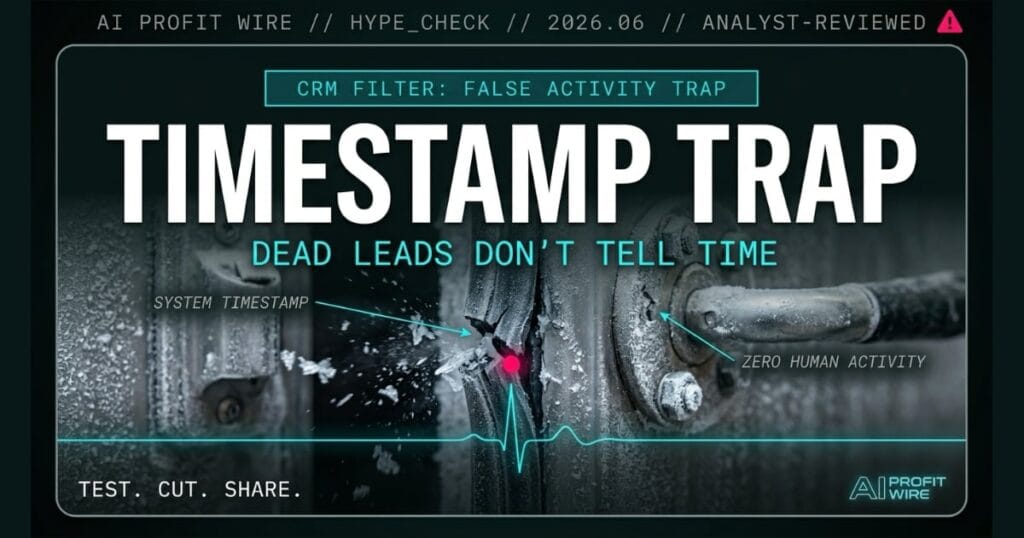
HubSpot’s widely used “updated in last X days” filter tracks system modification timestamps, not actual business activity.
A RevOps team found 31 of 47 “active” deals had no human activity in 14 days, only a bulk workflow reassignment. The filter counted that as an update.
This filter is designed for system tracking, not pipeline health, and using it for operational decisions builds reports on false data.
What’s the evidence behind the HubSpot modification timestamp problem?
HubSpot stores two data types: system-generated modification timestamps and explicit date values tied to business events.
The “updated in last X days” filter reads Last Modified Date, which resets on any field edit, integration sync, workflow trigger, or bulk import. A Salesforce sync to 500 contacts, a data enrichment push to 800 leads, or a CRM migration updating addresses all reset this timestamp without indicating human engagement.
The platform functions exactly as designed; the failure is in user assumption, not system error.
How does the HubSpot filter flaw affect day-to-day operations for small businesses?
Sales teams chase dead deals, marketing burns sends on warm-looking ghosts, and leadership makes decisions from inflated pipeline data.
A customer success manager missed 3 at-risk accounts because a migration pushed new address data, making every account appear recently updated. The true stalled deals sat invisible. For small businesses with limited sales and marketing capacity, this misdirection directly wastes the scarcest resource: focused attention on real opportunities. Browse our filtered archive of operational blind spots that quietly drain small business pipelines to catch similar traps before they cost you quarters.
Every hour spent on a false-positive lead is an hour not spent on revenue.
You check the reservation system and it shows 12 tables “active” for tonight. You walk the floor and 4 of those are holds from a corporate block that canceled yesterday, but the cancellation only updated the notes field, not the status. The system timestamp refreshed on all 12 when a software update pushed a new field to every record at 3 AM. Your host seats a walk-in at a table that’s actually reserved because the screen says it’s open. Your floor manager, the one who still keeps a paper chart because she stopped trusting the screen six months ago, catches it.
That gap between what the system reports and what’s physically true is The Phantom Workflow, and it operates identically inside HubSpot. The “updated in last X days” filter doesn’t measure human engagement. It measures system modification. A Salesforce sync, a workflow trigger, a bulk import, all reset the timestamp without a single human touching the record. The RevOps team in this signal found 31 of 47 “active” deals were ghosts. Your competitor, filtering on “Last Activity Date,” found her ghosts first and called the real prospects before you knew they existed.
What’s the final verdict on the HubSpot “updated in last X days” filter flaw?
Replace modification-based filters with explicit date property filters for every operational report.
Use “Last Activity Date” for deal health, “Last Contacted” for sales engagement, “Close Date” or “Deal Stage entered” for pipeline movement, and “Last Marketing Email Click Date” or “Recent Conversion Date” for marketing engagement. Build a documented “True Inactivity” view and test new reports against known records before trusting them.
CRM data is only as good as the logic you build inside it, and bad logic costs you trust, time, and closed deals.
Source: ATAK Interactive
