Reduces operational costs by automating repetitive GUI-based tasks (CRM, spreadsheets, browser workflows) with high privacy and low latency.
What did Holo3.1 just launch?
Holo3.1 is a suite of open-source AI agents designed for local computer and mobile app operation. The release includes models ranging from 0.8B to 35B parameters to fit different hardware profiles. These weights are available on Hugging Face for immediate deployment. Local execution eliminates the need to send sensitive business data to cloud providers, cutting both latency and security risks.
Does local execution actually work for business tasks?
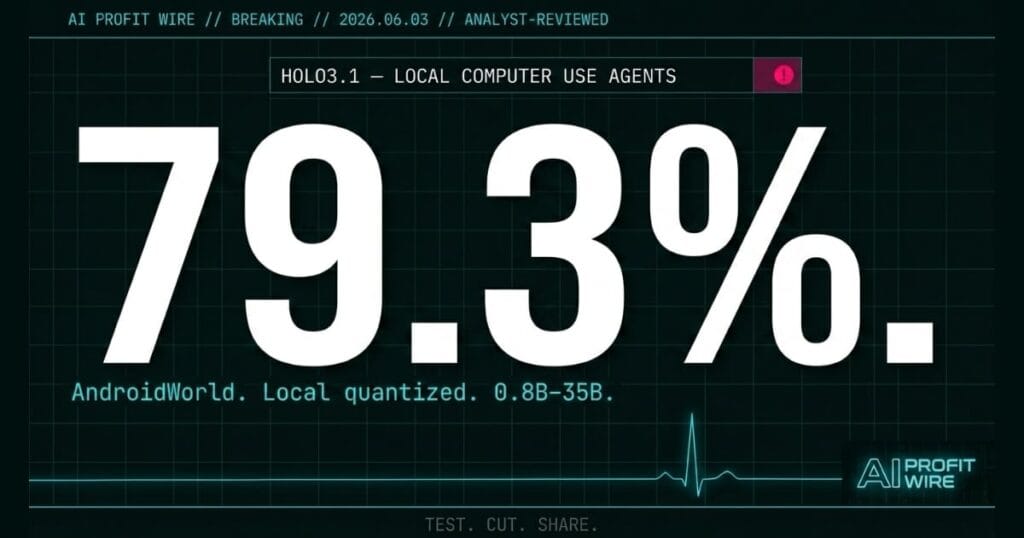
Benchmarks show Holo3.1 reaches 79.3% accuracy on AndroidWorld and shows significant gains in OSWorld. Quantized versions allow these models to run on standard consumer GPUs without specialized enterprise clusters. This allows for high-speed interaction with local OS elements. The gap between cloud-based agents and local performance is closing fast enough to make private automation viable.
Should small business owners care about Holo3.1?
Local agents can automate repetitive GUI-based tasks in CRMs and spreadsheets without external API costs. This shift reduces the cost per exception for fragile workflows that previously required human oversight. Check other local AI signals to see how this fits the broader trend. Running automation on your own hardware turns a recurring SaaS cost into a fixed infrastructure asset.
Exact Founder Execution Steps
1. Access the Holo3.1 weights on Hugging Face.
2. Select a model size (0.8B to 35B) based on available VRAM.
3. Deploy quantized versions for faster execution on consumer hardware.
4. Test on specific GUI workflows like CRM data entry or browser-based reporting.
Too many AI vendor announcements are “coming soon” whitepapers from vendors who only want a deposit. The weights need to be on the machine, not a polished video of a demo environment that crashes the moment a real API call hits it. When you can pull the model from Hugging Face and run it locally, the marketing fluff dies and the actual benchmark takes over. I will trust the latency numbers on my own GPU before I sign another 12-month contract for a cloud agent that hallucinates every 5th click.
What’s the move on Holo3.1?
Deploy Holo3.1 on a local test machine to automate 1 or 2 high-volume GUI tasks. Focus on workflows where data privacy is a non-negotiable requirement. This avoids the risk of data leaks during the automation process. Audit your current cloud agent spend and move the highest-latency tasks to local hardware.
Source: Hugging Face
