Potential for increased compute costs or limited access to high-end AI tools for smaller businesses if energy constraints manifest.
What is AI rationing and why does it matter now?
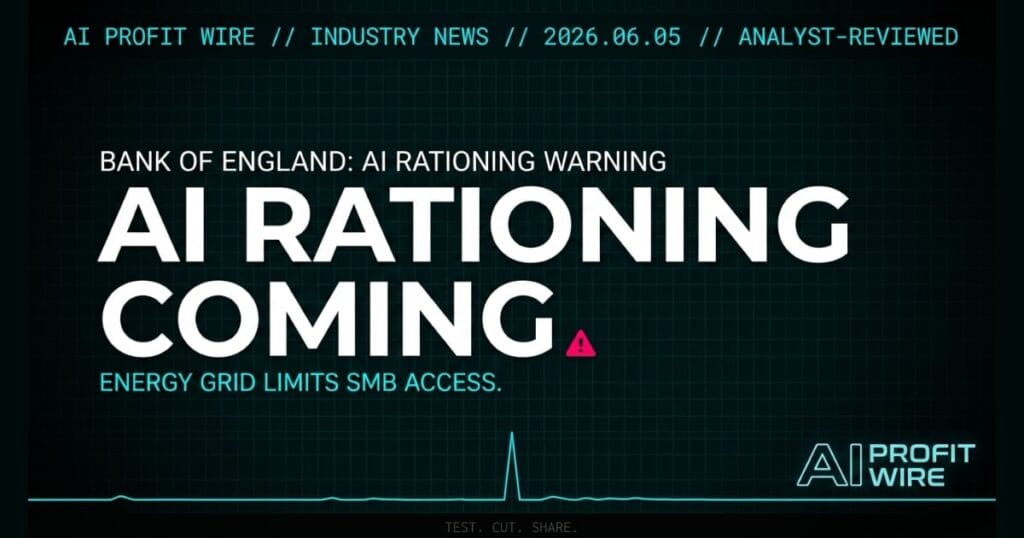
AI rationing is the forced limitation of compute access due to energy shortages. Energy grids are failing to scale at the pace of data center demand, which forces providers to prioritize specific users. Access isn’t a given when the grid fails.
What proof backs this signal?
The Governor of the Bank of England, Andrew Bailey, issued a warning that capacity limits will lead to rationing. This comes from a recognized global economic authority monitoring the intersection of infrastructure and technology. When the Governor of the Bank of England warns of rationing, it’s an economic reality, not a theory.
Should small business owners care about AI rationing?
Small businesses face the highest risk of being throttled during energy spikes. Large enterprises can negotiate guaranteed capacity in their contracts, but SMBs rely on standard API tiers that are easiest to restrict. Infrastructure risk signals like this, where compute availability directly affects SMB access and cost, show up regularly in the AI Profit Wire signals. The risk is that SMBs get priced out of high-reasoning models during peak energy demand.
A regional capacity event hit one of the APIs in our pipeline for about four hours earlier this year. Unannounced. The workflow didn’t crash cleanly. It queued, partially retried, and left a batch of half-processed items with no visible error state, just silence until I spotted the gap the next morning and ran a manual cleanup pass. That’s what rationing looks like in practice: not a hard shutdown, a quiet degradation that doesn’t announce itself until you’re already dealing with the fallout. A stack built on a single provider has no defense against that. Distributing critical workloads across at least two providers isn’t redundancy as a luxury. It’s the minimum viable architecture for what’s coming.
Should you act on this signal now?
Diversify your model stack to avoid a single point of failure. Relying on one provider for all high-reasoning tasks creates a vulnerability if that provider’s specific region hits a capacity limit. Distribute your critical workloads across 3 different providers to mitigate the impact of regional energy rationing.
Source: Bloomberg Tech
