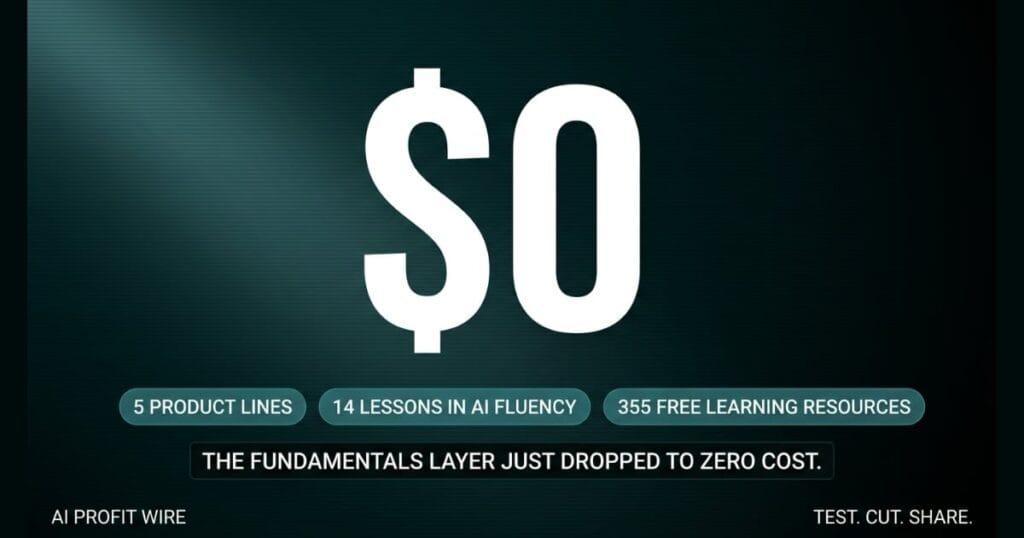
Lowers the barrier to AI adoption and removes training costs for SMB teams.
What is Anthropic Claude Academy?
Anthropic launched Claude Academy, a free public library of courses, tutorials, and job-specific guides that teach users how to use Claude across its full product surface.
The Academy is organized around five Claude product lines: Claude.ai, Claude Cowork, Claude Code, Claude Tag, and Claude Platform, plus an AI Fluency framework course built on the 4D model of Delegation, Description, Discernment, and Diligence.
Every resource is free and open to anyone, with no paywall and no team-size minimum.
Anthropic turned professional AI training into a free public resource.
Do the Anthropic Claude courses actually work for a small team?
The courses are written by the people who built the model, so the instructions match the actual product behavior rather than a third-party summary of it.
The AI Fluency framework alone runs a 14-lesson course with a quiz, clocked at roughly 4 hours, plus a shorter 13-lesson companion course at 3.5 hours.
The framework rests on the 4D model: Delegation (what to hand to AI), Description (how to specify the task), Discernment (how to judge the output), and Diligence (how to govern the workflow), which gives the whole team a shared vocabulary.
Independent course catalogs including TermDock and SpectrumAIlab index Claude Academy at 13 to 22 courses and 355 free learning resources total.
The Academy is organized around five Claude product lines: Claude.ai for chat and analysis, Claude Cowork for handing off whole tasks, Claude Code for building in the terminal and IDE, Claude Tag for channel-based team work, and Claude Platform for API and MCP integration.
Each track ships with a free certificate on completion, which means a small business owner can verify team progress without paying for a third-party credential, and the full library pairs naturally with the broader free AI training signals a founder can pull into onboarding every quarter.
Official courses eliminate the guesswork and variance in team AI performance.
Should you use Anthropic training instead of paying for AI consultants?
For foundational prompt engineering and product onboarding, the free official courses replace the need for an external consultant running a generic workshop.
The value of a generic prompt workshop collapses when the model vendor gives the same material away, because the vendor’s version is the source of truth rather than a third-party interpretation.
For a small team, the framework also resolves a common operational fight: who decides what good AI use looks like. With a vendor-published 4D model, the answer stops being the loudest person in the room and starts being a shared standard the whole team can point to.
Custom architecture and high-level deployment still warrant an expert, but the foundational training layer no longer carries a price tag.
The cost of foundational AI training dropped to zero.
A new hire walks in on her first Monday and is told the team uses Claude for first-draft research, Claude Code for shipping internal tools, and Claude Tag for shared channel work. She does not guess, she does not watch a 45-minute YouTube explainer from a third party, she walks through the three corresponding Academy tracks before lunch and is running real work by the afternoon.
The operational shift is not about saving the cost of a consultant. It is about removing the variance where five hires on the same team use the same model five different ways, and only two of those ways actually match how the model is designed to be used.
The Academy tracks standardize the use before the team ever builds a habit around the wrong workflow.
How do you integrate Claude Academy into a small business workflow?
Map each Academy track to a real role on the team: Claude.ai for analysts who draft and summarize, Claude Cowork for ops leads who hand off whole tasks, Claude Code for the in-house builder, Claude Tag for the team channel, Claude Platform for whoever ships the API integration.
Assign the AI Fluency framework to every new hire as the first 4 hours of onboarding, so the entire team speaks the same vocabulary about delegation, description, discernment, and diligence.
The 4D model is the operational spine of the framework, and it maps directly to the four failure modes that show up when a team uses AI without training: under-delegation, vague description, blind trust, and no governance.
Reassign the consultant budget to custom architecture work, where the free courses stop and the expert still matters.
Assign by role, standardize onboarding, and move the consultant budget upstream.
Is official Anthropic training better than third-party AI courses?
Yes, for the foundational layer, because the official courses reflect the model’s actual behavior instead of a third-party guess at it.
Third-party courses still matter for vertical-specific deployment patterns the Academy does not cover, but the fundamentals are now better sourced from Anthropic directly.
Start with the 4-hour AI Fluency framework as the single shared baseline across the team, then layer the product-specific tracks on top.
Use the official Academy for foundations, keep third-party courses only for vertical depth.
Source: Claude Academy
