Reduces overhead by replacing expensive finance analyst roles with AI, directly cutting labor costs for data processing tasks.
What is AI-driven white-collar displacement in London and what changed?
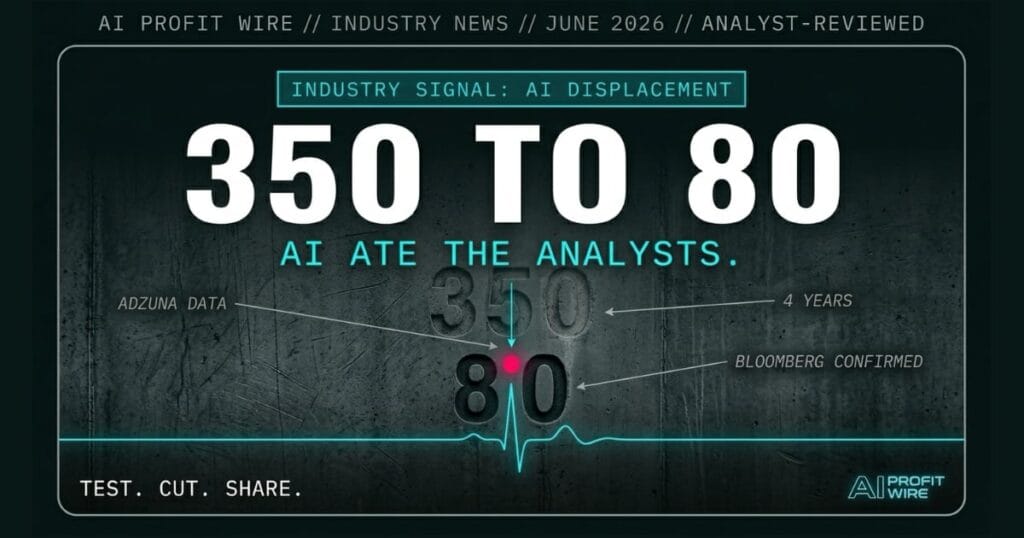
Finance analyst job vacancies in London fell from more than 350 to around 80 on Adzuna, a major UK recruitment website, over the past four years, and Bloomberg names the role explicitly as one of the main victims of artificial intelligence.
Bloomberg’s reporting confirms that London is ground zero for a broader white-collar AI displacement shift affecting not just finance analysts but also coders, lawyers, and consultants across the city, with the Adzuna data providing a measurable, four-year vacancy collapse rather than a forward-looking projection.
This isn’t a forecast. It’s a documented, category-level collapse in white-collar demand driven by AI adoption at institutional scale, with the data already four years deep.
What is the evidence behind London’s AI-driven finance analyst vacancy collapse?
The Adzuna recruitment data, cited directly by Bloomberg, shows finance analyst listings dropped from more than 350 to around 80 over four years, a decline Bloomberg attributes to artificial intelligence rather than broader economic contraction or offshoring.
Standard Chartered is cutting approximately 8,000 roles citing AI-driven efficiencies, and HSBC is considering eliminating around 20,000 jobs as AI takes over middle and back-office functions. Bloomberg’s analysis covers coders, lawyers, and consultants as additional categories showing steep vacancy declines across London, which means the displacement is not sector-specific but structural across white-collar work. You can track AI labor displacement signals as they clear the pipeline at the live archive of analyst-reviewed workforce and automation signals here.
When two of the world’s largest banks are publicly executing five-figure headcount reductions on AI grounds, the Bloomberg vacancy data isn’t a prediction. It’s a confirmation of what’s already in motion.
How does AI-driven white-collar displacement affect day-to-day operations for small businesses?
Small business owners who depend on analysis, research, or reporting headcount now face a cost floor being set by competitors who have already replaced those roles with AI systems running at a fraction of the salary cost.
A finance analyst seat runs between $60,000 and $80,000 annually for data processing, model building, and reporting work that AI systems now handle at a fraction of that cost. The 350-to-80 vacancy collapse in London is not a London problem: it’s a preview of what happens when AI adoption in back-office functions reaches critical mass in any professional services economy, and the institutional-scale decisions at Standard Chartered and HSBC confirm the timeline is already executing, not approaching.
Small businesses that delay replacing analysis headcount with AI systems aren’t preserving quality. They’re subsidizing a cost structure their competitors are actively dismantling.
A proposal sits in a client’s inbox: 3 days of senior analyst time at $275 per hour, $6,600 total for a financial modeling engagement at a boutique accounting firm in Hamilton. The competing bid that arrives the same afternoon is $1,400 for the same deliverable. The partner assumes the competitor is discounting to win the work. She finds out two weeks later that the competing firm automated the entire first-pass model build with an AI system and charges the analyst only for interpretation and client presentation. No headcount was cut. The billable ratio of human-to-machine time per engagement simply changed, and that ratio rewrote the cost floor. The 350-to-80 vacancy data in London is the aggregate measurement of what happens when enough firms make that same shift: the senior analyst doesn’t disappear, but the number of them required to close the same revenue compresses until fewer seats cover the same volume of work.
What is the final verdict on AI-driven white-collar displacement?
The Bloomberg and Adzuna data confirms that AI displacement of white-collar roles is already measurable at scale, with finance analysts as the most documented category, London as the most reported geography, and institutional-level evidence from Standard Chartered and HSBC confirming the shift is executing at the largest organizations first.
Small businesses in professional services are not insulated by size. They compete on cost structure against firms that have already made the automation decision, and the 350-to-80 vacancy collapse is the data footprint of that competitive shift happening in real time.
Audit your back-office roles for AI replaceability now, before a competitor’s lower cost floor sets the pricing standard in your market.
Source: Bloomberg Tech
