Reduces hiring risk and time wasted on unqualified candidates who use AI to game the application process.
What is AI resume screening and what changed?
AI resume screening is the practice of evaluating candidates based on resumes generated or polished by large language models, which has changed how employers approach hiring in 2026.
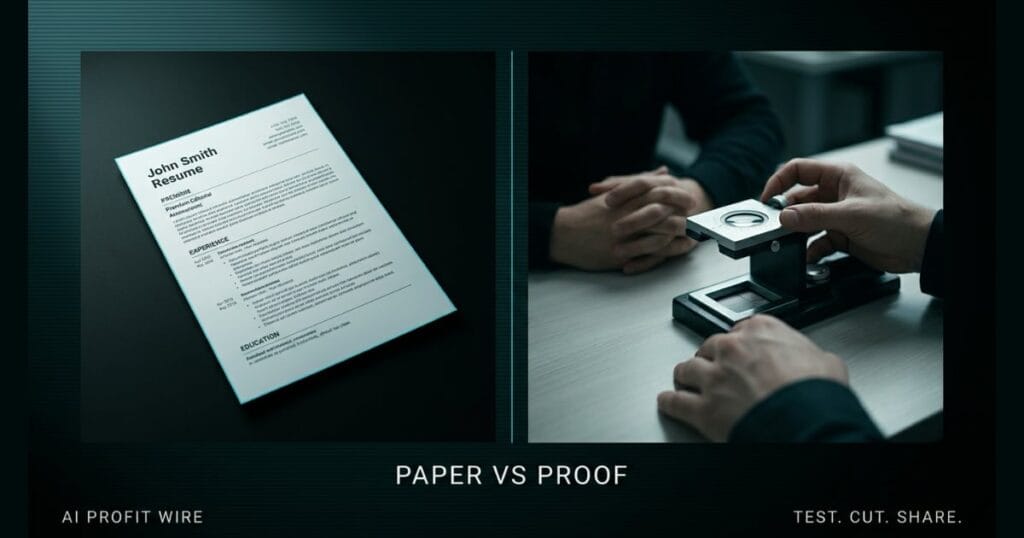
Bloomberg reports that companies are now retreating from the polished PDF toward analog verification methods, which include networking, live assessments, and phone calls.
The shift marks a return to direct human verification, where a candidate’s actual ability is tested through real-time work rather than paper credentials.
Employers are abandoning the AI-perfect resume for live proof of work.
What is the evidence behind AI resume screening?
Bloomberg’s “AI Today” newsletter, published on August 24, 2026 by Maya Thompson, confirms that employers are prioritizing networking, live assessments, and phone calls over AI-generated application materials.
The article reports that companies are on a quest to find real candidates in the age of AI resumes, where perfectly optimized documents no longer reflect real-world skills.
A companion Bloomberg piece published the same day confirms the same shift, where live tests, networking, and recommendations are now the standard evaluation methods.
External data backs the trend: a February 2026 Resume survey cited by KraftCV found that 49% of hiring managers automatically dismiss resumes they suspect were AI-generated.
LockedIn AI reports that 87% of companies use AI to filter resumes, and 75% of resumes never reach a recruiter, which means the AI noise cuts both ways.
The Bloomberg reporting is confirmed by independent survey data across the hiring market.
How does AI resume screening compare to the alternatives, and what background do small business owners need?
The alternative to AI resume screening is the live assessment model, which tests a candidate’s actual ability in real time through working interviews, skill tests, and direct conversation.
Networking serves as a trust layer, where referrals from existing employees or industry contacts filter out candidates who look good on paper but cannot perform the work.
Phone calls cut through the AI-polish by forcing a candidate to think out loud, which reveals gaps that a written document can hide.
The Hiring Trends Report 2026 found that 10% of employers have largely replaced resumes with skills-based and scenario-driven assessments, and 42% have added more assessments in the past year.
DPI Staffing reports that 71% of candidates now use AI tools to create or edit their resumes, which is the supply-side pressure driving employers back to live verification.
Live assessments, networking, and phone calls now form the verification stack that replaces the resume screen.
A stack of AI-polished resumes lands on the print shop owner’s desk for a single press operator opening. Each one reads like a master craftsman wrote it, with pristine typography and flawless phrasing. None of them mention the same plate-loading technique or the same ink-mixing ratio.
The owner brings candidates in for a working press test, which is the only way to see who can register a 4-color job without tripping the emergency stop. Bloomberg reports the same shift happening across the broader market, where employers are prioritizing networking, live assessments, and phone calls over PDF perfection.
The cost of a bad hire shows up in wasted stock, missed deadlines, and a client who takes their next print job elsewhere. The Bloomberg shift toward live assessments is the only operational hedge against an AI-resume market that no longer rewards the polished PDF.
How does AI resume screening affect day-to-day operations for small businesses?
Small business owners must redesign their hiring funnel around live verification, which means the application phase loses value and the verification phase gains it.
The first filter becomes a working interview, a referral check, or a phone screen, which cuts hours of resume review out of the weekly schedule.
The 49% rejection rate from the Resume survey means owners who still rely on PDFs are spending time on candidates who would not pass a basic live test.
Owners who want broader context on AI signals reshaping small business operations can follow the live signals coverage at Metadata Marketer for ongoing updates on hiring, automation, and verification shifts.
The hiring funnel now starts with verification, not application.
What is the final verdict on AI resume screening?
The AI resume is now a liability for any hiring process that stops at the PDF, which means small business owners must invest in live verification before extending an offer.
Bloomberg’s reporting confirms that the market is moving toward networking, live assessments, and phone calls, which puts the burden of proof back on the candidate.
The cost of skipping this step is a bad hire, which is more expensive than a working interview ever will be, and 71% of the candidate pool is now using AI to polish their applications.
Stop trusting the AI resume, and start testing the candidate live.
Source: Bloomberg Tech
