Potential future labor cost savings through automated long-running administrative and operational tasks.
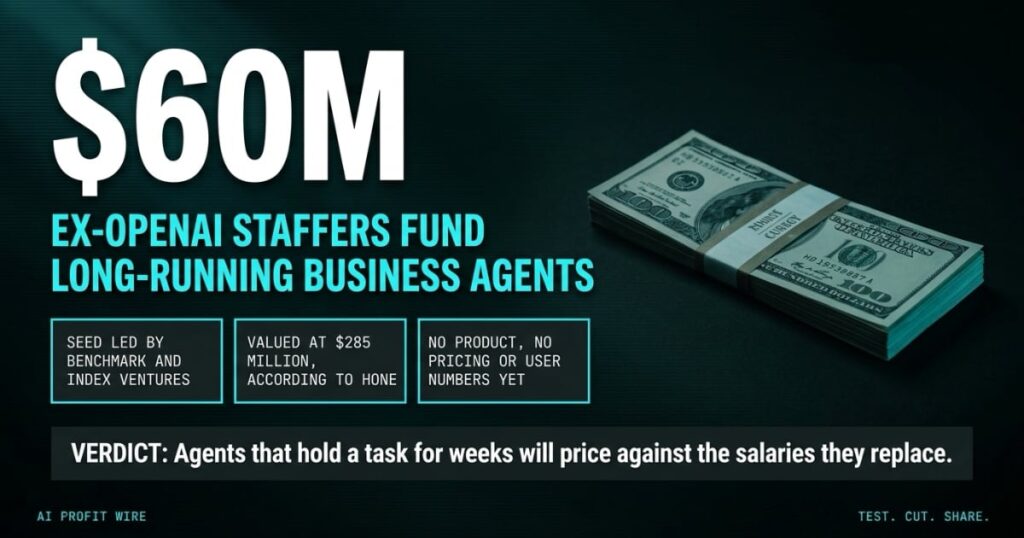
Hone, a 5-month-old startup founded by former staffers of OpenAI and Cognition AI, raised a $60 million seed round led by Benchmark and Index Ventures at a $285 million valuation. The company is building what it calls engines: AI agents that hold business tasks open for weeks or months.
How Much Did Hone Raise?
Hone raised a $60 million seed round led by Benchmark and Index Ventures, announced Thursday and reported by Bloomberg, with the company valuing itself at $285 million.
Chief executive Moritz Stephan, previously chief of staff at Cognition, told Bloomberg the company is building AI that owns outcomes. Index partner Shardul Shah and Benchmark partner Peter Fenton both joined the board, and Cognition chief executive Scott Wu is a personal investor.
A $60 million seed at a $285 million valuation is a bet on headcount economics.
What Does Hone AI Actually Do?
Hone’s engines are persistent agents assigned an outcome rather than a task, and they stay on that outcome after the conversation ends. The company’s announcement describes engines that onboard themselves into a role, build a model of what good looks like in the organization, and improve with tenure, with the company’s ultimate measure being the profit and loss statement.
Bloomberg’s reporting describes agents that field long-running tasks over the course of weeks or even months, which is the duration that separates an engine from a chatbot that closes a request in seconds. Early customers include Cognition and Modal, 2 technical teams capable of judging the claims.
What Hone does not have yet is equally specific: Bloomberg notes the company has released no product, no pricing and no user numbers. The Economic Times’ report adds the same detail set: 5 months old, early customers named, valuation per the company.
Today’s evidence is a design document backed by $60 million.
How Are Hone’s Engines Different From Chatbots?
A chatbot answers when prompted and stops when the session ends, which keeps it in the software budget line.
An engine that carries a task across weeks competes with a salary line instead, because the work it targets is the follow-up and coordination load companies staff with people today. Shah framed the ambition on the record: what Cognition is to software development, Hone can be to every other function in an organization.
The pricing will eventually reflect that comparison, and Fenton told Bloomberg the company is working on guardrails to protect customers from agents going rogue, calling the needed protections appropriate immune systems.
The difference lands in the budget, and every buyer should price it that way from day 1.
The follow-up email sits in the drafts folder for the 9th day, the vendor still has not confirmed the delivery window, and the one person who remembers the promise is the one who wrote it. That folder of open loops is the work nobody schedules and everybody pays for, because it rides inside a salary until someone adds it up.
Hone is betting $60 million that an engine can hold those loops open for weeks without dropping them, and the $285 million valuation says Benchmark and Index agree. Whether the bet pays off is a question about trust: an engine that owns an outcome is either the coordinator you stop chasing or another system you check twice.
The open loops already have a price. It hides inside the payroll line.
What Does the Hone Round Mean for Your Hiring Plans?
If the engine model works, the first roles it targets are the ones built on follow-up: coordination, vendor management, project chase, the work that keeps a task alive across weeks.
Bloomberg notes Hone joins a crowded field of AI services chasing business work, so the bet rests on execution and duration rather than on the idea itself. The valuation buys the company time to prove duration is a product feature and not a demo trick.
For a hiring plan, the practical read is that a slice of coordination labor is about to get a software price, and buyers who know which slice will negotiate from data instead of a demo.
Map the follow-up work now, because it is the line item this category is coming to price.
What Should You Do About Hone’s AI Engines Now?
Inventory, not adoption: list the tasks in your business that stay open longer than 2 weeks, because that list is what this class of agent will be priced against.
Watch what the first customers report, since Cognition and Modal both run technical teams able to judge the claims, and their results will land long before any marketing claim could. Guardrails, per Fenton’s own comments, are already a board-level topic.
For a wider view of where the money is moving, we log every AI raise that touches small teams, and Hone’s is the newest entry.
Write the list of long-running tasks now, and you will know within a quarter whether an engine deserves a salary conversation.
Source: Bloomberg Tech
