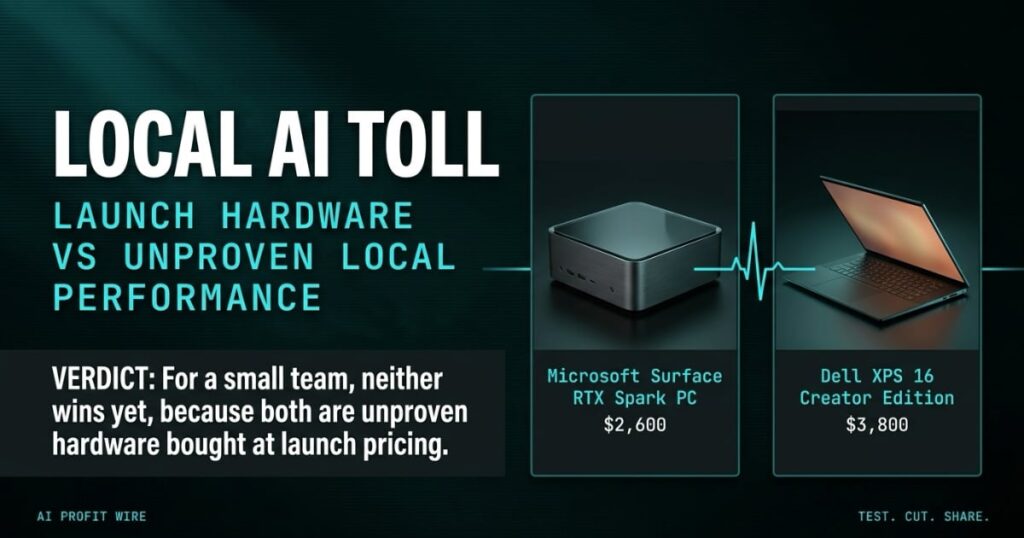
High upfront hardware costs make this targeted at specialized developers rather than general small business operations right now.
Microsoft revealed full specs and pricing for its new Nvidia-powered AI PCs on Wednesday, and the line has a name: the Surface Laptop Ultra. According to TechCrunch, the machines are built on Nvidia’s RTX Spark chip and designed to run AI models and agents locally on the device instead of in the cloud. The announcement landed at a San Francisco event during the city’s Tech Week, and it fills in the details behind the agreements Nvidia announced with Microsoft and other PC makers back in June.
What are Microsoft’s Nvidia RTX Spark AI PCs?
The Surface Laptop Ultra comes in 2 base models, one starting at $2,600 and one with a more powerful chip starting at $3,700, and prices climb to $5,900 with added memory and storage. Microsoft says the highest-end device is already out of stock, which is its own demand signal. The full spec sheet and configurator live on the official Surface Laptop Ultra page.
Microsoft also revealed the Surface RTX Spark Dev Box, a workstation on the same chip that starts at $6,000 and ships with Microsoft dev tools like VS Code, GitHub Copilot CLI, WSL and PowerShell 7. This is Microsoft’s first full spec and price reveal for the Nvidia AI PC partnership announced in June, and the pricing puts it in developer territory from the first configuration.
Does local AI actually work on Microsoft RTX Spark PCs?
That is the core pitch, and Microsoft says the CPU, GPU, unified memory and upgraded cooling in these machines are built specifically to handle local model workloads at no per-use charge. No independent performance benchmarks exist yet, so every capability claim in this launch comes from Microsoft itself, including the promise that the graphics hardware also handles content creation, video processing and gaming. The machines run a revamped Windows 11 that includes Execution Containers, a feature Microsoft says makes it easier to sandbox AI agents, and Nadella confirmed it will reach all Windows 11 users.
Nadella framed the strategy around orchestration: a model alone does not do much, and Windows will provide the layer combining multiple models, context, memory and an action space for anyone’s agent, not only Microsoft’s apps. The local-AI claim is plausible on this hardware, and it stays unverified until third-party benchmarks land.
Microsoft Surface Laptop Ultra vs Dell XPS 16 Creator Edition: which is the better buy?
On price alone, Microsoft’s $2,600 base model undercuts Dell’s XPS 16 Creator Edition, which Dell priced at $3,800 for Best Buy preorder with delivery later in October. Both machines run the same Nvidia RTX Spark chip family, so the honest comparison is configuration and bundle: Dell’s blog lists up to 128GB of unified memory and a studio-class OLED display in a 0.7-inch chassis, while Microsoft counters with the developer toolchain on the Dev Box and a trade-in offer worth up to $1,000 for MacBook Pro owners. Neither machine has independent benchmark data behind it yet, which makes a spec-sheet comparison the only honest one available.
The trade-in offer is the tell about who Microsoft is chasing, because buying out MacBooks is a move aimed at developers, not front offices. For a small team, neither wins yet, because both are unproven hardware bought at launch pricing.
Who are Microsoft’s RTX Spark AI PCs actually for?
Developers running heavy local workloads, and Microsoft barely pretends otherwise: the $6,000 Dev Box ships with a coding toolchain, and the MacBook Pro trade-in targets the crowd building agents daily. The free on-device inference only pays off if your team runs models constantly enough that API bills exceed the hardware cost over the machine’s useful life, and a business that prompts a model a few dozen times a day never crosses that line. The part of this launch that touches a general small business is Execution Containers arriving free for all Windows 11 users, because sandboxing agents at the OS level lowers the risk of letting an agent touch real files and workflows.
The supplier invoice lands on the front desk of a small business, and the manager reads it twice: $2,600 for a single workstation before the memory upgrades that push it toward $5,900, against a metered cloud setup that processes every task for a fraction of that per month. The rep’s pitch sounds familiar, and it always does: buy the machine once and stop paying per use. But this business runs a handful of agent calls a day, the math never flips at that volume, and the machine would sit there depreciating while the cloud bill it replaced stayed small.
Run the same math on your own desk before the launch pricing tempts you. Pull the last 3 months of AI and cloud compute spend, put it next to $2,600 per seat plus the overhead of owning hardware, and let the numbers name the buyer. If your team is not building or running agents all day, the metered bill is almost certainly the smaller number.
Is Microsoft’s $2,600 Surface AI PC worth it now?
For most small businesses the answer today is no, because the machine is priced and bundled for developers and the local performance claims are unverified at launch. The disciplined version of this purchase starts with your own usage data: current per-model API rates live in the AI API pricing tracker, and your last 3 months of spend tells you whether on-device inference would save or cost money. Watch the Execution Containers rollout regardless, because free agent sandboxing in Windows 11 changes what you can safely delegate to an agent on the hardware you already own.
Revisit the question when independent benchmarks land and the launch premium burns off, which is usually 2 quarters in this market. Let the benchmarks and your own API bill make the case, and keep the $2,600 in the budget until one of them does.
Source: TechCrunch AI
