Helps small business owners quickly verify the authenticity of media files, protecting against deepfakes and misleading content.
Google launched a public website on Tuesday that lets anyone check whether an image, video or audio clip was generated by AI using its SynthID watermarking technology, according to TechCrunch. The tool was available to select journalists, media professionals and researchers for testing at Google I/O last year, and it is now open to everyone at no cost. For a small business owner, this moves media verification from a paid service to a browser tab.
What is Google SynthID and what does it do?
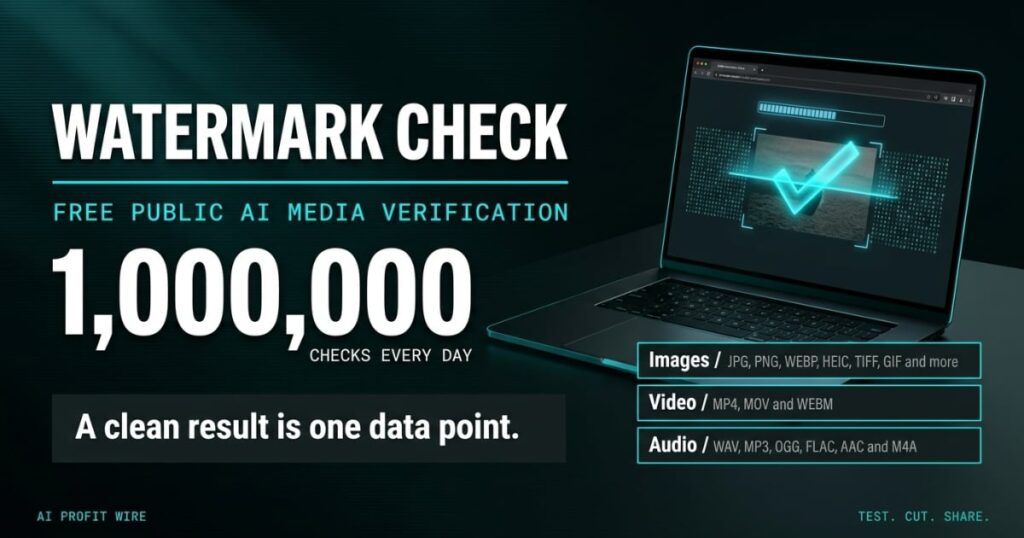
SynthID is the watermarking system Google introduced in 2023, and the new site is its public checkpoint. It supports a wide range of formats: JPG, JPEG, PNG, BMP, WEBP, AVIF, HEIC, HEIF, TIFF, TIF and GIF for images; MP4, MOV and WEBM for video; and WAV, MP3, OGG, FLAC, AAC and M4A for audio, which adds up to 20 formats across the 3 media types. You can run a check yourself at Google’s SynthID detector site without an account.
The check is also baked into the Gemini app and Chrome, so verification sits where the media already arrives. SynthID is now a free, public checkpoint for any media file that crosses your desk.
How accurate is Google SynthID?
It works within a defined boundary: SynthID detects media that carries a watermark embedded at generation time by tools that support the standard. Google’s own Nano Banana, Veo and Lyria models watermark their output, as do Gemini, Flow, ProducerAI and Vids, and the mechanics of that watermarking are documented on Google DeepMind’s SynthID page. OpenAI, Nvidia and Kakao also support SynthID, with Apple reportedly adding support soon.
The system is not infallible, and Google says so through the boundary itself: a file generated outside the SynthID system carries no watermark to find, so a clean result means no SynthID watermark was detected, never that the media is genuine. Microsoft and Meta run their own watermarking standards, and TechCrunch notes these tools often fail to identify content created by their makers’ models. Treat SynthID as a strong filter for watermarked content and a weak one for everything else.
Should you use Google SynthID instead of paying for verification?
For a first-pass check at zero cost, yes, although it answers a narrower question than paid forensic tools. The scale is notable: Google says people already make 1 million verification requests every day, and OpenAI maintains its own verification site for content from its models, so the free layer keeps widening. Paid detection services attempt to flag AI content regardless of origin, which SynthID does not claim to do.
If your exposure is to fakes built on mainstream tools from Google, OpenAI or Nvidia, the free check covers a large share of that risk. If your exposure is a determined attacker using a non-watermarked generator, no free checker catches it. Use SynthID as your first check, with paid forensics reserved for high-stakes disputes.
Who should use Google SynthID?
Anyone whose business decisions depend on trusting a media file: payment approvals by voice note, damage claims by video or product photos from a new supplier. The fit is strongest for teams that currently have no verification step, because adding one takes minutes and the tool is free and browser-based. Standards like this multiply fast, and every free verification launch gets logged in the wire’s daily signal feed as it breaks, which is faster than most approval workflows have adapted.
It is weakest where the stakes are highest: a determined attacker using a non-watermarked generator will pass the check. High-value transactions still need a human confirmation step on a second channel. Use SynthID as a default screening layer, never as the only control on money movement.
The payment approval lands as a voice note from a supplier you have paid for years, and it references the exact invoice number from this morning’s email. Nothing about it looks wrong, and that is the point. A free check that processes 1 million requests a day now exists for that moment, and it takes seconds.
Nothing in that scene gets solved by instinct. The supplier’s voice, the invoice number and the urgency are all reproducible now, and the honest question is whether your approval flow has any checkpoint at all between the file and the bank transfer.
What should you do about Google SynthID now?
Start with SynthID today because it is free and fast, then decide if your risk profile justifies more. Wire it into the workflows where media triggers action: refund approvals, supplier onboarding and payment change requests, and check any file that can move money before the money moves.
Keep the caveat attached: SynthID confirms watermarked AI content, and absence of a watermark is not proof of authenticity. For disputes above a threshold that matters to your business, escalate to a second verification channel. Adopt SynthID as your free default check and keep human confirmation on anything that moves real money.
Source: TechCrunch AI
