Gives AWS-built agent teams a stronger coding model with a 500K context window, at a token cost that needs deliberate effort-level management.
What Is Grok 4.7 on Amazon Bedrock?
Grok 4.7 is xAI’s frontier model for coding, long-running agents, and knowledge work, and it is now in the Amazon Bedrock catalog. It brings a 500K token context window and four configurable reasoning effort levels: low, medium, high, and xhigh.
Access runs through cross-Region inference profiles on the bedrock-runtime endpoint, under the model IDs us.xai.grok-4.7 and global.xai.grok-4.7. The model supports the Responses, Chat Completions, and Converse APIs, and because it is OpenAI-compatible, existing OpenAI SDK integrations port with a base URL change.
xAI positions it as its most capable model for coding and knowledge work, with a theme of endurance rather than raw speed: the model works longer on difficult tasks and verifies its own output before moving on.
Grok 4.7 puts a 500K-context reasoning model inside existing AWS infrastructure.
How Good Is Grok 4.7 at Coding?
Independent testing puts it ahead of Grok 4.6, with the strongest gains on long-horizon agentic work and coding run in xAI’s own harness.
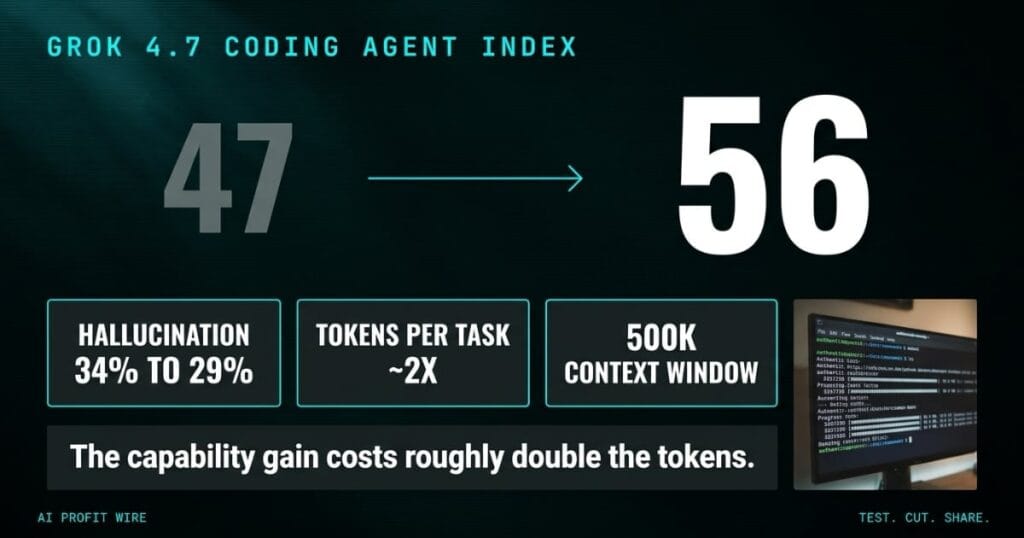
Artificial Analysis, which runs its own evaluations rather than republishing vendor numbers, scores Grok 4.7 at 56 on its Coding Agent Index against 47 for Grok 4.6. The AA-Briefcase measure of long-horizon knowledge work moved from 1,546 to 1,657, and the hallucination rate dropped from 34 to 29 percent.
xAI’s own launch announcement reports gains across CursorBench, DeepSWE, Terminal-Bench, EEBench, the Harvey Legal Agent Benchmark, and HealthBench Professional, trained with a longer reinforcement learning run weighted toward problems that take hours. For agent builders, the self-verification behavior is the detail that matters, because a model that checks its own output catches early mistakes on long trajectories before they compound.
The coding gains are real, tested by an independent lab, and concentrated in long agent work.
What Does Grok 4.7 Cost Compared to Grok 4.6?
The capability gain costs roughly double the output tokens per task. Artificial Analysis measured about 81,000 output tokens per Intelligence Index task against about 38,000 for Grok 4.6, which is why the effort level deserves deliberate setting.
Bedrock gives you 3 levers on that bill. Service tiers run Standard pay-per-token, Priority for faster processing at a premium, and Flex for work that is not time-sensitive.
The Global inference profile prices below the US geographic profile, trading latency control for cost. Reasoning effort is the biggest lever: it defaults to high, and leaving it unset on high-volume calls spends more tokens than those calls need.
Per-token rates across the tiers are on the Amazon Bedrock pricing page, and implicit prompt caching softens the edge for agents that resend the same system prefix every turn.
Plan the token spend before the capability upgrade, because the default setting will not.
Who Is Grok 4.7 on AWS Actually For?
Engineering teams running repo-scale coding, long agent trajectories, and document-heavy workflows inside AWS. The 500K window exists for jobs that ingest entire codebases or documentation sets in one call.
The effort dial suits mixed workloads: low for extraction and classification, high and xhigh for multi-step planning where an early error propagates. Bedrock Guardrails, structured outputs, and CloudWatch invocation logging support unattended agent runs, and xAI’s model documentation carries the parameter details.
Safety teams get a new data point too: xAI calls Grok 4.7 the strongest model it has tested on refusals and jailbreak resistance, built on a new safeguard stack. Model releases with this cost-capability profile land in the signal log we keep on frontier model economics.
If your agents hit context walls or compound early mistakes, this release targets your workload.
The new wide-format printer at a 6-person sign shop runs circles around the old machine on complex vinyl wraps, and the service tech flags one number during setup: it drinks ink at roughly twice the rate per job. The owner approves the upgrade anyway, because the wrap quality wins clients the old machine lost.
Grok 4.7 is that upgrade for agent workloads on Amazon Bedrock. Independent testing puts output tokens at about 81,000 per task against 38,000 for Grok 4.6, and the capability gains are real: the Coding Agent Index moved from 47 to 56.
The shops that profit from the new press quote each job with the ink cost already inside the number. The teams that profit from Grok 4.7 set reasoning effort per task, because the default spends like the old machine never had to.
Should You Run Grok 4.7 on Amazon Bedrock?
Run it if your agents hit context walls, need self-verification on long trajectories, or process repo-scale code. Skip it for simple extraction and classification, where cheaper models at low effort win on cost.
Getting started is a console check and a client choice: confirm Region availability in the Bedrock console, then call the model through the OpenAI SDK against the OpenAI-compatible path or through Converse with your ordinary AWS credentials.
Keep the credential hygiene tight: long-term Bedrock API keys are for exploration only, and production should run on short-term bearer tokens generated from IAM credentials. Then benchmark the effort levels against your own workload before moving production traffic.
Test it on your longest agent run this week, and set the effort dial before the invoice sets it for you.
Source: AWS Machine Learning Blog
