Signals enterprise AI competition intensifying for business tooling, and creates vendor stability questions for teams running MongoDB under their stack.
What Is Meta Enterprise Platform and What Does It Do?
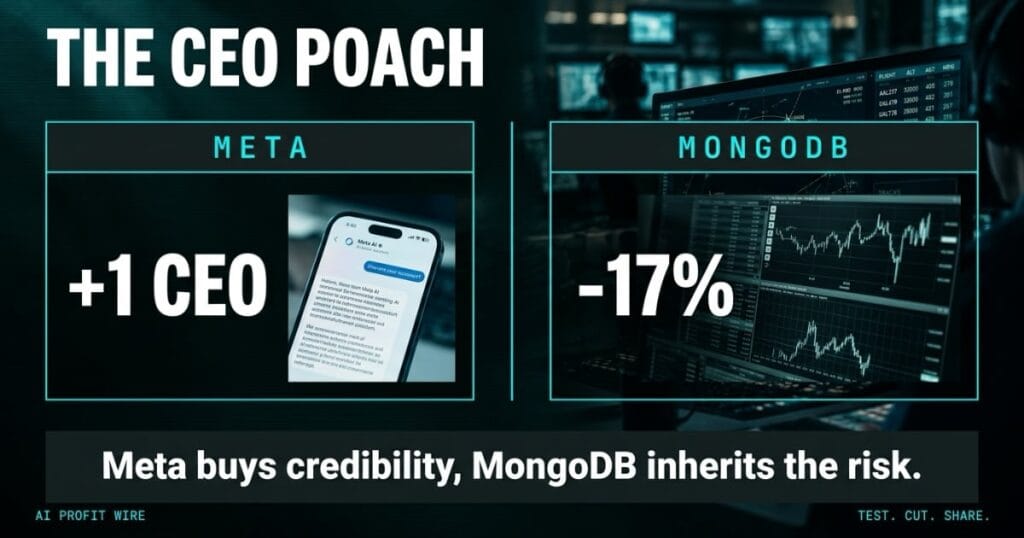
Meta Enterprise Platform is Meta’s new business unit for selling its AI stack to companies, announced Monday. Former MongoDB CEO Chirantan “CJ” Desai left the database company to lead it.
The stack heading to corporate customers includes Muse, Meta Business Agent, the Muse API, and Muse Code. Muse, the personal assistant launched September 8, already handles tasks like sending emails and booking travel for consumers.
Desai’s statement framed the ambition in full: AI will redefine how organizations of all sizes innovate, grow, serve customers, and run operations, and Meta points to its track record helping millions of advertisers and hundreds of millions of businesses scale. The move could help Meta see a return on the money it keeps pouring into AI infrastructure.
Meta is packaging a consumer AI hit into an enterprise business, run by a CEO it poached to do it.
Why Did MongoDB Stock Drop 17 Percent?
MongoDB shares fell more than 17 percent on the news of Desai’s sudden departure. The drop priced in the loss of the CEO who led the company through its enterprise build-out.
MongoDB appointed Dev Ittycheria as interim chief executive, a return to the seat he held before Desai, while the board searches for a permanent replacement. Official word on the transition runs through the MongoDB newsroom, the company’s own press channel.
For teams running MongoDB in production, nothing about the database changed Monday. What changed is the roadmap question: the person who set the product direction now works at a company building an agent platform that wants enterprise budgets.
The product is intact, and the leadership bench is in transition.
How Is Meta Enterprise Platform Different From Muse?
Muse is a consumer assistant that lives in an app. Meta Enterprise Platform wraps similar capability, plus business agents and APIs, for deployment inside companies.
The consumer side has traction worth noting: Muse passed 3.4 million downloads in under 3 weeks according to Sensor Tower estimates, reached the top of the US App Store on September 18, and is available only in the US and Canada. Other measurement firms put the count between 2.3 million and 4.3 million, which tells you the trajectory more than the exact number.
The enterprise side inherits a harder question: trust. Meta’s business sells ads, and commentators are asking whether the company that built its fortune on consumer data handling is the one enterprises want inside their workflows.
Corporate buyers will push on data governance before any of this ships, and the terms Meta publishes will matter more than the demo reels.
Muse proved the demand, and the enterprise platform has to prove the governance.
Who Is Meta Enterprise Platform Actually For?
The first buyers are corporate customers and developers who want Meta’s models inside their own workflows: customer-facing agents, internal automation, and API-driven builds. Meta has not published pricing, tiers, or availability dates.
Companies already advertising at scale on Meta are the natural first pitch, because the same account teams and measurement infrastructure carry over. Smaller teams without integration resources will wait, and that is the right call until packaging exists.
Enterprise AI moves like this one land in the signal log we keep on vendor and platform shifts, because the buyer calculus changes before the products ship.
Today this is a story for procurement watchlists, not deployment plans.
The Friday route sheet at a 12-crew commercial cleaning company lists 40 client buildings, and the dispatcher who built every one of those schedules resigns on a Monday to run a rival operation across town. By Wednesday, 3 account managers are rebuilding lock codes and visit frequencies from emailed PDFs, and 2 clients ask whether their contracts still hold.
MongoDB customers watched the same shape of event at market scale: the CEO who led the company’s enterprise build-out left for Meta, shares dropped more than 17 percent in a day, and an interim leader stepped back into the seat while the board searches. The database kept running, the same way the cleaning routes still got cleaned.
The risk was never the product. It was the discovery, made in one morning, of how much institutional knowledge a single departure moves to a competitor.
What Should You Do About Meta Enterprise Platform Now?
If MongoDB sits under your stack, put the leadership transition on your vendor-risk register and watch the permanent CEO search. The database, the support organization, and your deployments are unchanged today.
If you are evaluating Meta’s enterprise stack, there is nothing to evaluate yet: no pricing, no tiers, no release dates. Track the official channels and hold your workflows where they are.
If you build agents for a living, the Muse API and Meta Business Agent will arrive with enterprise controls attached, and the data-governance terms will decide whether serious buyers can touch them. Watch those terms closer than the feature list.
Watch the governance terms and the MongoDB CEO search, and commit nothing yet.
Source: TechCrunch AI
