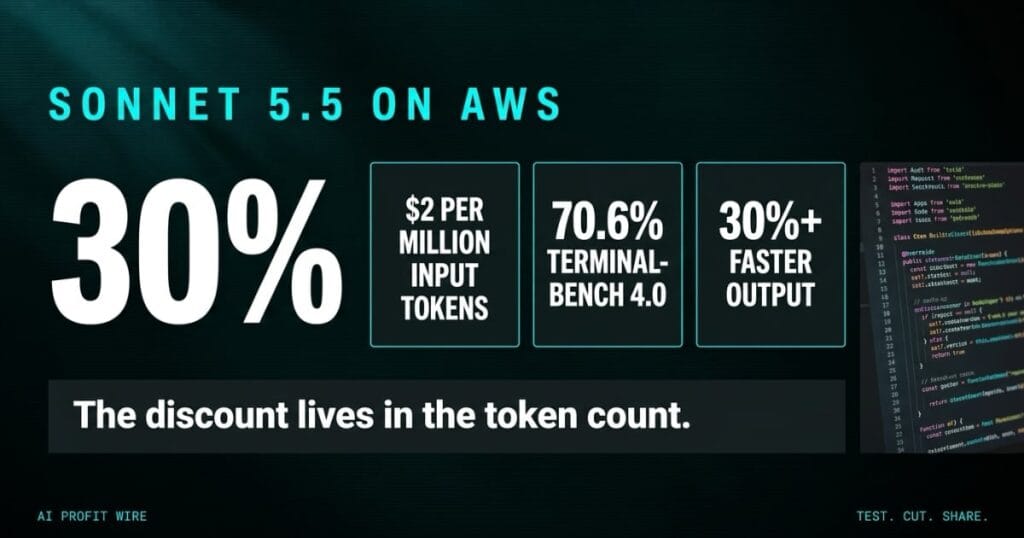
Cuts the cost per task for businesses running continuous coding and document workflows on AWS, without a per-token price change.
What Is Claude Sonnet 5.5 and What Does It Do?
Claude Sonnet 5.5 is Anthropic’s updated mid-tier model, and it went live on Amazon Bedrock and Claude Platform on AWS this week. AWS positions it for focused coding and knowledge work, with a lower cost per task for most work at faster speed.
The release runs through the Global CRIS inference profile on bedrock-runtime, so teams already inside AWS keep their existing controls: IAM for access, CloudTrail for audit, CloudWatch for monitoring, and Bedrock Guardrails for content policies. Usage lands on the regular AWS bill, with Regional data residency.
On the work itself, AWS says the gains concentrate on well-scoped tasks: assign the model a feature or a bug fix, and it completes the work and checks the result against the stated requirements. It also produces more polished documents than Sonnet 5, including one-pagers, architecture diagrams, and summary slides.
Claude Sonnet 5.5 is a cheaper execution layer for defined work, not a new flagship.
Does Claude Sonnet 5.5 Actually Cost Less Per Task?
Yes, by up to 30 percent per task in Anthropic’s own testing. The mechanism is token efficiency rather than a rate cut: the model needs fewer tokens to finish the same work.
The sticker price holds at $2 per million input tokens, $10 per million output tokens, and $0.20 per million cache reads, identical to Sonnet 5, per the Anthropic announcement page. The benchmarks there show where the efficiency lands: 70.6 percent on Terminal-Bench 4.0 against Sonnet 5’s 10.3 percent, and 55.5 percent on CursorBench 4.0 against 34.1 percent.
Run it at low or medium effort and the gap widens. On several benchmarks, Sonnet 5.5 at those settings beats Sonnet 5’s best score for roughly a tenth of the cost per task, and at max effort it lands close to Opus 5.5.
The discount lives in the token count, not the price list.
Claude Sonnet 5.5 vs Opus 5.5: Which One Should You Run?
Run Sonnet 5.5 where the approach is clear and Opus 5.5 where the work needs judgment. That is AWS’s own framing for the pair, and the split is practical.
Opus 5.5 takes release debugging, multi-PR feature stacks, security review of large pull requests, code migrations with clear targets, long analyses, financial research, and contract redlining. Sonnet 5.5 takes first response to alerts, always-on monitoring of agents, SQL generation, UI and UX testing, and fast coding agents in the IDE under a fixed spend cap.
The cost case compounds at volume, because a model that finishes well-scoped work with fewer tokens changes the unit economics of anything that runs around the clock. Per-token rates across the Bedrock catalog are on the Amazon Bedrock pricing page.
Volume work goes to Sonnet 5.5, judgment work stays on Opus 5.5.
Who Is Claude Sonnet 5.5 Actually For?
Engineering teams running continuous or at-scale workloads on AWS are the target buyer. The model is built for jobs where the task is defined and the cost of running it at volume matters more than peak intelligence.
Inside engineering, AWS names alert response, agent monitoring, SQL generation, UI and UX testing, and capped IDE coding agents. Across the wider business, it handles scoped analysis, short spreadsheet edits, and routine document tasks for large user populations.
The AWS-native details are the quiet selling point: Regional data residency, the IAM and CloudTrail controls your team already runs, and region availability documented in the Bedrock model cards for Claude. Model releases that move unit costs like this one land in the running signal log we keep on model pricing.
If your team already pays a Bedrock invoice, this release is aimed at you.
The toner invoice for a 40-person accounting office arrives every month at the same per-cartridge price it has carried for years. A new copier shows up on a Tuesday, and the same client workbooks print with 30 percent less toner because the machine stops reprinting pages it has already proofed. Nobody negotiated a discount, and the invoice still drops.
That is the mechanic behind Sonnet 5.5 on Amazon Bedrock. The per-token price holds at $2 per million input tokens, and the model finishes well-scoped coding and document work with fewer tokens than Sonnet 5 needed, so the cost per task falls without a rate cut.
The offices that feel it are the ones printing around the clock. A team that runs one report a week will not notice the difference, and a team feeding always-on agents sees it on the next bill.
Should You Switch to Claude Sonnet 5.5?
Switch the well-scoped, high-volume workloads first and leave judgment-heavy work on Opus 5.5. The migration cost sits near zero because the model runs on the endpoints your team already calls.
Testing takes minutes in the Bedrock console: open the Playground and select Sonnet 5.5. For code, call it through the Anthropic Messages API or the Invoke and Converse APIs on bedrock-runtime, with the model ID global.anthropic.claude-sonnet-5-5.
The Getting Started notebooks on GitHub walk through working examples.
Verify the savings on your own workloads rather than the benchmarks: track usage and cost in CloudWatch and AWS Cost Explorer for 2 weeks, then compare per-task spend against Sonnet 5. The teams that skip that step are the ones who read a benchmark and assumed their invoice followed it.
Switch the volume work this week, measure for 2 weeks, then decide on the rest.
Source: AWS Machine Learning Blog
