Could improve developer productivity and automated workflow efficiency, though enterprise API costs apply.
What is Claude Opus 5.5 on Amazon Bedrock?
Anthropic launched Claude Opus 5.5 on September 22, 2026, and AWS confirmed same-day availability on Amazon Bedrock and Claude Platform on AWS, the first release of the Claude 5.5 family. The model targets agentic coding, complex knowledge work, and long-running tasks for teams building production workflows on AWS.
Developers can call it through the Anthropic Messages API against bedrock-runtime or bedrock-mantle, or stay on the Invoke and Converse APIs, with inference profiles across US, EU, AU, JP, and Global geo regions. Reuters reports the model underwent external safety testing by Frontier Design and METR before launch.
The most capable Opus model now runs inside managed enterprise cloud environments on day one.
Anthropic lists Opus 5.5 across Claude API, Amazon Bedrock, Google Cloud, Microsoft Foundry, and Claude Platform on AWS, which makes the Bedrock release a reach play rather than an exclusivity play. For an AWS-committed shop, the practical effect is simple: the model arrives inside the contract and the security review you already run.
How good is Claude Opus 5.5 at agentic coding?
AWS positions Opus 5.5 as Anthropic’s most capable Opus model for extended autonomous tasks and complex software engineering, built to hold context across massive codebases during multi-step work. Anthropic’s announcement puts Terminal-Bench 4.0 at 66.4% with adaptive thinking, up from 52.3% for Opus 5, and output more than 30% faster than its predecessor.
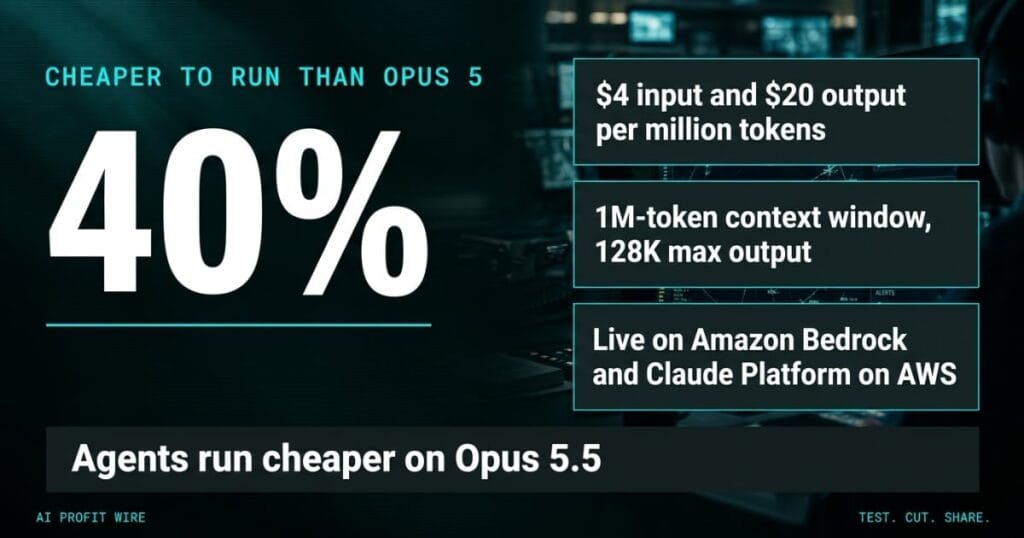
The spec sheet backs the agentic pitch: a 1M-token context window and 128K max output tokens, per Anthropic’s model documentation, which is the headroom long coding sessions burn through first. The same benchmark page lists GDPval-AA v2.1 at 1846 and Humanity’s Last Exam at 67.7% with tools, for teams that grade on more than coding.
Top-tier autonomous coding performance, with the context window to run it unsupervised for hours.
Is Claude Opus 5.5 better on Bedrock than the standard API?
The model is the same; the wrapper is the difference. Running Opus 5.5 on Bedrock integrates it with existing enterprise security controls and data governance, and billing runs through AWS Marketplace under standard Bedrock pricing, so no separate Anthropic API relationship is required.
Anthropic lists identical $4 and $20 per million token pricing across Bedrock and its own API, and OpenRouter’s tracker shows Bedrock at the same $4.00 input, $20.00 output, and $0.20 cache read. You are choosing governance and consolidated billing, not a better model or a worse one.
The cost levers also carry over from the Anthropic side. Cache reads bill at $0.20 per million tokens, a 60% cut against Opus 5’s read price, and the Batch API applies a further 50% discount for workloads that can wait for completion.
Bedrock trades platform-preview novelty for enterprise controls and one invoice, at the same token price.
Who is Claude Opus 5.5 actually for?
The model targets development teams and technical founders running autonomous coding agents on production software. Small teams without dedicated engineering resources will find long-running agentic workflows harder to justify, because the oversight burden does not shrink with the price.
Organizations already scaling on AWS can integrate without new API keys or external billing layers, and the model card documents both endpoints plus the Messages, Responses, Chat Completions, Converse, and Invoke interfaces.
Anthropic lists Opus 5.5 across every major platform, including Google Cloud and Microsoft Azure, so a multi-cloud shop can standardize on one model without renegotiating vendor relationships. The docs also set expectations for planning: the model retires no sooner than September 22, 2027, which gives a 12-month minimum window on any migration you start now.
Built for technical teams running automated engineering pipelines rather than casual software users.
The dev shop’s Wednesday standup opens with the same complaint: the coding agent stalled again overnight on a refactor that should have finished by morning.
Anthropic’s own numbers put Opus 5.5 at $4 per million input tokens with a 1M-token context window, which means the agent stops running out of context long before your codebase does.
The stall came from a context window closing mid-job, and a bigger window closes that gap, at 20% less per token than the model you are running now.
What should you do about Claude Opus 5.5 now?
Point one internal coding agent at the new model ID this week and measure output quality and spend against your current setup, because every model launch we track lands in the daily signals archive as the pricing settles.
Run the evaluation inside a sandbox on Bedrock, monitor token consumption daily for the first 2 weeks to catch cost spikes, and note that Reuters puts real-world runs about 40% cheaper than Opus 5 once caching and speed gains are counted. Staying on Opus 5 for the same work now costs 20% more per token.
Run a structured 2-week evaluation on a single internal project before shifting production workloads.
Source: AWS Machine Learning Blog
