Directly reduces the operational cost of running custom AI workflows and automation agents for small businesses.
What are GPT-6 Sol and Luna?
OpenAI introduced GPT-6 Sol and Luna on September 22, 2026, two lower-cost models built for everyday professional work and software engineering, slotted under the GPT-6 Astra flagship that launched earlier in the month. The announcement frames the pair as frontier intelligence with different balances of capability and cost.
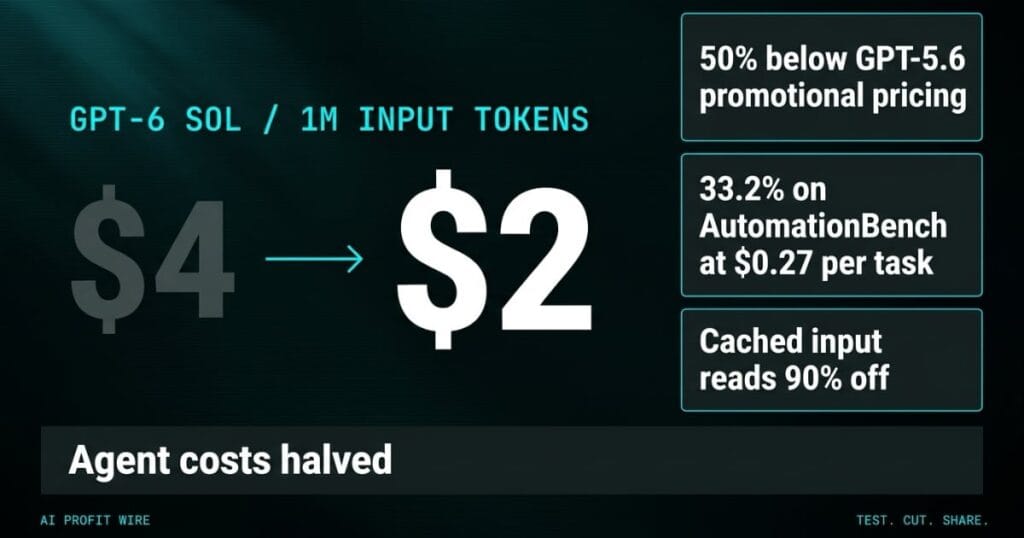
OpenAI cut API prices for both models by 50% compared with their GPT-5.6 promotional pricing. GPT-6 Sol input drops to $2 and output to $10 per million tokens, while GPT-6 Luna input drops to $0.10 and output to $0.50 per million tokens, a cut of half or more on every line of the table. The OpenAI API pricing documentation lists both models at those rates, with cached input reads priced 90% below fresh input.
The default price for frontier-grade agent work fell by half overnight.
Does GPT-6 Sol actually beat Claude Opus 5?
On OpenAI’s own numbers, yes, at a fraction of the cost. GPT-6 Sol at xhigh effort scores 33.2% on AutomationBench, Zapier’s 47-tool simulation of real SaaS work, at $0.27 per task, outperforming Claude Opus 5 at max effort while costing 9% as much per task.
On DeepSWE v1.1 for software engineering, Sol at max effort scores 68.8%, within 1.1 percentage points of Claude Fable 5’s 69.9%, at about 80% lower cost per task. On Agents Last Exam, Sol at max effort scores 56.4%, above Opus 5’s highest score there, at 60% lower cost per task.
Every benchmark figure is OpenAI self-reported, and The New Stack’s launch coverage ran its own confirmation of the pricing and the headline comparison. An OpenAI spokesperson told the outlet the GPT-6 rates are the default price, not another promotional tier, which is the difference between a discount and a market.
The pattern across all 3 tests is the same: near-parity quality at a fraction of the per-task cost.
The benchmark gap closed, and the cost gap did the talking.
How does GPT-6 Sol compare to Claude Opus 5 and Fable 5?
Sol is not claiming the absolute quality crown, and the announcement does not pretend otherwise. Fable 5 still edges DeepSWE at max effort, and OpenAI’s own footnote notes that Fable 5.1’s cost datapoint understates reality because it omits Opus 5 fallbacks that occurred on about 40% of tasks.
The trade is explicit: a buyer gets 90 to 99% of the benchmark performance for 9 to 20% of the per-task cost, which changes what classes of automation pencil out. Prompt caching improvements carry over too, with discounts of 90% on cached input-token reads for long-running sessions.
You trade the last few benchmark points for an order of magnitude on the invoice.
Who is GPT-6 Sol actually for?
Sol targets development teams and small business owners running automated workflows that need frequent model iterations. OpenAI’s own research organization shows where agent usage was heading: daily token usage there has exceeded $600 for the median researcher and $7,000 at the 90th percentile, valued at API prices, which is OpenAI describing its own staff.
Developers can adjust reasoning effort and tool availability without breaking prompt caching, preserving earlier context for reuse across long sessions. Luna handles the high-volume end, where $0.10 per million input tokens makes always-on internal agents viable.
If your automation died on the old pricing, the models it was too expensive to run are the ones to retest.
Stacks of ledger books sit on the counter of a bookstore while an assistant logs inventory into the catalog. Three days later half the titles are priced wrong because a background step never checked its work, and at $0.27 per automated task, the error cost less to create than to find.
Cheap inference multiplies whatever process you point it at, including the broken one. The bookstore owner now ships pricing mistakes faster, and the fix is the same as it ever was: a human check on the step that writes the numbers.
The models got cheaper. Your tolerance for unmonitored agents should get stricter, because the cost of a bad loop fell along with everything else.
Is GPT-6 Sol worth switching to?
For teams running custom agents, the 50% cut makes retesting shelved projects the obvious first move, and we track launches like this one in the daily signals archive as the rates land. The models are available in ChatGPT Work and Codex for all Plus, Pro, Business, Enterprise, and Edu users, with API access open via the gpt-6-sol and gpt-6-luna endpoints.
Evaluate your current prompt caching configuration and adjust explicit breakpoints, because cached input reads bill at 90% off and long sessions are where the discount compounds. Batch and Flex tiers drop Sol to $1.00 input and $5.00 output for workloads that can wait.
Switch the agents, keep the human review on the steps that write numbers, and bank the 50%.
Source: OpenAI Blog
