Local AI processing capabilities on mobile devices could improve on-the-go productivity apps and local task automation without cloud latency.
What is the Snapdragon 8 Elite Gen 6?
Qualcomm announced two flagship smartphone processors at its annual Snapdragon Summit on September 22, 2026: the Snapdragon 8 Elite Gen 6 and the Snapdragon 8 Elite Extreme Gen 6. The company’s announcement positions the pair as the foundation of the “agentic AI age”, built on a 2nm process with the custom Oryon CPU, rearchitected Adreno GPU, and an advanced Hexagon NPU.
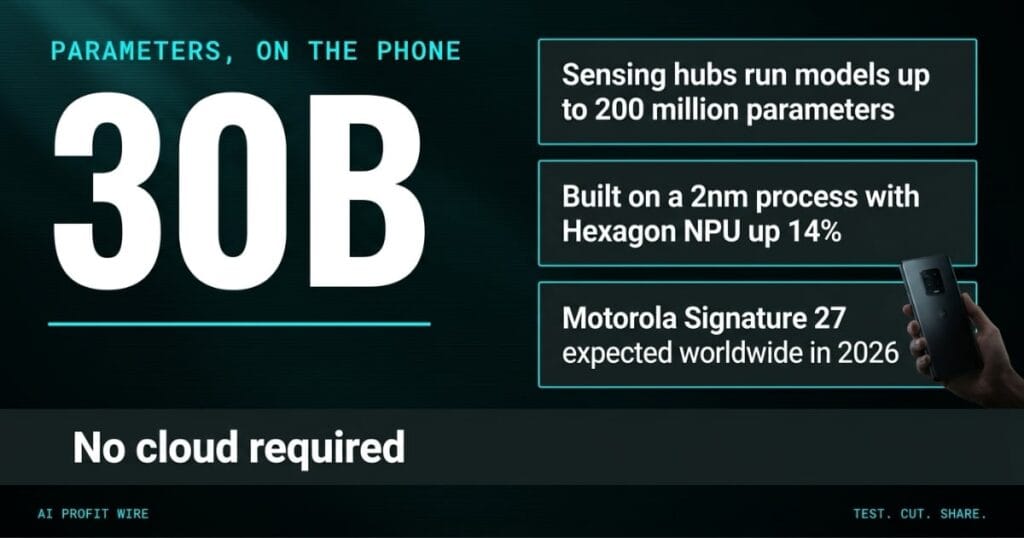
The chips carry new sensing hubs that run small models of up to 200 million parameters directly on the device, which enables a personal scribe that runs locally, speaker differentiation, and voice bubble technology that isolates your voice from noise during calls. Engadget’s teardown of the spec sheet adds the hard numbers: a 14% faster NPU with 20% better performance-per-watt, an Oryon CPU up 10% in performance with 37% better efficiency, and 16MB of Flex Cache, 18MB on the Extreme.
The silicon detail underneath is consistent with the on-device pitch: an 8-core Oryon CPU with 2 prime cores reaching up to 5GHz, the new X105 5G modem, and Wi-Fi 8 plus Bluetooth 6 for the connectivity side. Qualcomm’s own product brief describes AI Voice Bubble as isolating your voice in noisy environments, which matches the sensing hub story of permanent low-power models running between calls and between tasks.
Qualcomm built these chips to handle advanced on-device AI tasks without asking a server for permission.
Can the Snapdragon 8 Elite Extreme Gen 6 actually run 30-billion-parameter models locally?
Yes, per both the launch coverage and Qualcomm’s own materials. The high-end Extreme version runs a 30-billion-parameter mixture-of-experts model locally on the phone, and the mixture-of-experts architecture means only a subset of those parameters activates for any given task, which is what makes the workload fit in a phone.
The standard Snapdragon 8 Elite Gen 6 includes a new accelerator element designed to run models in a more efficient way than previous generations, per TechCrunch’s launch report. The Extreme variant also carries the video side: 8K 60fps recording, 4K240 ultra HD slow motion, and the Advanced Professional Video codec for pro-level capture.
A 30-billion-parameter model on the phone is a floor for on-device AI, not a ceiling.
How does Snapdragon local AI compare to cloud AI?
Local execution runs the model on the device hardware, which removes network latency, works offline, and keeps sensitive data on the physical device. Cloud-based architectures offer larger compute but introduce dependency on a stable connection, and every request routes your data through somebody else’s server.
The Qualcomm product page frames the trade the same way, with the Hexagon NPU and sensing hub handling persistent tasks while the cloud handles the heavy tail. For field work, the offline half of that trade is the one that matters, because a cloud model with no signal is a paperweight.
Local execution trades server-scale compute for immediate response, offline capability, and data that never leaves the device.
Who benefits from on-device AI in the Snapdragon 8 Elite Gen 6?
The chips target flagship device manufacturers building for power users and mobile professionals, with HONOR, iQOO, Motorola, OnePlus, OPPO, REDMI, RedMagic, vivo, and Xiaomi named as launch OEMs. Motorola’s Signature 27 is the first announced device on the Extreme chip, expected to reach markets worldwide in 2026 with a 50MP Sony LYTIA 910 main sensor and 7 years of OS upgrades.
The beneficiary list beyond phones is concrete: field teams running diagnostics in weak-coverage zones, mobile professionals who process sensitive data, and developers building offline-capable productivity apps. Each of those workflows still depends on a round trip to a server that the new silicon makes optional.
Mobile device buyers and developers building offline-capable applications stand to gain most from this hardware cycle.
The service tech stands on a rooftop with one bar of signal while the diagnostic app spins on a cloud round trip that never finishes.
Qualcomm’s answer puts a 30-billion-parameter model on the phone itself, with sensing hubs running models up to 200 million parameters without touching the network.
The dead zone stops being an IT problem when the model stops leaving the device.
Should you upgrade your mobile fleet for local AI?
Upgrading depends on whether your mobile workflows require offline AI capabilities, and every launch we track lands in the daily signals archive as the device cycle unfolds. Businesses relying on cloud tools with reliable coverage gain little operational advantage from local mixture-of-experts models.
Teams operating where cloud latency disrupts work will find local execution necessary for productivity, and the practical test is simple: list the tools your team runs in weak-coverage zones and score how much of each depends on a server round trip.
Evaluate the technical requirements of your mobile fleet before committing capital to a hardware refresh.
Source: TechCrunch AI
