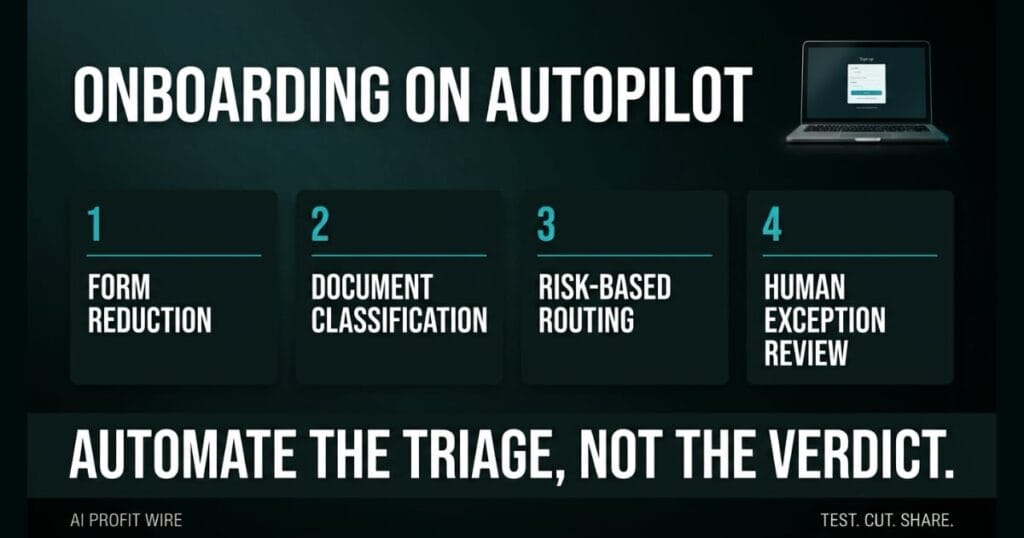
Increases conversion rates by reducing onboarding friction and cuts manual labor costs for identity verification.
How do AI onboarding workflows automate customer sign-ups?
AI onboarding workflows use a layered architecture to automate the collection and verification of user data. This system replaces static forms with dynamic paths that change based on user input.
The framework consists of 8 workflows that handle tasks from intelligent form reduction to fraud detection. It utilizes orchestration tools like Zapier, Make, and n8n to move data between identity services and AI models.
Vision-capable models are used to classify uploaded documents and extract specific data fields. This ensures that only the minimum required information is requested from the user.
Move the operational complexity away from the customer and into a monitored system.
Do AI onboarding workflows actually reduce friction?
Yes, they reduce friction by implementing risk-based identity verification. This means the system matches the strength of the check to the actual level of risk associated with the user.
Low-risk cases move through the system quickly with minimal checks, such as email confirmation. High-risk cases are routed to stricter paths requiring liveness checks or manual review.
The process follows NIST guidance by separating resolution, validation, and verification into distinct tasks. This separation makes the entire workflow easier to audit and test for errors.
Route low-risk customers through faster paths to prevent high-security requirements from slowing them down.
How is AI onboarding different from traditional digital forms?
Traditional forms are static and require every user to answer the same set of questions regardless of their risk profile. AI onboarding is dynamic and adapts in real time.
An AI workflow can automatically pull public company information based on an email domain. This allows the user to confirm existing data instead of typing it manually.
Traditional systems often rely on a single checkbox for privacy notices. Automated systems display different explanations based on the user’s location and the specific data being collected.
Remove redundant data entry to convert users faster.
“Hold on, let me check the back,” I tell the guy on the phone who’s looking for a 12-inch auger bit. I’m staring at a new inventory screen that requires 8 different clicks just to see if the shelf is empty.
It’s the same trap as over-engineering an AI onboarding flow. You buy a system that’s supposed to save time, but you spend 3 weeks training your staff just to use the search bar.
The value isn’t in the complexity of the tool. The value is in how quickly the customer gets their answer without the business owner losing their mind.
Which industries need automated identity verification?
Automated verification affects businesses in regulated industries like financial services and digital entertainment. These sectors must balance conversion rates with strict compliance laws.
The European Commission requires that people not be subject to solely automated decisions that have legal effects. This means a human review process must be designed into the workflow from the start.
As the tooling keeps shifting, the cheapest insurance is watching the weekly AI signal feed instead of rebuilding your stack every quarter.
Design a hybrid system where AI routes and humans decide the exceptions to maintain compliance.
Should you automate customer sign-ups this quarter?
It changes the approach from a full-system overhaul to a gradual, task-based automation. You don’t automate the entire process in one weekend.
The most effective starting point is automating low-risk, reversible tasks. This includes classifying uploaded documents without approving them or detecting missing form fields.
Business owners should measure accuracy, processing time, and user drop-off rates for each single component. Only after a component is reliable should it be connected to the next part of the workflow.
Automate the triage, not the final legal authority.
Source: AutoGPT Blog
