Reduces time spent on travel logistics and helps business owners lower overhead via AI-driven price tracking.
How does flight price tracking work in Google AI Mode?
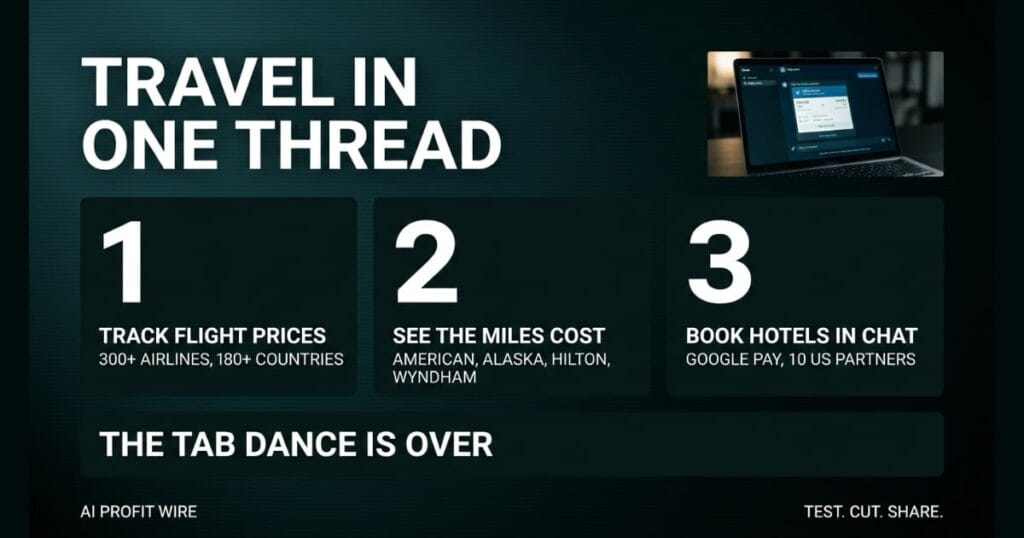
Google Flights’ popular price tracking now runs directly inside AI Mode, so you set alerts mid-conversation without breaking your flow. Describe where and when you want to fly, and AI Mode shows the best options with the latest prices from more than 300 partner airlines and travel sites.
Say “track these flight prices for me” and you get an email the moment prices change for the destination and dates you have in mind. When you’re ready to buy, the itinerary still completes through the airline’s website or your preferred booking platform.
The tracking feature is live in more than 180 countries and territories, with EEA countries excluded. That coverage makes it the widest of the 3 new travel features.
Price watching became a single sentence and an email, in 180+ countries.
Which airlines and hotels does Google AI Mode support?
On flights, the pricing data comes from more than 300 partner airlines and travel sites. On rewards, the points and miles view launches with Alaska Airlines, Hawaiian Airlines, American Airlines, Choice Hotels, Hilton, and Wyndham.
More loyalty programs land in the coming weeks: Accor, Flying Blue, Hyatt, LATAM Airlines, and Lufthansa Group. The miles rates come directly from partner data, not estimates.
Hotel booking goes live in the US in English first, with 10 partners at rollout: Booking.com, Choice Hotels, Expedia, Hilton, Hotels.com, IHG Hotels, Marriott International, Priceline, Trip.com, and Wyndham.
Broad airline coverage on day 1, hotel depth concentrated in the US rollout.
Does Google AI Mode replace your travel booking apps?
Partially, and the honest answer matters. For hotels, AI Mode fronts the same partners you’d book with anyway, Expedia, Marriott, Hilton, and the rest, then completes the reservation through Google Pay after you pick the room and check the cancellation policy.
The hotel or booking platform stays merchant of record and handles customer service, so your cancellations and disputes route where they always did. The apps don’t disappear, they become the back end.
Flights still book through the airline or your chosen platform. What actually dies is the multi-window routine of comparing fares, rewards portals, and hotel sites by hand.
AI Mode is the new front door. The booking apps are now the back office.
The airfare spreadsheet opens at 6 a.m. and closes at 6:15, every weekday, and the fare it watches still slips away anyway. A consultant flying monthly to client sites knows the sting: the fare she bookmarked on Tuesday is gone by the time the trip gets approved on Friday.
Google just moved the watchman into the search bar. AI Mode tracks prices across more than 300 partner airlines in more than 180 countries and sends the email the moment a tracked fare moves.
The 15 minutes of daily fare-checking just became somebody else’s job. That’s not a travel feature, that’s a weekly hour back for every frequent flyer on payroll.
Who is Google AI Mode travel booking actually for?
It’s for owners and consultants who book their own travel and bill for their time. If you fly the same routes repeatedly, price alerts on those routes are free money.
Rewards-heavy travelers get the sharper upgrade: asking for the cost in miles straight from partner data, for flights and hotels, kills the multi-portal cross-check. The first wave of loyalty partners covers American, Alaska, Hilton, and Wyndham programs, with Accor, Hyatt, and Lufthansa Group arriving in the coming weeks.
It’s less useful if your hotel travel sits outside the US English rollout or if a travel agent already does this work for you. The wire keeps a running log of AI features that quietly delete admin work, and this feature earns its line.
Frequent flyers who book their own trips get the most, starting this week.
Google Flights vs AI Mode: what’s actually different?
Same tracking engine, new door. Google moved its popular Google Flights price tracking directly into AI Mode, so the alert logic you may already use is now reachable inside a conversation.
The difference is the surrounding workflow: in AI Mode you can compare, ask for miles pricing, and start a hotel booking in a single thread, while Google Flights stays a dedicated fares tool. Neither kills the other, they share an engine.
For a small business owner, the practical move is picking 1 and setting alerts on your 3 most-flown routes today. The tool matters less than the alerts existing before the next trip gets priced.
Flights if you live in fares all day, AI Mode if you want the whole trip in a single thread.
Should you book business travel through Google AI Mode?
For price tracking, yes, immediately, wherever you are, since it’s live in 180+ countries. For hotel booking, the US English rollout lands over the coming weeks, and cancellations still route to the hotel or platform as merchant of record.
Set alerts on your frequent routes now, check your miles rates on the next booking, and let the email do the watching. There’s no cost to having alerts in place, and dynamic pricing doesn’t wait for your spreadsheet.
The 1 caution: EEA users are excluded from parts of the rollout, so confirm availability in your market before you rebuild your routine around it.
Track everything now, book hotels once the rollout reaches you.
Source: Google AI Blog
