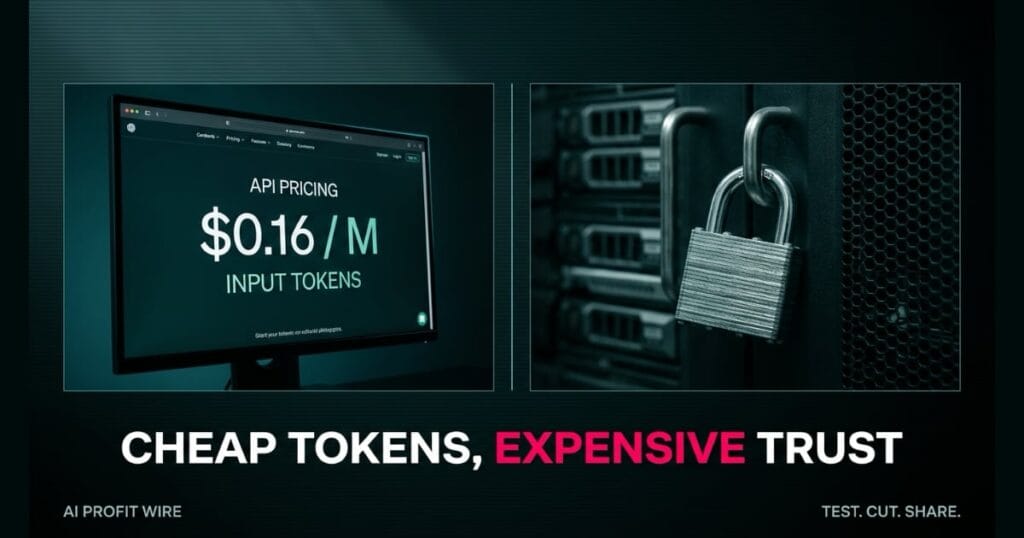
Significantly lowers the operational cost of deploying AI agents and tool-calling apps.
What is Qwen 3.8 Flash-Next and what does it do?
Qwen 3.8 Flash-Next is Alibaba’s new open-weight AI model, released August 26 as an early preview of the architecture behind the upcoming Qwen 4. It is built for agentic workloads: tool calling, coding applications, and interaction with complex APIs, calculators, and custom external databases.
It is a 125B-parameter model using a mixture-of-experts design, so only 6B parameters are active per token. That lean activation is what keeps inference costs down while the full model stays available.
It is also multimodal, meaning it handles visual and text prompts, and it excels at computer use tasks. Alibaba highlighted that it carries lower training and inference costs than Qwen 3.7-Plus.
The scale context matters: Qwen 3.8 Max runs 2.4 trillion parameters, and rival Moonshot’s Kimi K3 MoE model runs 2.8 trillion. Flash-Next is Alibaba playing the efficiency lane, not the size lane.
A lean, cheap, agentic model positioned as an enterprise workhorse, not a frontier flagship.
Is Qwen 3.8 Flash-Next actually cheaper than OpenAI?
On token price, yes, and it isn’t close. The API runs at $0.16 per million input tokens and $0.47 per million output tokens, and because the weights are open, self-hosting is on the table instead of renting the API forever.
Gartner analyst Arun Chandrasekaran credits the pricing to inference efficiency: the model contains many parameters, but only a few activate, which keeps the cost per token low.
He positions it as competitive for a very broad category of enterprise workloads, priced aggressively on purpose. It is open weight, unlike the frontier models from OpenAI and Anthropic, which is the structural difference underneath the price tag.
The honest ceiling on the comparison: the same analyst says low price alone should not be a parameter, and enterprises need to weigh safety, legal indemnification, and governance, not just the invoice.
Cheaper than the US frontier APIs on tokens, but the rate card is 1 line of the decision.
Is Qwen 3.8 Flash-Next good enough to replace paid AI models?
For agentic workloads like tool calling and coding, Alibaba aimed it directly at the enterprise middle market during a price war among top AI vendors. The capability case doesn’t require faith, the vendor optimized it for exactly these jobs.
The open weights are the real replacement argument. A team can self-host, inspect, and control the stack, which proprietary models never allow, and Chandrasekaran’s advice is to examine whether self-hosting makes sense rather than consuming it via API.
The friction is market penetration and trust, not raw capability. Alibaba holds big market share outside the West but still needs a foothold in the US and Western Europe, and it faces Chinese rivals Moonshot, Z.AI, and DeepSeek at home.
Capable enough for lean agentic work. Whether you should switch is a governance question.
The cheapest quote on the freight board is the 1 nobody can trace. A new broker offers to move your pallets for a fraction of the going rate, and the savings look real until a customer asks where their order actually is.
Qwen 3.8 Flash-Next at $0.16 per million input tokens is that quote. The rate card is published and verified, and so is the question of where your prompts and data sit while the model runs.
Data residency is the question you ask before the pallets move, not after. The self-hosting option exists precisely because some cargo shouldn’t leave your own warehouse.
Who is Qwen 3.8 Flash-Next actually for?
It is for teams already running agentic workloads, tool-calling apps, coding assistants, and automation pipelines, where token volume makes price the dominant cost line.
It is also for teams with the technical depth to self-host an open-weight model, because that is where the price advantage and the data control both land. If you consume AI purely through a polished SaaS wrapper, this release isn’t aimed at you yet.
Alibaba is also courting verticalized, application-level players rather than pure model buyers, per the Gartner read. The price war among model vendors keeps producing moments like this, and we log them all as they land.
For builders with volume and the skills to self-host. Not for the set-and-forget crowd.
Qwen 3.8 Flash-Next vs Qwen 3.8 Max: which fits your workload?
They answer different questions. Max is the 2.4-trillion-parameter flagship built for heavy lifting, while Flash-Next is the 125B, 6B-active efficiency model built for high-volume agentic runs.
The pricing logic follows the architecture. Activating 6B parameters per token is what makes the $0.16 rate possible, and it is why the Gartner read calls it super competitive across a broad set of enterprise workloads.
If your job is frontier reasoning, Max-class models exist for that. If your job is thousands of tool calls a day, the lean model is the 1 that pencils.
Max for depth, Flash-Next for volume. Most small business automation lives in the volume column.
Is Qwen 3.8 Flash-Next production ready?
It is a preview of Qwen 4’s architecture, which is the honest answer and the caution in the same sentence. Previews ship so teams can evaluate, not so mission-critical systems can migrate.
Production readiness for your business is really 3 checks: does the model support your use cases, does data residency pass your governance review, and does legal indemnification hold up. The source flags every 1 of those as an open question for Chinese vendors.
Chandrasekaran’s framing is the 1 to keep: consume a cost-efficient model, but not at the price of security, data residency, and continuous innovation.
Ready to evaluate today. Migrate only after the residency and security review clears.
Source: AI Business
