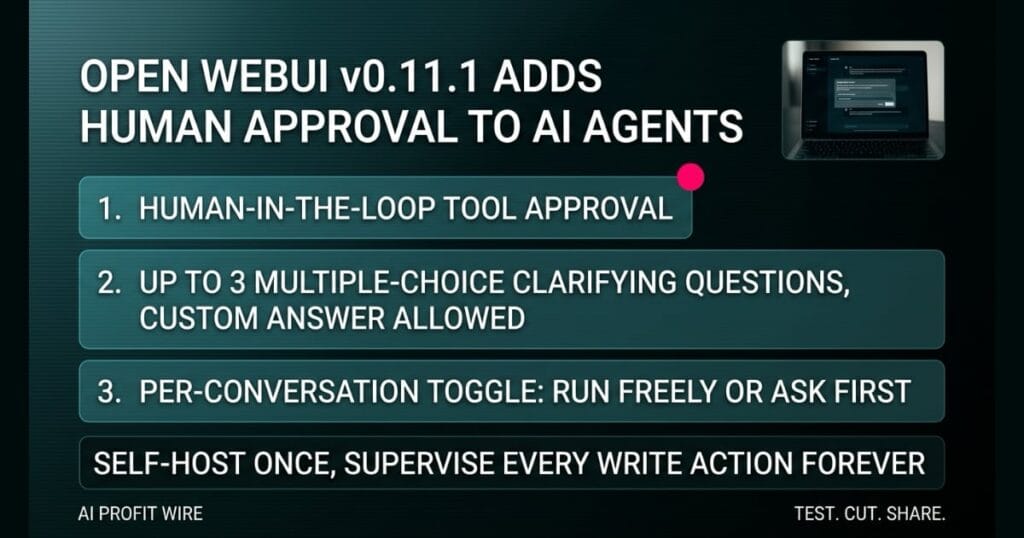
Reduces the risk of costly AI errors by ensuring a human reviews automated actions before they are executed.
What is Open WebUI v0.11.1?
Open WebUI v0.11.1 is the August 25, 2026 release of the open-source, self-hosted interface for running AI models, and it ships two safety layers built for agent workflows.
The release adds human-in-the-loop tool approval, which lets an administrator force a model to stop and wait for a human to allow or deny a tool call before it executes.
It also adds a built-in tool that lets a model pause and ask the user up to three multiple-choice questions to clarify instructions before proceeding, with room to type a custom answer instead.
v0.11.1 transforms AI agents from autonomous risks into supervised assistants.
Does Open WebUI v0.11.1 actually prevent AI errors?
Yes, by removing the autonomy that leads to silent failures, the release makes tool execution a deliberate human choice instead of an automatic model choice.
The administrator can switch a conversation from letting tools run freely to being asked first, and the choice is remembered for that conversation and for future ones in the same saved thread.
The 3-question clarifying step survives a page reload, so an unanswered prompt does not lose the conversation, and the user can come back and answer it later.
The release also ships a stop button that ends a reply paused on a tool approval, so a conversation does not get stuck partway through if the approver walks away from the keyboard.
Tool calls that return an error are now marked as failed with a red cross rather than a green tick, so a reply built on a failed call is easier to spot before it gets acted on.
The system replaces blind trust with a manual verification gate.
Should you use Open WebUI instead of paying for an agent platform?
Open WebUI is open-source and self-hosted, so the cost is the hosting environment and the API credits consumed by the underlying model, not a per-seat SaaS subscription.
Most paid agent platforms ship either full automation or no automation, while v0.11.1 ships a per-conversation toggle between running freely and asking first, which is a control plane most paid platforms gate behind an enterprise tier.
The tradeoff is operational: you self-host, you self-monitor, and you carry the deployment burden that a paid vendor would absorb for you.
The release also adds a memory tool fix that stops the model from answering the second message as though the first had never been sent, which closes a silent failure mode that undermined long conversations.
Open WebUI gives small business owners enterprise-grade control without the monthly subscription, at the cost of self-hosting.
A fulfillment lead walks into the warehouse on a Friday and finds 100 units of a slow-moving SKU auto-reordered overnight by an agent that misread a forecast signal. The model reported the action as successful, the inventory system logged it as complete, and the operational reality is a pallet of stock that will sit for nine months.
The cost is not the model. The cost is the autonomy. An agent that can take a write action without a human checkpoint turns a single hallucinated number into a real purchase order that lands on a real dock.
v0.11.1 forces the model to stop and ask before that tool call fires, which means the hallucination gets caught at the gate instead of at the receiving bay.
Who is Open WebUI v0.11.1 actually for?
It is for founders who want to deploy AI agents but cannot risk unvetted write access to company data, customer systems, or operational tools.
The release is best suited for technical owners who can manage a self-hosted deployment and want to avoid vendor lock-in on a paid agent platform.
Teams running internal customer support or back-office automations where a wrong answer or wrong action carries a real cost get the most direct lift from the human-in-the-loop gate, and this release is one of the safe-agent deployment signals worth tracking for any team running self-hosted AI in production.
It is for the risk-averse founder who demands total oversight and is willing to self-host to get it.
Is Open WebUI production ready?
v0.11.1 is production ready for businesses that have the capacity to self-host and monitor their own AI infrastructure, and the iterative release cadence (v0.11.0 in July 2026, v0.11.1 in August 2026) shows an active maintenance pace.
The release ships hundreds of performance fixes, including faster message sending, file uploads, search, sign-in, and admin page loads on busy servers, which matters for any team running the tool at internal scale.
The Faster JSON handling patch alone returns faster chats, settings, tool results, streaming replies, sign-in flows, and stored chunk reads, which is the kind of plumbing work that decides whether a self-hosted install survives a 6-month trial.
For teams that need a managed SLA, a paid agent platform still wins. For teams that value control over convenience, the open-source path is now stable enough to bet on.
It is ready for production if you value control over convenience and can self-host.
Source: GitHub Release v0.11.1
