Significantly reduces time spent on repetitive data entry and cross-app coordination for white-collar workflows.
What’s ChatGPT Work and what changed?
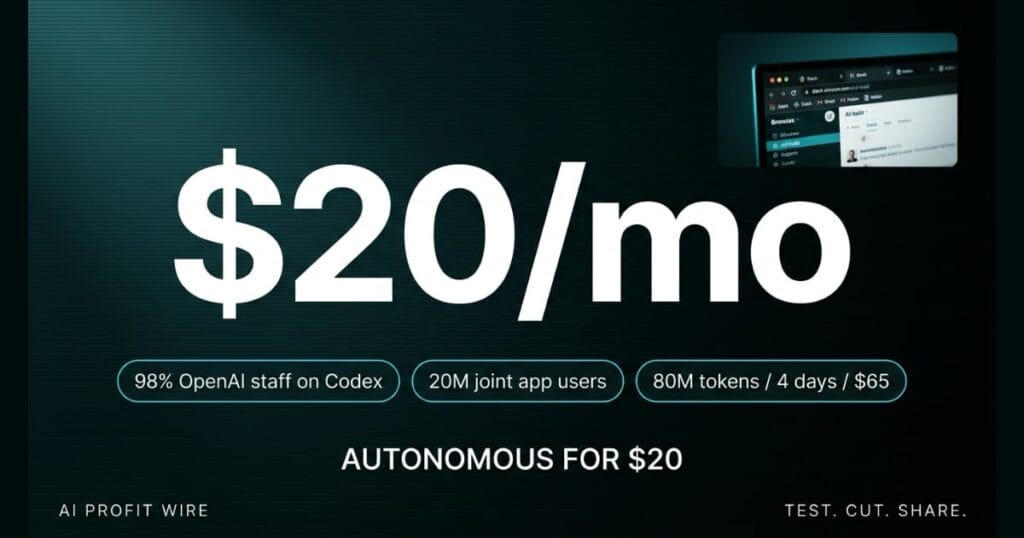
ChatGPT Work is an AI agent tool for non-technical professionals that OpenAI released for $20 a month on its lowest subscription tier.
It’s a modified version of the Codex coding tool, which lets it complete multi-step projects autonomously instead of just answering prompts.
The tool connects to email, Slack, Notion, and Figma to execute workflows for white-collar workers, which is the population OpenAI is targeting.
OpenAI’s marketing copy puts the goal as a world where artificial intelligence goes beyond answering questions to helping everyone turn their biggest ideas into reality.
It’s a shift from a chatbot to an autonomous agent for cross-app work.
What’s the evidence behind ChatGPT Work?
An OpenAI-backed study found that 98% of OpenAI employees were using Codex in June, which suggests the tool has reached internal saturation.
The same study found that just 17% of organizational subscribers and less than 1% of individual subscribers use the agentic coding tool, which is the adoption gap ChatGPT Work is built to close.
OpenAI’s benchmark GDPval, drawn from 44 occupations and hundreds of knowledge work tests, validates performance, and the joint Codex app reaches 20 million people.
That 20 million is a fraction of the more than 1 billion users prompting ChatGPT online, which is the headroom OpenAI is chasing.
OpenAI product leads Thibault Sottiaux and Andrew Ambrosino confirmed these findings to TechCrunch, which focused on routine, data-intensive coordination tasks.
The internal adoption proves the utility, but the external market is still early.
How does ChatGPT Work compare to the alternatives, and what background do small business owners need?
ChatGPT Work competes with Claude Code, Claude Cowork, and vertical-specific tools like Harvey (for law) and Clay (for sales), which all approach agentic workflows differently.
Claude Code was oriented around a back-and-forth conversation with the user, which surveys options and reduces errors by checking in at each step.
OpenAI’s approach focuses on a “magic box” interface for simplicity, which bets the model is smart enough to handle a task entirely on its own.
OpenAI engineers admit they initially bet too heavily on the model’s intelligence, and they’ve since added more opportunities for users to interact with the model.
Databricks found that Pi, an open source harness published by Earendil, outperformed Codex while using the same GPT 5.5 model, which proves the harness layer matters as much as the model itself.
Pi’s creator Mario Zechner built it as an intentionally minimalist harness, and it has already been used to build projects like OpenClaw and Cloudflare OS.
Claude Code was more in demand than Codex until April 2026, but Codex has now taken a slight lead in download statistics, and surveys of enterprise use suggest OpenAI is catching up.
The battle is between guided interaction and autonomous execution, and the harness layer decides who wins.
A new hydraulic bucket lift invoice lands on the contractor’s desk, sold on the promise of cutting job time. The machine is a beast on paper, but the control panel requires a certified technician to calibrate the sensors before the boom lifts an inch.
The setup eats the first jobs’ profit before the lift ever touches the work site, because the calibration guide runs in circles. That’s the $20 a month gamble with ChatGPT Work, where the power is real but the permission settings reportedly send users in circles.
TechCrunch’s reporter burned 80 million tokens in 4 days, which cost OpenAI $65 against his $20 monthly subscription, and that’s a subsidy of more than 3x the subscription price. The setup friction is the tax on that subsidy, which is what to expect before the autonomous agent actually ships work.
How does ChatGPT Work affect day-to-day operations for small businesses?
ChatGPT Work reduces time spent on repetitive data entry and cross-app coordination, which is the workload OpenAI is targeting for white-collar workers.
The TechCrunch reporter moved his son’s preschool calendar from email to Google Calendar automatically, which is a single concrete example of the cross-app automation the tool enables.
Other reported uses include building auto-updating dashboards from Slack conversations, parsing Salesforce records, and turning raw spreadsheets into planning tools.
VCs are using it to assemble investment memos, ops teams are spinning up bespoke data visualizations, and Sam Altman is using it to plan his vacations, which shows the range of multi-step work the tool handles.
Small business owners who want to pair this with a dedicated SEO content workflow can run ChatGPT Work drafts through a tool like NeuronWriter’s AI content optimizer to turn raw drafts into ranked search results.
It kills the manual copy-paste phase of cross-app work for $20 a month.
What’s the final verdict on ChatGPT Work?
ChatGPT Work is a powerful but unpolished autonomous agent that delivers real utility for $20 a month, which is a price OpenAI is currently subsidizing at more than 3x.
The permission setup is reportedly circular and confusing, with many important settings only available on the web app and not the desktop client.
The Luna model recently saw an 80% price cut, which is the efficiency gain that has to keep landing for the $20 economics to hold over time.
Buy the $20 subscription for the utility, but expect setup friction before the agent actually ships work.
Source: TechCrunch AI
