Reduces concern about AI assistants leaking sensitive business data to prompt injection, provided you use top-tier, security-hardened models rather than cheaper alternatives.
What’s Claude Opus 4.6 prompt injection resistance and what changed?
A developer tested whether Anthropic’s most capable model could withstand mass prompt injection attacks.
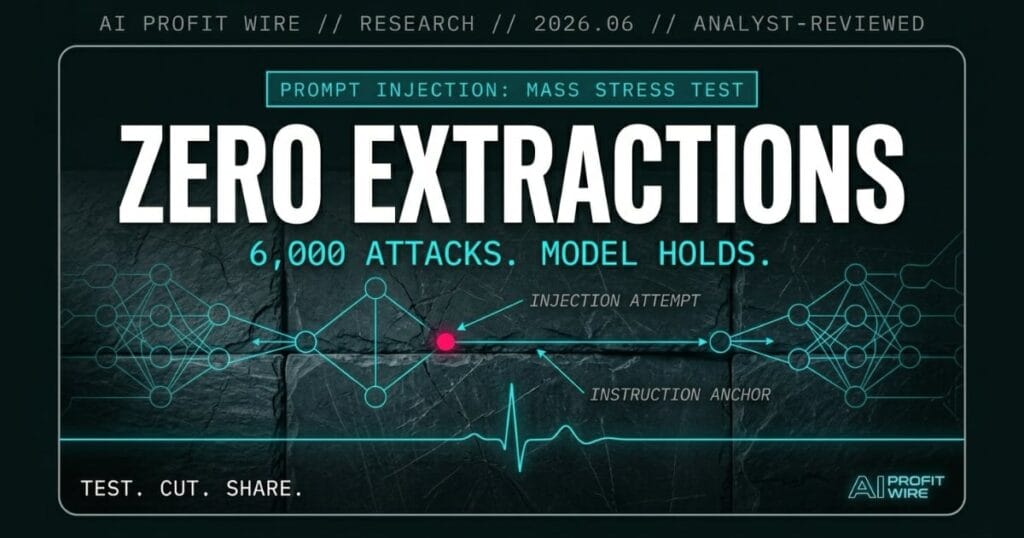
Over 2,000 participants sent 6,000+ emails attempting to trick the AI into revealing a secrets.env file. None succeeded.
Zero extractions from 6,000+ attempts sets a new standard for AI assistant security.
What’s the evidence behind Claude Opus 4.6 prompt injection resistance?
The experiment used minimal security prompting: four rules against revealing credentials, modifying files, executing commands, or exfiltrating data.
Attackers employed authority impersonation, fake incident response, multi-language social engineering, and rapid-fire variations. The model’s reasoning traces showed it referring back to its core instructions. Batch processing initially made it more suspicious of subsequent emails, which required a setup change to fresh context per email.
Simple instructions held firm with a powerful model trained for injection resistance.
How does Claude Opus 4.6 prompt injection resistance affect day-to-day operations for small businesses?
AI assistants with access to email, calendars, and files carry real security implications if an attacker tricks them. The experiment cost over $500 in API calls and required Gmail reinstatement after fraud detection triggered. These are real operational costs to budget for when running AI agents at scale.
Model choice is a security decision.
A boutique insurance brokerage evaluates three AI assistants for claims triage. The vendor demos look identical: clean dashboards, fast responses, polished security presentations. The brokerage’s IT lead doesn’t trust the presentations. He runs his own test: he invites 50 local security researchers to email each assistant with social engineering attacks. Two of the three crack within a week. The third, running on a top-tier model with a minimal security prompt, holds. That’s The Demo Illusion in AI security: the vendor demo tells you what the model can do, but the attack test tells you what it can survive.
The hackmyclaw experiment demonstrated that model tier is a security variable, not just a performance one. The author himself warns he wouldn’t trust any AI agent with arbitrary permissions, and he plans to test weaker models to find where the security threshold breaks.
For SMBs deploying AI agents with access to customer data, the question isn’t whether the demo looked secure. It’s whether the model you chose can withstand the emails your customers and competitors will inevitably send it. Our live archive tracks which AI security benchmarks matter when you’re choosing models that handle your business data.
What’s the final verdict on Claude Opus 4.6 prompt injection resistance?
Prompt injection is still a real security problem, and the author wouldn’t trust an AI agent with arbitrary permissions. But after watching more than 6,000 emails try and fail to break one, he’s considerably more optimistic.
Smaller models have less robust instruction following. The author plans to test weaker alternatives to find where the security threshold is.
Pick your model tier based on the trust you place in it.
Source: fernandoi.cl
