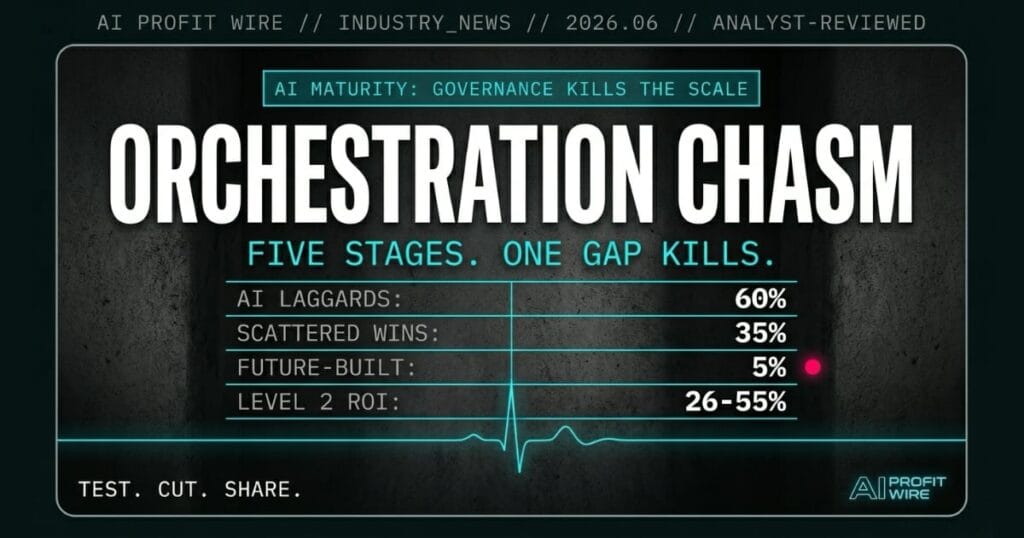
Identifying your current AI maturity stage prevents wasted spending on disconnected pilots and helps prioritize the governance and infrastructure changes needed to capture real ROI.
What’s the n8n AI Maturity 5-Level Framework and what changed?
n8n published a diagnostic framework that maps how deeply AI is embedded in an organization.
The model identifies 5 stages from unsanctioned Shadow AI to fully AI-native operations, and it highlights two critical transition points where organizations most commonly stall.
Most businesses overestimate their AI maturity because they confuse tool purchases with operational integration.
What’s the evidence behind the n8n AI Maturity 5-Level Framework?
The framework draws on McKinsey, BCG, and Cyberhaven research.
McKinsey found 60% of companies are laggards generating no material AI value, 35% are scalers with pockets of success, and only 5% are future-built with AI embedded across the organization. BCG’s research shows future-built companies create new revenue streams and competitive moats. Cyberhaven’s data confirms Shadow AI is already pervasive in most enterprises.
The research consensus is that governance maturity, not technology access, separates companies that scale from those that stall.
How does the n8n AI Maturity 5-Level Framework affect day-to-day operations for small businesses?
Small businesses typically operate between Level 0 and Level 2.
At Level 0, employees use personal AI accounts with company data, creating compliance exposure with zero visibility. At Level 1, disconnected pilots accumulate technical debt. Level 2 requires an orchestration layer to connect AI to legacy systems, which is where 10-to-20-year-old ERPs and CRMs become blockers. Companies achieving Level 2 integration see 26-55% productivity gains.
Audit Shadow AI usage before buying any new AI tool.
A vendor pitches your 15-person agency on an AI-powered workflow that will cut proposal turnaround from 3 days to 3 hours. The demo is flawless: it pulls client briefs from the CRM, cross-references past wins, and drafts a proposal deck with accurate pricing tables. You sign. Week one, it pulls the wrong client’s pricing history because your CRM has duplicate records nobody cleaned up. Week two, it drafts a proposal for a service line you discontinued last quarter because nobody updated the internal knowledge base. The AI worked exactly as promised. Your data infrastructure didn’t.
That’s The Demo Illusion applied to AI maturity: the vendor sells Level 3 capability to a Level 0 organization. The framework’s most brutal finding is that McKinsey identified organizational design, not technology access, as the dominant factor separating companies that scale AI from those that stall. The 5% who are future-built didn’t buy better tools. They built the governance, data hygiene, and cross-departmental protocols that let any tool perform. Our operational signals archive tracks which AI deployment patterns actually hold up under real business conditions.
What’s the final verdict on the n8n AI Maturity 5-Level Framework?
The framework is a practical diagnostic for small business owners.
It replaces vague AI ambition with specific stage definitions and clear transition requirements. The Level 2-to-3 chasm, where Klarna stumbled, is the most expensive failure mode for growing companies.
Stop buying AI tools and start building AI infrastructure.
Source: blog.n8n.io
