Restructuring your site around audience-specific pillar pages can significantly increase lead conversion and ensure AI search engines surface your content to high-intent buyers.
What’s the B2B homepage shift and what changed?
B2B websites are shifting their front page to route visitors to audience-specific content rather than attempting to convert them directly.
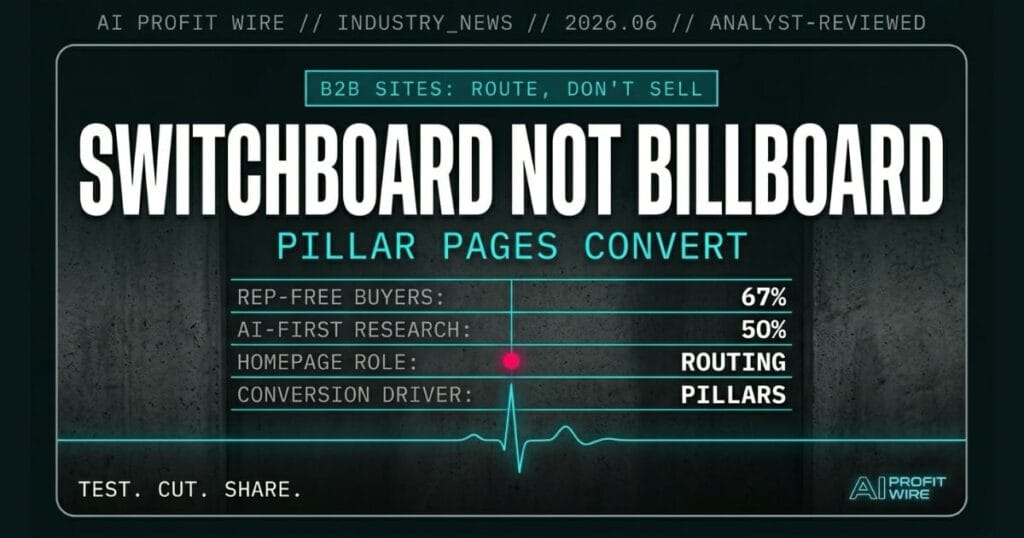
Gartner research indicates that 67% of B2B buyers now prefer a rep-free buying experience, and G2 data shows half of B2B software buyers begin research with AI chatbots like ChatGPT and Perplexity. This shift means buyers arrive at websites already informed, having consulted multiple sources before landing.
The homepage’s purpose has fundamentally shifted from selling to routing.
What’s the evidence behind the routing-first homepage?
The evidence comes from established buyer behavior research and observable search trends.
Gartner’s 67% figure on rep-free preference and G2’s finding on chatbot-initiated research form the core data foundation. The article also references the author’s operational observation that homepage success should be measured by routing efficiency, not time-on-page or bounce rate.
Traditional homepage metrics obscure whether visitors ever reach content that addresses their specific situation.
How does this affect day-to-day operations for small business owners?
Small business owners must shift from creating single catch-all pages to building multiple audience-specific pillar pages with clear internal linking.
This operational change requires identifying three to five distinct audience segments and creating dedicated hub pages for each, which then link to supporting case studies, product details, and proof points. The homepage itself becomes a simplified switchboard with visible paths above the fold.
For resource-constrained teams, this approach compounds visibility across both traditional and AI search simultaneously.
You pull up the analytics on your restaurant’s website and 400 people visited this month. The homepage got 380 of them. The catering inquiry page got 6. The private events page got 3. Eleven people bounced within 4 seconds. The homepage has a beautiful hero photo of your dining room, a rotating carousel of menu highlights, a “Book a Table” button, and a paragraph about your story. It does everything and converts nothing because a corporate event planner searching for “private dining downtown” landed on a page that also tried to sell her Tuesday lunch specials and cooking classes. That’s The Margin Obsession in website design: every visitor who can’t self-identify within 5 seconds is margin walking out the door.
The switchboard model costs nothing extra to implement, it costs exactly the same as building one bad page, but it multiplies the value of every visitor by routing them to proof that speaks to their specific situation. The corporate planner gets the private events pillar with capacity specs, minimum spend, and past client logos. The catering lead gets the catering pillar with per-head pricing and delivery radius. The homepage just asks one question: “What brings you here?” and forks. Our live archive tracks which AI-era website strategies actually move conversion for small businesses.
What’s the final verdict on the B2B homepage?
The switchboard model replaces the billboard model for B2B websites in 2026.
AI search delivers users directly to specific pages, making audience-specific pillar pages the primary conversion drivers while the homepage handles broad orientation. Small business owners who implement this architecture gain compounding visibility in both LLM citations and traditional search rankings.
Attempting to make one page serve every audience guarantees that no audience is served well.
Source: ATAK Interactive
